Possibility of Heavy Snow Warning in Central Inland from Early Morning on the 1st
Temperatures Drop Significantly from the 2nd, Beware of Icy Roads
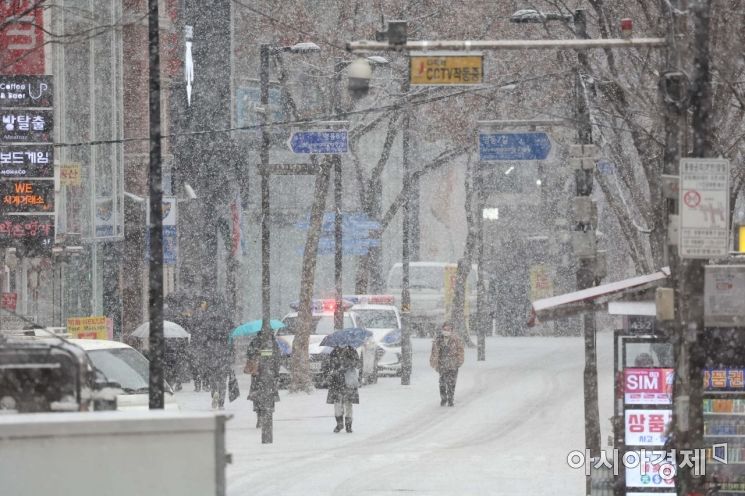 The Korea Meteorological Administration issued a heavy snow advisory for the entire Seoul area at 9 a.m. on the 19th. A heavy snow advisory is issued when snowfall is expected to accumulate 5 cm or more within 24 hours. Snow is falling on the streets of Myeongdong, Seoul, on this day. Photo by Moon Honam munonam@
[Asia Economy Reporter Han Jinju] Temperatures will remain similar to the average until the Lunar New Year holiday ends on the 31st, but on February 1st, when citizens return home, snow is expected in the Seoul metropolitan area and central regions.
According to the Korea Meteorological Administration on the 28th, most areas nationwide will maintain average temperatures until the 31st. In the northern Gyeonggi region, inland and mountainous areas of Gangwon, northern Chungbuk, and northeastern mountainous areas of Gyeongbuk, where cold wave warnings have been issued, morning temperatures will be very cold, dropping below -10 degrees Celsius.
The minimum morning temperature on the 29th is expected to be between -12 and 0 degrees Celsius, with daytime highs ranging from 0 to 8 degrees. On the morning of the 30th, temperatures will range from -13 to -1 degrees Celsius, with daytime temperatures between 2 and 9 degrees.
On February 1st, snow will fall in the Seoul metropolitan area, Gangwon Yeongseo, Chungcheong, Honam, and Jeonbuk regions, while rain or snow is expected in the Jeonnam area. The amount and timing of precipitation may vary depending on the position and movement speed of the low-pressure system passing to the north.
Han Sang-eun, a meteorological expert at the Korea Meteorological Administration, explained, "From the 31st, precipitation may begin around midnight or late at night, mainly along the west coast," adding, "On the 1st, Seoul will see snow rather than rain, a heavy snow warning may be issued for the central inland areas, and snowfall amounts are likely to vary depending on surface and lower atmospheric temperatures."
The snow on the 1st is expected to be concentrated between dawn and morning. Especially due to low temperatures and the influence of mountains and terrain, there is a high possibility of heavy snow in eastern Gyeonggi and Gangwon Yeongseo regions.
The minimum morning temperatures from the 31st to the 2nd are expected to range from -10 to 1 degrees Celsius, with daytime highs between 2 and 10 degrees. On the 1st and 2nd, a low-pressure system will develop over the sea, and cold air will expand from the northwest, causing strong winds. When using maritime transportation in the West Sea or South Sea, it is essential to check navigation information.
After the snow and rain, the central region will generally be clear on the 2nd, but temperatures will drop again, increasing the likelihood of ice forming from the previous day's snow or rain, so caution is needed for traffic safety.
One meteorological expert said, "Until the 31st, warm air flowing in from the west will stabilize the atmosphere, but fog and moisture near the surface may cause icy roads," and added, "From the 2nd, morning temperatures will drop significantly, so special attention is required for road traffic on the return journey."
© The Asia Business Daily(www.asiae.co.kr). All rights reserved.

![User Who Sold Erroneously Deposited Bitcoins to Repay Debt and Fund Entertainment... What Did the Supreme Court Decide in 2021? [Legal Issue Check]](https://cwcontent.asiae.co.kr/asiaresize/183/2026020910431234020_1770601391.png)














