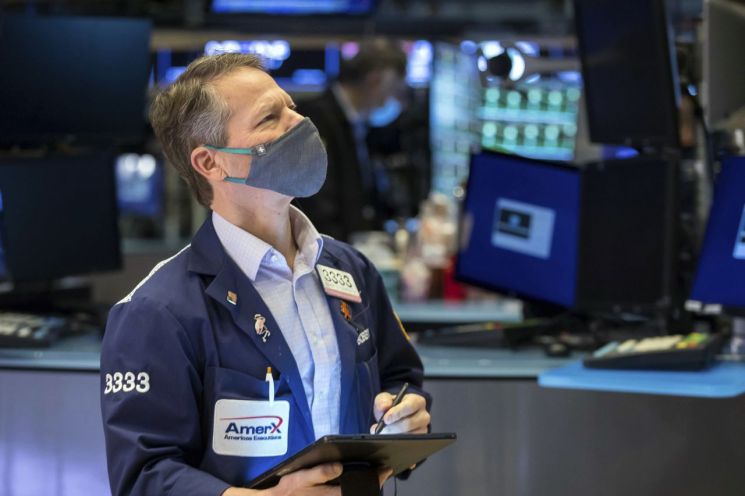
[Asia Economy New York=Special Correspondent Joselgina] The Nasdaq index, centered on tech stocks, in the U.S. New York stock market is taking a particularly heavy hit due to intensified early tightening signals. Leading big tech companies such as Tesla and Nvidia have given back a significant portion of the gains accumulated over the past year since the start of the new year. The decline in January alone was a staggering 14.65%, ranking as the 6th largest monthly drop in the Nasdaq index since the 2000s.
On the 27th (local time), the Nasdaq index closed at 13,352.78, down 189.34 points (1.40%) from the previous trading day in the New York stock market. Following the entry into a 'technical correction' phase with a drop of more than 10% from the peak in November last year, the downward trend continues. On the same day, the Dow Jones Industrial Average fell 0.02%, and the S&P 500 index closed down 0.54%.
The plunge of the Nasdaq index is particularly pronounced. The spread of early tightening concerns caused tech stocks sensitive to interest rates to trigger a crash. The Nasdaq's decline of 14.65% this year far exceeds that of the Dow (-5.99%) and the S&P (-9.22%). Compared to the peak, it has fallen more than 17%, approaching the threshold for a bear market (-20%).
By individual stocks, Tesla, which has driven the growth of the Nasdaq index, has dropped 21.54% since the beginning of the year. During the same period, Netflix slid 35.81%, and Nvidia fell 25.39%.
Investors agree that even if the Nasdaq index rebounds during the remainder of this month, it will be recorded as the 'worst January' in decades. The highest monthly decline rate for the Nasdaq was 22.90% in November 2000 during the dot-com bubble. The 14.65% drop in January so far ranks 6th in monthly declines since the 2000s.
Mike Novogratz, CEO of Galaxy Digital Holdings, said, "The recent market downturn is just the beginning of a correction," and predicted, "The Nasdaq index could fall an additional 20% from now." He argued that the Federal Reserve's early tightening moves will accelerate, causing the bubble to burst.
On the other hand, considering employment indicators and others, there is also a diagnosis that the recent decline in the Nasdaq index is not due to the real economy's impact. The decline, which was preemptively reflected ahead of the FOMC where interest rate hike signals were expected, is now expected to turn into a buying opportunity at low prices. Marco Kolanovic, a strategist at JP Morgan, analyzed in an investor note that "the market correction is in its final stage."
© The Asia Business Daily(www.asiae.co.kr). All rights reserved.