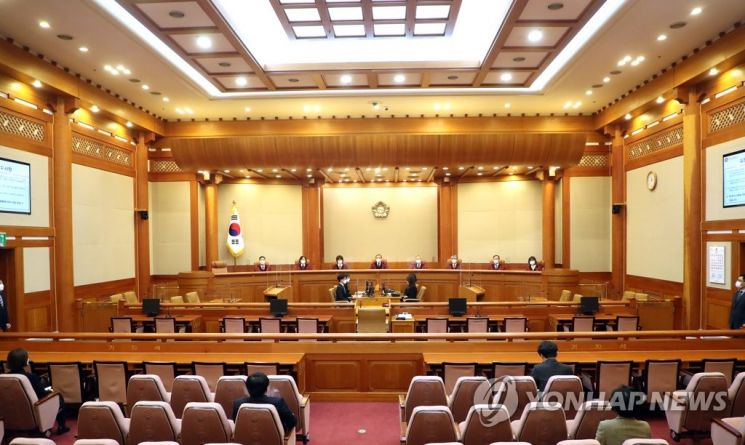
[Asia Economy Reporter Choi Seok-jin, Legal Affairs Specialist] The Constitutional Court has ruled that the Park Geun-hye administration's decision to completely suspend operations at the Kaesong Industrial Complex in response to North Korea's nuclear tests and long-range missile launches in 2016 did not violate the property rights of the Kaesong Industrial Complex investors.
On the 27th, the Constitutional Court unanimously dismissed the constitutional complaint filed by Kaesong Industrial Complex investors and cooperating companies against former President Park and the then Minister of Unification, who claimed that their property rights were infringed. The claims of the cooperating companies were dismissed on the grounds that they lacked direct relevance to the infringement of fundamental rights.
On January 6, 2016, North Korea conducted its fourth nuclear test, followed by a long-range missile launch on February 7 of the same year. The next day, former President Park instructed the Minister of Unification to prepare measures for withdrawal from the Kaesong Industrial Complex. Subsequently, on February 10, 2016, after consultation with the Standing Committee of the National Security Council, it was decided to immediately and completely suspend operations at the Kaesong Industrial Complex.
Thereafter, the Minister of Unification prepared detailed plans for withdrawal from the Kaesong Industrial Complex and explained the government's decision to suspend operations and its background during a meeting with business leaders from the Kaesong Industrial Complex Association at 2 p.m. on February 10, 2016. The government announced ▲a complete halt to factory operations and office activities within the Kaesong Industrial Complex starting February 11 ▲minimization of access to the complex and the return of all South Korean residents staying locally within three days from February 11 ▲and the refusal of approval for visits to the Kaesong Industrial Complex. Later that day at 5 p.m., a statement announcing the complete suspension of the Kaesong Industrial Complex was issued.
In response, North Korea announced on February 11, 2016, at 5 p.m. the expulsion of all South Korean residents from the Kaesong Industrial Complex and a complete freeze on assets. Approximately 280 South Korean businesspeople and workers remaining in the complex returned to South Korea by 11 p.m. that same day. Subsequently, all cooperative projects, including factory operations at the Kaesong Industrial Complex, were halted.
A total of 145 Kaesong Industrial Complex investors and 18 cooperating company representatives who traded with the Kaesong Industrial Complex investors or their subsidiaries claimed that a series of measures by the President and the Minister of Unification infringed on their property rights (freedom of business) and filed a constitutional complaint with the Constitutional Court on May 9, 2016.
The Constitutional Court first ruled that the cooperating companies lacked standing to file the constitutional complaint and dismissed their claims. To file a constitutional complaint, one must have suffered a direct infringement of fundamental rights due to the exercise or non-exercise of public authority, but the court found that the damage they suffered was indirect.
The court stated, "The cooperating company claimants are domestic companies that traded with Kaesong Industrial Complex investors and are not the direct parties to the suspension measures in this case. Even if they suffered a decrease in business profits due to the impact on the Kaesong Industrial Complex investors caused by the suspension measures, such damage is merely indirect and economic in nature. Therefore, these claimants lack direct relevance to the suspension measures, and their constitutional complaint is inadmissible."
Regarding the investors, the court recognized their standing to file the constitutional complaint because their property rights were directly restricted and proceeded to examine whether their fundamental rights were violated.
First, the court rejected the government's argument that the suspension measures were a highly political act by the President related to national security and thus not subject to judicial review.
Furthermore, the court found that the series of measures by the President and the Minister of Unification had legal grounds in the Constitution and laws, including Article 66 of the Constitution, which stipulates the President's duty to protect the nation's independence, territorial integrity, continuity, and the Constitution; Article 11 of the Government Organization Act, which provides the President's authority to supervise administration; Article 10 of the Constitution concerning the state's obligation to protect fundamental rights; Article 18, Paragraph 1, Subparagraph 2 of the Act on Inter-Korean Exchange and Cooperation; and Article 15-3 of the Act on Support for the Kaesong Industrial Complex.
The claimants argued that the series of measures violated the principle of due process, such as by not undergoing deliberation by the State Council.
However, the court held that the President is granted a certain degree of discretion in deciding which policies require State Council deliberation, and especially for national security-related policies, the National Security Council, a constitutional body, can provide a more efficient and appropriate decision-making process than the State Council due to the urgency and confidentiality involved. Therefore, the President's procedural decision to consult the Standing Committee of the National Security Council rather than the State Council was not irrational or arbitrary.
The court also found it difficult to conclude that prior consultation with the National Assembly or mandatory hearing of stakeholders' opinions was required before implementing the suspension measures, contrary to the claimants' assertions.
The claimants also argued that the government's suspension measures violated the principle of trust protection. However, the court found it difficult to recognize that the "Agreement for the Normalization of the Kaesong Industrial Complex," adopted on August 14, 2013, directly granted investors trust in the effectiveness and continuity of the complex. Compared to past cases, the court viewed the degree of trust infringement caused by the suspension measures as relatively low. On the other hand, the public interest pursued by the suspension measures sufficiently justifies such damage to trust.
Moreover, the court noted that the suspension measures did not constitute a public use restriction on individually and concretely established property rights for public purposes. Therefore, Article 23, Paragraph 3 of the Constitution, which stipulates that "expropriation, use, or restriction of property rights for public necessity shall be by law and accompanied by just compensation," does not apply.
Finally, the court concluded that the suspension measures did not violate the principle of proportionality concerning the claimants' property rights.
The principle of proportionality requires that public authority infringing fundamental rights must ▲have a legitimate purpose ▲use appropriate means ▲minimize infringement on fundamental rights ▲and maintain a balance between the private interests infringed and the public interests protected.
The court stated, "The suspension measures aim to contribute to international consensus to block North Korea's nuclear weapons development attempts through economic sanctions, induce stronger international cooperation by independently implementing economic sanctions as a key party to the North Korean nuclear crisis, ultimately contributing to peace on the Korean Peninsula and worldwide. Simultaneously, they aim to ensure the safety of our citizens engaged in business activities related to economic sanctions, thereby recognizing the legitimacy of the purpose."
It also judged, "The suspension of operations at the Kaesong Industrial Complex aligns with the international community's sanction methods against North Korea's nuclear development as an economic sanction measure. The withdrawal of workers staying locally minimizes the exposure of our citizens to North Korea's retaliatory actions, thus recognizing the appropriateness of the means."
Regarding whether the measures minimized infringement on fundamental rights, the court pointed out, "The suspension measures were adopted based on a political judgment that partial suspension would not achieve the intended objectives of economic sanctions to the same extent as a complete suspension, given the complex interrelations of inter-Korean, North Korea-US, and international relations. Such judgment is not evidently irrational."
It added, "Given the difficulty in anticipating changes in North Korea's attitude, it is challenging to set a predetermined suspension period. The restrictions on the number of residents also have a temporary nature, subject to changes depending on North Korean authorities' cooperation regarding equipment and product removal. Therefore, the suspension measures comply with the principle of minimizing damage."
The court further noted, "Protection of cooperative projects and investment assets at the Kaesong Industrial Complex inevitably faces limitations due to regional characteristics and conditions. Relevant laws on support for the Kaesong Industrial Complex provide for various supports to investors in case of damages arising from such special circumstances. The suspension measures were premised on such damage support and, in practice, substantial support was provided accordingly."
It continued, "Although the investors suffered considerable damage due to the suspension measures, it is difficult to regard the President's judgment that economic sanctions through suspension of the Kaesong Industrial Complex operations are necessary to ensure the Republic of Korea's existence, safety, and continuity in response to North Korea's nuclear development as clearly wrong. This judgment and choice, made within the authority granted by the Constitution, should be respected as a political responsibility," concluding that the suspension measures satisfy the requirement of balancing legal interests.
Ultimately, the Constitutional Court concluded, "Therefore, the suspension measures do not violate the principle of proportionality and do not infringe upon the investors' freedom of business and property rights."
© The Asia Business Daily(www.asiae.co.kr). All rights reserved.

![User Who Sold Erroneously Deposited Bitcoins to Repay Debt and Fund Entertainment... What Did the Supreme Court Decide in 2021? [Legal Issue Check]](https://cwcontent.asiae.co.kr/asiaresize/183/2026020910431234020_1770601391.png)














