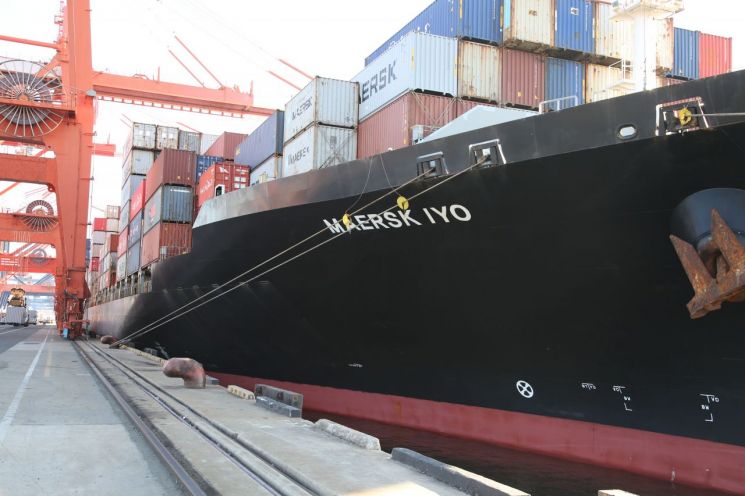
In December of last year, South Korea's export-import value index reached an all-time high again after just one month. This is interpreted as being influenced by rising prices of raw materials such as natural gas, along with increased exports of semiconductors and automobiles.
According to the trade index and terms of trade statistics for December last year released by the Bank of Korea on the 27th, the import value index (based on 2015 = 100) rose 37.6% from a year earlier to 170.64. This marks 13 consecutive months of increase since December 2020 (2.9%). The import volume index (135.76) also rose 5.9%, maintaining an upward trend.
The export-import value index is an indicator calculated by dividing the customs export-import value (in dollars) at the comparison point by the export-import value at the base point (2015). The export-import volume index is calculated by dividing the export-import value index by the export-import price index. Items for which price surveys are difficult, such as ships, weapons, aircraft, and artworks, are excluded from the price index.
The import volume index showed an upward trend as of December last year, despite a decrease in transport equipment, due to increases in computers, electronic and optical devices, and mining products. The import value index rose due to increases in mining products, computers, electronic and optical devices, and coal and petroleum products.
The export value index reached an all-time high at 146.64 in December, rising 22.0%. The export volume index (133.01) increased by 4.8%. Choi Jin-man, team leader of the Price Statistics Team at the Economic Statistics Bureau of the Bank of Korea, explained, "Export volume, export value, import volume, and import value all recorded all-time highs."
The export volume index increased due to computers, electronic and optical devices, and transport equipment, despite decreases in chemical products and primary metal products. The export value index rose due to increases in computers, electronic and optical devices, and coal and petroleum products, although agricultural, forestry, and fishery products decreased.
The net barter terms of trade index fell 10.4% year-on-year as import prices (29.9%) rose more than export prices (16.4%). Compared to the previous month, it decreased by 0.7%.
This index is the ratio of the price of one unit of export goods to the price of one unit of import goods, indicating how much quantity of goods South Korea can import with one unit of exports.
The income terms of trade index fell 6.1% year-on-year as the export volume index rose (4.8%) but the net barter terms of trade index declined (-10.4%). While the net barter terms of trade index fell 2.8% year-on-year, the income terms of trade index rose 5.1% year-on-year.
The income terms of trade index represents the total quantity of goods that can be imported with South Korea's total export value.
© The Asia Business Daily(www.asiae.co.kr). All rights reserved.

![User Who Sold Erroneously Deposited Bitcoins to Repay Debt and Fund Entertainment... What Did the Supreme Court Decide in 2021? [Legal Issue Check]](https://cwcontent.asiae.co.kr/asiaresize/183/2026020910431234020_1770601391.png)














