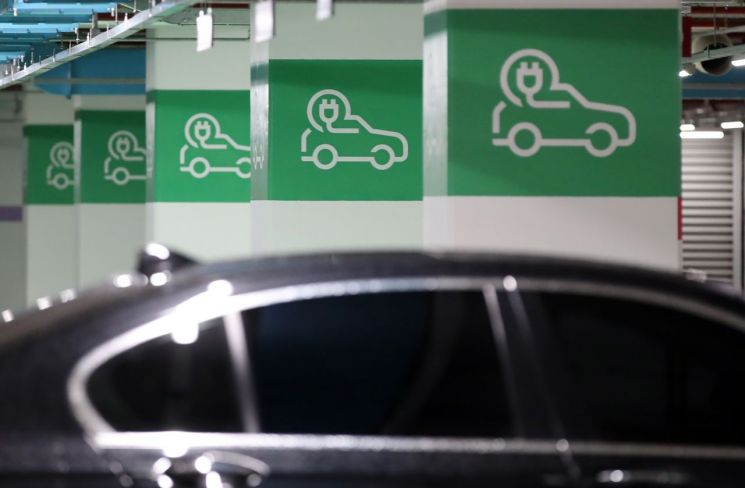
[Asia Economy Sejong=Reporter Dongwoo Lee] The government plans to supply a cumulative total of 500,000 zero-emission vehicles by the end of this year. Subsidies will be focused on high-performance and mass-market electric vehicles, and the distribution of commercial vehicles will be expanded in areas with hydrogen charging stations.
On the 27th, the Ministry of Environment announced that it held the '2022 Zero-Emission Vehicle Supply Policy Briefing' to accelerate carbon neutrality in the transportation sector. Zero-emission vehicles are cars that produce no exhaust emissions or noise and whose parts can be fully recycled after disposal; electric vehicles and hydrogen vehicles are representative examples.
The goal of the zero-emission vehicle supply policy is to significantly reform the subsidy support system to increase the share of new vehicle sales by more than 10%. The target is to increase a total of 235,500 vehicles this year, including 207,500 electric vehicles and 28,000 hydrogen vehicles.
For electric vehicles, according to the previously announced '2022 Electric Vehicle Subsidy Processing Guidelines,' support will be expanded for high-performance and mass-market electric vehicles, aiming to supply more than twice the volume compared to the previous year. Specifically, for electric passenger cars, a price reduction incentive policy will be newly supported. Vehicles priced below 55 million KRW will receive an additional subsidy of 30% of the price reduction compared to the previous year, up to a maximum of 500,000 KRW. However, the total additional subsidies, including the price reduction incentive, implementation subsidy, and energy efficiency subsidy, cannot exceed 1 million KRW.
For hydrogen vehicles, subsidy support unit prices reflecting the hydrogen metropolitan buses and hydrogen cleaning vehicles scheduled for release this year will be applied to expand the supply of commercial vehicles in areas with hydrogen charging stations.
Along with the supply of zero-emission vehicles, efforts will be made to improve charging infrastructure. For electric chargers, projects to establish representative chargers by region will be identified and promoted in cooperation with vehicle manufacturers and charging operators. Installation of chargers will be focused on residential areas vulnerable to charging, such as apartment complexes, detached houses, and urban and rural areas. Based on the strategic deployment plan established last year, more than 310 hydrogen charging stations nationwide will be expanded in a balanced manner. To prepare early infrastructure for the transition of large hydrogen vehicles such as hydrogen buses, new liquefied hydrogen charging stations will be selected during the public offering for special-purpose hydrogen charging stations for buses and trucks.
Last year, the number of newly supplied zero-emission vehicles was 109,000, more than doubling compared to the previous year, accounting for about 6% of the total 1.75 million new vehicles. The cumulative supply reached 257,000, about 1% of the total 24.91 million vehicles. The number of newly supplied electric vehicles increased 2.3 times to 100,427 compared to the previous year, and the share of new registrations rose from 1.9% last year to 4.8%. The number of newly supplied hydrogen vehicles increased 1.5 times to 8,532 during the same period, achieving the world's number one ranking for two consecutive years based on supply volume.
Park Yeon-jae, Director of Air Quality Policy at the Ministry of Environment, said, "With the goal of making 2022 the inaugural year of zero-emission vehicle popularization, we will actively respond to market conditions and further refine the supply policy."
© The Asia Business Daily(www.asiae.co.kr). All rights reserved.









![The Special Connection Between the Statue of Martyr Lee Jun in Jangchungdan Park and Mayor Oh Sehoon ③ [Current Affairs Show]](https://cwcontent.asiae.co.kr/asiaresize/319/2026012110001599450_1768957215.jpg)
