Opening of the Industrial Ecosystem Support Center in Pangyo
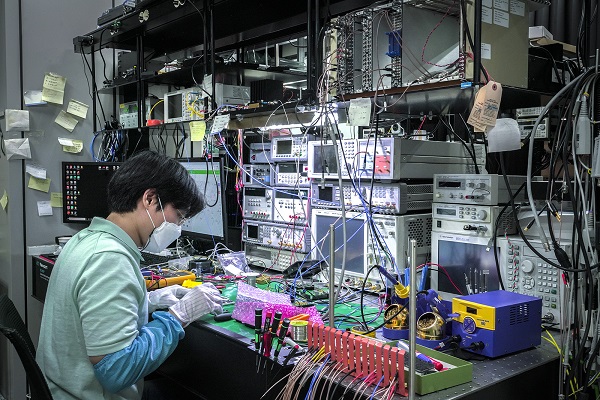
[Asia Economy Reporter Cha Min-young] The government will invest 81.4 billion KRW this year to foster quantum technology, a future essential strategic technology. This is a 67% increase compared to last year, and a support center for nurturing related companies and workforce will also be opened in Pangyo. The telecommunications industry also plans to lead not only the development of related markets but also international standardization, as the growth potential in the quantum cryptography infrastructure sector is high.
Quantum Technology Investment Increased by 67%
The Ministry of Science and ICT announced on the 26th that the government will invest 81.4 billion KRW this year in the development of core source technologies such as quantum communication, sensors, and computing, as well as workforce training and technology commercialization to intensively foster quantum technology, which is considered one of the 'Top 10 Essential Strategic Technologies.' This is a 67% increase compared to last year.
Quantum technology is a technology that applies quantum mechanical properties observed in the microscopic world of atoms or electrons to computing, communication, sensors, and more. It is regarded as a 'game changer' that can overturn the industrial ecosystem by being used for ultra-high-speed computing technology development or strengthening information security. South Korea also announced its quantum technology R&D investment strategy last April.
Based on this year's investment, the Ministry of Science and ICT will promote R&D projects leading future quantum technology, including core technology development for the quantum internet, advanced industry-linked quantum sensor development, and Korean-style quantum computer development. Additionally, it plans to materialize bilateral cooperation in this field discussed at the Korea-US summit last May through international joint research.
On the same day, the government opened the 'Quantum Industry Ecosystem Support Center' at the Pangyo Corporate Support Hub in Gyeonggi Province to support the establishment of a virtuous cycle structure between quantum technology and industry. The center supports the commercialization of core quantum technologies and supporting technologies. It also supports the training of PhD-level personnel in cooperation with major domestic universities and builds a database to secure supply chains for materials, parts, and equipment.
Three Major Telecom Companies Accelerate Technology Development
Private sector quantum cryptography communication pilot projects have also achieved results. SK Telecom decided to apply quantum cryptography communication technology to the Ministry of the Interior and Safety’s national convergence network construction project. The three major telecom companies have also introduced B2B pilot tariff plans for quantum cryptography communication and quantum-resistant cryptography.
They have also succeeded in international standardization. SK Telecom standardized equipment interoperability technology that enables compatibility among various devices with the European Telecommunications Standards Institute (ETSI). Through the government's New Deal projects, SK Telecom plans to expand the use of quantum cryptography communication in medical, public, industrial, and financial sectors while focusing on revitalizing the quantum ecosystem. They will build a 'Quantum Cryptography Highway' connecting major cities nationwide.
KT collaborated with the International Telecommunication Union (ITU-T) to standardize technology for integrated management and service quality standards of quantum cryptography communication networks. To commercialize dedicated quantum cryptography communication lines, KT developed service quality parameters applicable to SLA (Service Level Agreement) standards for the first time in the world, and this technology was approved as an ITU-T international standard and actually implemented.
The related market is expected to continue growing. Market research firm MarketsandMarkets forecasts that the global quantum cryptography market will grow from 100 million USD in 2018 to 500 million USD in 2023, with an average annual growth rate of 38%. As more devices connect to communication networks, the risk of hacking increases, accelerating this trend.
LG Uplus plans to officially launch a dedicated quantum-resistant cryptography communication line service for enterprises in the first half of this year and introduce new services strengthened with quantum security within the year. The quantum-resistant cryptography communication line service will be applied first to security-sensitive public and financial markets and then expanded to the private sector.
Goo Sung-chul, Head of LG Uplus Wired Business, said, "To complete a secure communication network in the upcoming quantum computer era, we will actively expand quantum-resistant cryptography services to public and financial institutions and provide reliable communication services in various private sectors."
Ha Min-yong, Innovation Suite Leader at SK Telecom, emphasized, "We will continue to focus on advancing quantum cryptography technology and expanding business, lead international standardization activities, and strive to revitalize the ecosystem." Lee Jong-sik, Director of Infrastructure DX Research Lab at KT Convergence Technology Institute, said, "To enable citizens to safely enjoy advanced ICT life in the non-face-to-face era, we will focus on developing quantum cryptography standards, enhance technological capabilities, and develop various application services."
© The Asia Business Daily(www.asiae.co.kr). All rights reserved.