From February 3, Transition to 'Omicron Response System'
If Not in 'Priority Testing Group', Start with Rapid Antigen Test
Distribution of Self-Test Kits at Screening Clinics from the 29th
"Need to Increase PCR" Criticism... Authorities "Striving to Expand Capacity"
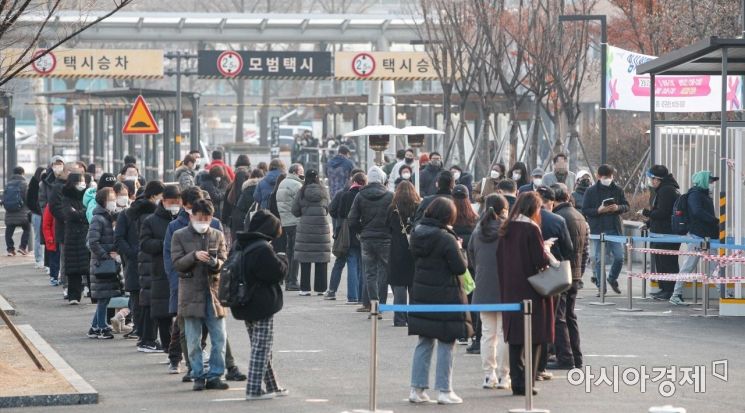 On the 26th, when 13,012 new COVID-19 cases were reported, an increase of about 4,400 cases in just one day, citizens lined up to get tested at a temporary screening clinic set up near the Express Bus Terminal Station in Seocho-gu, Seoul. Photo by Jinhyung Kang aymsdream@
[Asia Economy reporters Chunhee Lee and trainee reporter Youngwon Kim] Starting from the 3rd of next month, unless you are aged 60 or older or an epidemiologically related person, you will no longer be able to receive a polymerase chain reaction (PCR) test even if you visit a screening clinic.
On the morning of the 26th, Son Young-rae, head of the Social Strategy Division at the Central Disaster and Safety Countermeasures Headquarters, stated at the regular COVID-19 briefing, "From today (the 26th), we are starting the transition to a diagnostic testing and epidemiological investigation system centered on high-risk groups, involving local clinics in four regions (Gwangju, Jeonnam, Pyeongtaek and Anseong in Gyeonggi Province). From the Lunar New Year holiday on February 3rd, this system will be expanded nationwide."
With this system transition, the existing PCR testing method at screening clinics will only apply to high-risk groups (priority testing groups). Accordingly, at the 31 screening clinics established in these regions, only those aged 60 or older, epidemiologically related persons, those with a doctor's note indicating the need for a COVID-19 test, and those who test positive on self-test kits or rapid antigen tests will be eligible for PCR testing.
However, not all of these groups must undergo PCR testing exclusively. Kim Hyun, head of the Diagnostic Testing Operations Team at the Central Disease Control Headquarters, explained at the COVID-19 back briefing in the afternoon, "People aged 60 or older can opt to take a rapid antigen test if they wish. However, close contacts must undergo PCR testing as they are priority testing subjects due to infection risk." This means that for high-risk groups such as the elderly who are not in the priority testing group due to infection risk like epidemiologically related persons or those positive on rapid antigen tests, rapid antigen testing can be used as an alternative.
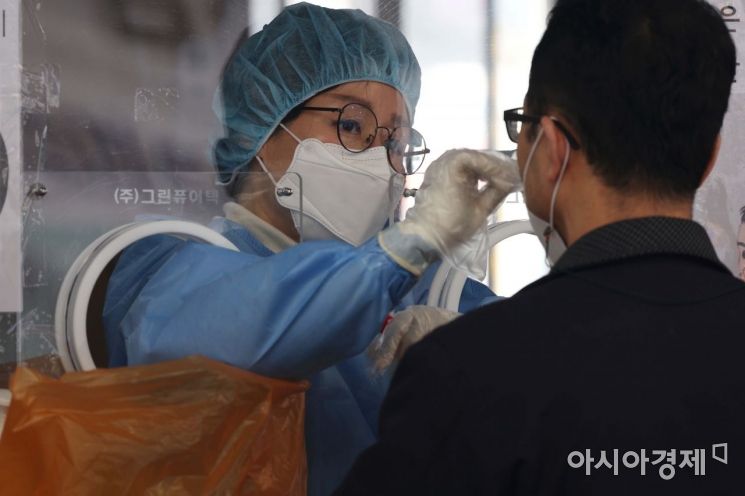 Due to the spread of the COVID-19 Omicron variant, the number of new confirmed cases exceeded 10,000 for the first time on the 26th, and citizens are visiting a temporary screening clinic set up at Seoul Station Plaza. Photo by Moon Honam munonam@
If you are not in the priority testing group, you will not be able to receive a PCR test immediately even if you have respiratory symptoms such as cough or fever. Authorities judged that if everyone who visits based solely on their own judgment of symptoms were given PCR tests, testing capacity would be overwhelmed.
To receive a PCR test at a screening clinic, you must have a positive result from a self-test kit for rapid antigen testing obtained at the screening clinic or a positive result from a professional rapid antigen test conducted after a doctor's examination at a respiratory-specialized clinic. If the rapid antigen test conducted at the clinic is positive and the clinic can perform PCR testing on-site, you can also receive a PCR test there. The test itself is free, but you must pay 5,000 KRW for the consultation fee at the clinic. This is the first case where a personal expense has been incurred related to COVID-19 testing and treatment, which had previously been fully covered by health insurance.
Self-test kits for rapid antigen testing can be purchased by individuals or obtained free of charge at screening clinics. If the test is positive, you can receive a PCR test at the screening clinic.
The issuance method for negative confirmation certificates, which unvaccinated individuals receive to use facilities requiring a quarantine pass, will also change accordingly. Certificates can be issued if the self-test kit is used under the supervision of the screening clinic manager or if a professional rapid antigen test conducted after a doctor's examination at a respiratory-specialized clinic is negative. Results from self-tests conducted independently by individuals will not be recognized. The validity period will be reduced from the existing 48 hours to 24 hours.
Distribution of self-test kits for rapid antigen testing at screening clinics will begin immediately from the 29th, when the Lunar New Year holiday starts. Those who visit screening clinics for testing can receive PCR tests or, considering long waiting lines or delayed results, can opt for rapid testing using self-test kits.
Additionally, individuals can take the self-test kits home and perform the test themselves. However, since it is difficult to properly verify the test results in this case, negative confirmation certificates for vaccination proof or quarantine pass purposes cannot be issued based on these results.
Concerns have been raised that this transition could cause disruptions in the supply of self-test kits. Son stated, "The Ministry of Food and Drug Safety is managing production and distribution," and added, "We expect supply to continue without major disruptions and are also reviewing measures to strengthen management."
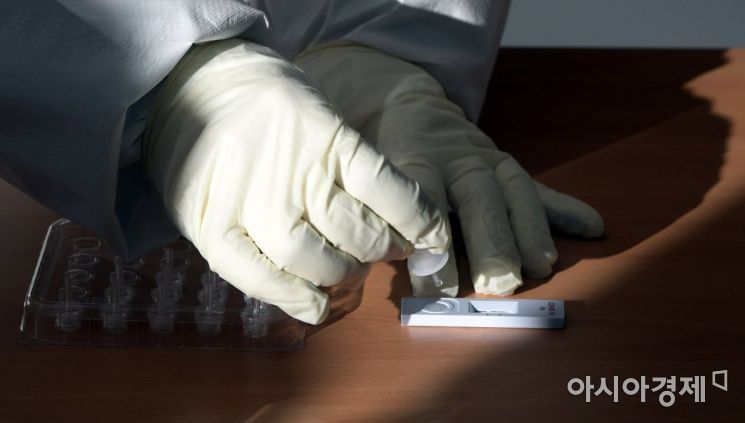 Medical staff are conducting rapid antigen tests for COVID-19 using samples collected at a temporary screening clinic set up in Seoul Plaza, Jung-gu, Seoul. Photo by Hyunmin Kim kimhyun81@
Meanwhile, in response to the Korean Society for Laboratory Medicine's call on the same day to increase PCR capacity rather than relying on rapid antigen tests with lower accuracy amid the surge in confirmed cases, health authorities explained that despite lower accuracy, the introduction of rapid antigen tests is unavoidable.
In a statement, the Society said, "We express serious concerns about the government's plan to implement self-antigen testing for asymptomatic individuals," and "At this point of a surge in confirmed cases, more active implementation of high-performance PCR testing and expansion of antigen tests conducted directly by medical professionals are necessary." The Society pointed out that the sensitivity of rapid antigen tests is below 50% even when performed by medical professionals and below 20% when self-administered. Rapid antigen tests require 1,000 to 10,000 times more viral shedding than PCR to detect the COVID-19 virus.
Regarding this, Kim Gap-jung, head of the Diagnostic Team at the Central Disease Control Headquarters, explained, "When medical professionals perform the professional rapid antigen test, they are well trained in specimen collection methods, whereas individuals have lower proficiency, leading to reduced accuracy." He added, "We understand these points and provide guidance to ensure proper testing." He also said, "We agree on increasing PCR capacity and plan to work on expanding it," adding, "This is not different from the experts' position."
© The Asia Business Daily(www.asiae.co.kr). All rights reserved.
![User Who Sold Erroneously Deposited Bitcoins to Repay Debt and Fund Entertainment... What Did the Supreme Court Decide in 2021? [Legal Issue Check]](https://cwcontent.asiae.co.kr/asiaresize/183/2026020910431234020_1770601391.png)