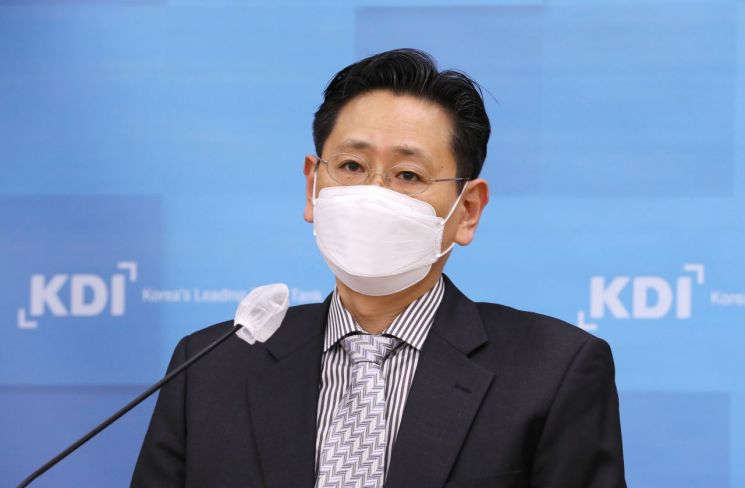
 Kim Hak-su, Director of the Fiscal and Social Policy Research Department at the Korea Development Institute (KDI), is giving a presentation on the topic "Local Education Finance Grants: Why and How Should They Be Reformed?" at the Government Complex Sejong in Sejong City on the morning of the 29th. 2021.12.29 Photo by Yonhap News
[Asia Economy Sejong=Reporter Son Seon-hee] As the birth population continues to decline, concerns have been raised that the allocation of education finances is becoming increasingly irrational due to the current method of calculating education grants linked to domestic taxes. An analysis suggests that if the grant calculation method is reformed to apply the gross domestic product (GDP) growth rate instead of domestic taxes, at least 1,000 trillion won in fiscal capacity could be secured over the next 40 years.
The Korea Development Institute (KDI), a national research institute, held a forum on the 26th at Post Tower in Jung-gu, Seoul, under the theme "Population Structure Changes and Education Finance Reform." KDI explained that the event was organized "to discuss investment directions by education stage and ways to improve the efficiency of education finances so that all members of society can receive the necessary education services evenly throughout their life cycle in response to future environmental changes caused by population decline and aging."
Kim Hak-su, head of KDI’s Fiscal and Social Policy Research Department and a presenter at the forum, stated, "The current education grant calculation method linked to domestic taxes does not reflect the declining trend of the school-age population and is inappropriate for rational adjustment of resource allocation within the education sector and other expenditure areas, so reform is urgent."
Education grants, introduced in 1972, are distributed to city and provincial education offices at a fixed rate (20.79%) of domestic taxes according to current law. In other words, if total tax revenue increases, education grants automatically increase as well.
However, Kim explained that this system was introduced over 50 years ago during a population boom to alleviate overcrowded classes and is not suitable for the current era of natural decline in the school-age population. He emphasized, "From the perspective of the entire national budget, the problems of education finance grants should be reexamined, and the current system linked to domestic tax revenue should be boldly reformed to expand education finance grants rationally and stably."
He also criticized the Green Smart School project, which began as part of the Moon Jae-in administration’s Korean New Deal initiatives, calling it "a classroom reconstruction project being pursued without effectiveness verification" and stating that "it is difficult to see it as directly improving the quality of future education."
Kim analyzed, "A reform plan applying trends in the school-age population and the growth rate of nominal GDP would stably and rationally expand the total amount of grants despite the decline in the school-age population, securing at least 1,000 trillion won in fiscal capacity over the next 40 years compared to the current method."
Hong Jang-pyo, president of KDI, said in his opening remarks, "It is time to gather wisdom to expand education finance inputs in response to population structure changes such as low birth rates and aging, while making more rational adjustments by education stage." He added, "It is more important than anything else to review policies and systems introduced during the population boom and to mediate conflicts to create more desirable policies and systems from the perspective of the entire nation."
Jung Hae-gu, chairman of the National Research Council for Economics, Humanities and Social Sciences, also gave a congratulatory speech, stating, "Recent environmental changes such as the decline in the school-age population due to low birth rates and scientific and technological advancements including digital transformation require reforms and adjustments across education, and new allocations of education finances are necessary." He added, "I hope this forum will be an opportunity to find alternatives on how education finances should be distributed and invested among early childhood, elementary and secondary, higher, vocational, and lifelong education."
© The Asia Business Daily(www.asiae.co.kr). All rights reserved.
![User Who Sold Erroneously Deposited Bitcoins to Repay Debt and Fund Entertainment... What Did the Supreme Court Decide in 2021? [Legal Issue Check]](https://cwcontent.asiae.co.kr/asiaresize/183/2026020910431234020_1770601391.png)
















