"Expansion of Battery Material Supply Chain"... Operating Profit Soars 101.9% Last Year
Energy Material Business Sales Up 59.7% Year-on-Year... "Driving Growth"
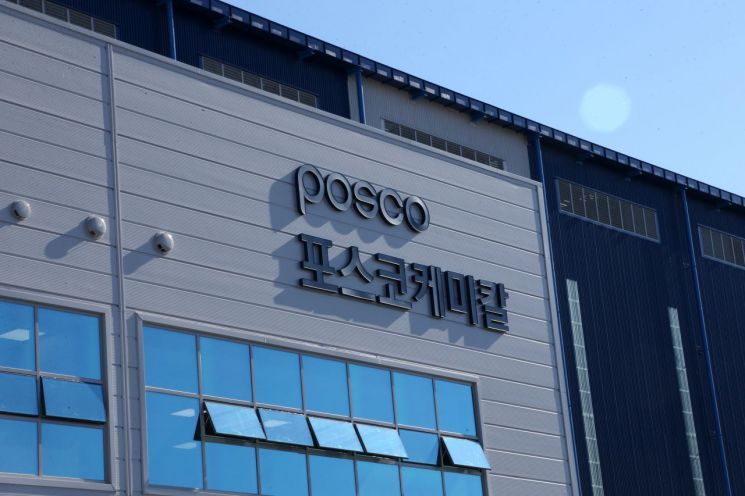 POSCO Chemical artificial graphite anode material production plant located in the Blue Valley Industrial Complex, Pohang-si, Gyeongsangbuk-do. (Image source=Yonhap News)
[Asia Economy Reporter Moon Chaeseok] POSCO Chemical recorded nearly 2 trillion KRW in consolidated sales last year, achieving its best business performance since its establishment. This was due to strong results across all business sectors, including energy materials, lime chemicals, and refractories. The company also succeeded in reducing its debt ratio.
POSCO Chemical announced on the 26th that its consolidated operating profit last year reached 121.7 billion KRW, an increase of 101.9% compared to the previous year. Sales grew by 27.0% during the same period, reaching 1.9895 trillion KRW.
In the energy materials business, sales of high-nickel cathode materials for electric vehicle batteries increased. The rise in raw material prices such as lithium and nickel was reflected in the sales prices. As a result, sales amounted to 851.8 billion KRW, up 59.7% year-on-year. This represents a 289% increase compared to the 219 billion KRW in cathode and anode material sales in 2019, when POSCOESM was merged and the cathode material business was first entered. The sales proportion of this segment also expanded from 14.8% to 42.8% during the same period.
In the lime chemical business, increased crude steel production led to higher sales of lime (quicklime) products, positively impacting performance. The rise in oil prices also increased the sales prices of products such as coal tar and roofing oil. Consequently, sales rose 16.4% year-on-year to 675.3 billion KRW. Sales in the refractory business slightly increased to 462.5 billion KRW compared to the previous year.
PMC Tech, a subsidiary that produces needle coke, the raw material for electrode rods and artificial graphite anode materials, recorded sales of 172.4 billion KRW, up 53.7% year-on-year, and an operating profit margin of 22.1%. This was due to increased product demand as the electric furnace utilization rate rose.
POSCO Chemical successfully lowered its debt ratio by 43.1 percentage points from 104% a year earlier through a successful paid-in capital increase. Last year, the debt ratio was 60.9%. Cash assets also increased to 1.3512 trillion KRW, improving overall financial soundness.
With the growth of the electric vehicle market expanding demand for battery materials, the company expects strong demand to be maintained for next-generation materials needed to increase driving range. They plan to expand mass production capacity and strengthen technological leadership through research and development (R&D).
In May, the company plans to complete the comprehensive construction of its Gwangyang cathode material plant, the world's largest with an annual capacity of 90,000 tons. They are establishing global mass production bases by newly building and expanding cathode material plants in North America, China, and Pohang. For anode materials, they are expanding production facilities for low-expansion natural graphite for electric vehicles and have started full-scale production of artificial graphite anode materials to diversify their product portfolio. Through this, they plan to secure annual production capacities of 105,000 tons for cathode materials and 84,000 tons for anode materials this year.
They will develop various products tailored to the demands of global electric vehicle manufacturers and battery companies, such as high-nickel single-particle cathode materials for electric vehicles, cobalt-free (Co-free) cathode materials, and artificial graphite anode materials using low-cost raw materials. They also plan to enhance cost competitiveness by introducing process technologies that improve productivity compared to existing methods.
While pursuing environmental certification for cathode materials from the Ministry of Environment, they aim to secure transparency and stability in the battery material raw material supply chain, thereby enhancing business competitiveness across the entire value chain from raw materials to material production.
© The Asia Business Daily(www.asiae.co.kr). All rights reserved.
![User Who Sold Erroneously Deposited Bitcoins to Repay Debt and Fund Entertainment... What Did the Supreme Court Decide in 2021? [Legal Issue Check]](https://cwcontent.asiae.co.kr/asiaresize/183/2026020910431234020_1770601391.png)