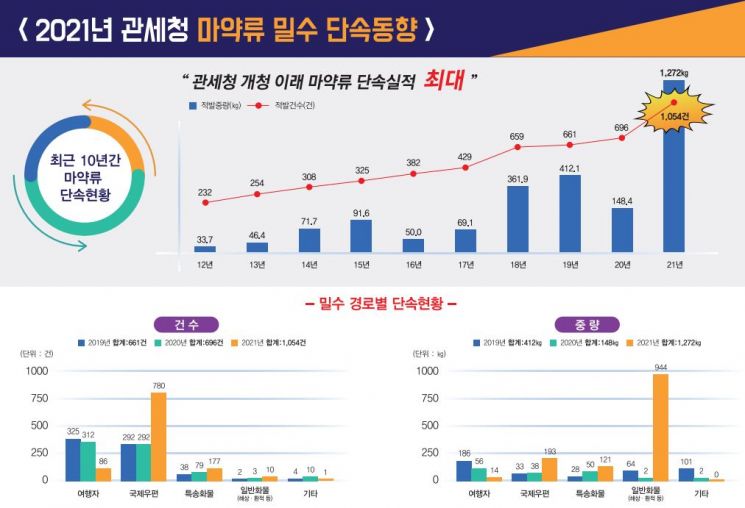
[Asia Economy (Daejeon) Reporter Jeong Il-woong] The scale of drug smuggling detected at customs borders last year recorded the highest level since the Korea Customs Service was established.
The Korea Customs Service announced on the 26th that a total of 1,054 cases involving 1,272 kg of drugs were seized through drug smuggling crackdowns last year. Considering that 696 cases involving 148 kg of drugs were detected in 2020, this represents an increase of 51% in the number of cases and 757% in weight compared to last year.
Recently, drug smuggling has shown a marked tendency to concentrate on international mail, express cargo, and maritime cargo. Due to restrictions on international flights caused by the spread of COVID-19, drug smuggling using cargo last year increased by 159% in the number of cases and 1,288% in the amount seized compared to the previous year. On the other hand, smuggling by air travelers decreased by 73% in the number of cases and 77% in the amount seized compared to the previous year.
In broad terms, the types of drug seizures were cases using imported cargo such as mail and express delivery, which increased from 374 cases involving 90 kg in 2020 to 967 cases involving 1,258 kg last year, while smuggling through air travelers decreased from 311 cases involving 55 kg to 83 cases involving 12 kg.
The major drugs seized last year included ▲methamphetamine (commonly known as Philopon) 577 kg (126 cases) ▲cocaine 448 kg (20 cases) ▲cannabis 99 kg (336 cases) ▲phenobarbital 57 kg (80 cases) ▲GHB (gamma-hydroxybutyrate) 29 kg (1 case) ▲temporary narcotics Rush 18 kg (213 cases), among others.
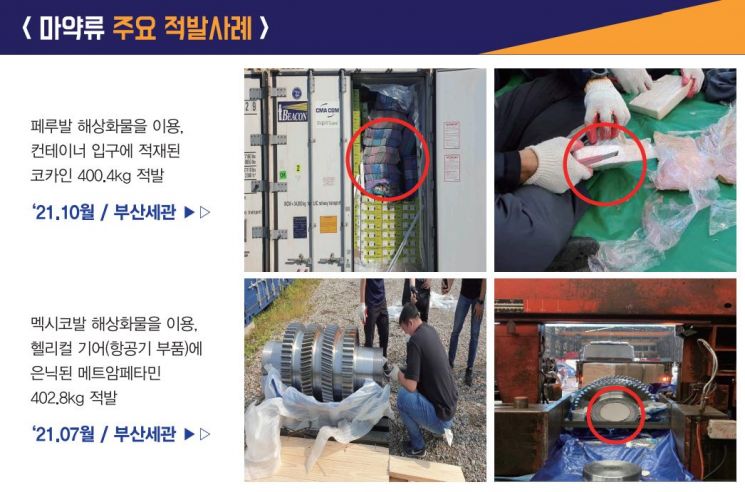
Among these, the amount of methamphetamine, which is mainly abused domestically, surged by 849% compared to the previous year (87 cases involving 60.7 kg). This was largely influenced by a single case (402.8 kg) detected in July last year in maritime cargo (aircraft parts) from Mexico.
In addition, the amount of new drugs seized, including psychotropic drugs such as phenobarbital, GHB, synthetic cannabis, MDMA (stimulant), ketamine, and temporary narcotics Rush, increased by 569%, from 333 cases involving 21.4 kg in 2020 to 687 cases involving 142.9 kg last year.
The amount of cannabis seized also increased. The amount of cannabis seized increased by 50% compared to the previous year, and customs authorities analyze that most of the seizures were attempts to smuggle from North America (the United States and Canada), where recreational cannabis is legalized.
Meanwhile, the Korea Customs Service pointed out the following peculiarities in last year's drug smuggling trends: ▲an increase in large-scale (kg-level) methamphetamine smuggling by international drug organizations ▲an increase in small quantities (under 10g) of drugs for personal use via international mail ▲an increase in cocaine smuggling transiting through South Korea.
Among these, the large-scale increase in methamphetamine smuggling is a phenomenon occurring throughout the Asia-Pacific region, including South Korea, with a trend of increased smuggling from Southeast Asian countries used as international distribution routes and the western United States, according to the Korea Customs Service.
The main countries producing methamphetamine include Mexico, Vietnam, the United States, Thailand, Laos, and Malaysia.
The number of cases of small-quantity drug smuggling detected via international mail increased from 138 cases in 2020 to 385 cases last year, with temporary narcotics Rush, cannabis products, MDMA, and LSD (hallucinogens) accounting for 77% of the total seized drugs.
The identification of cocaine smuggling transiting through South Korea as a peculiarity was largely influenced by a single case of cocaine (400.4 kg) smuggling detected in December last year in maritime cargo (avocados) from Peru.
A Korea Customs Service official explained, “Cocaine is a drug abused mainly in North America and Europe, and in most cases, South Korea is not the final destination,” but added, “However, considering recent trends, there is growing concern that South Korea could be used as a transit point for international drug distribution, so it is necessary to closely monitor the situation.”
© The Asia Business Daily(www.asiae.co.kr). All rights reserved.

![User Who Sold Erroneously Deposited Bitcoins to Repay Debt and Fund Entertainment... What Did the Supreme Court Decide in 2021? [Legal Issue Check]](https://cwcontent.asiae.co.kr/asiaresize/183/2026020910431234020_1770601391.png)