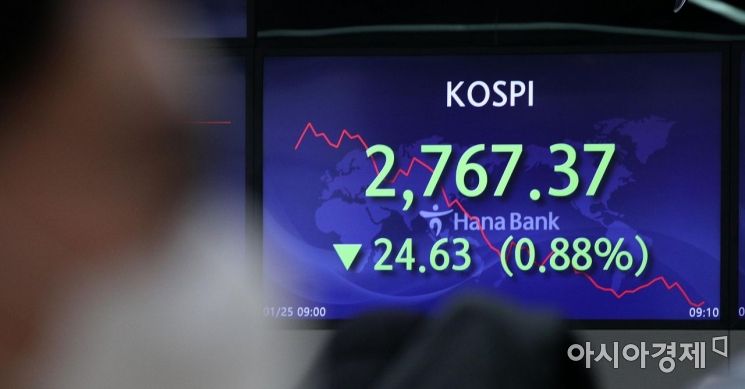
 On the 25th, the KOSPI opened at 2,786.41, down 5.59 points (0.20%) from the previous trading day, at the Hana Bank dealing room in Jung-gu, Seoul. On the same day, the won-dollar exchange rate opened at 1,196.0 won, down 0.1 won from the previous trading day. Photo by Kim Hyun-min kimhyun81@
[Asia Economy Reporter Ji Yeon-jin] The KOSPI index fell by about 80 points on the 25th, sliding down to the low 2700s. Ahead of the U.S. Federal Open Market Committee (FOMC) meeting starting that day, concerns over tightening increased, while the geopolitical crisis in Ukraine froze investor sentiment, marking the largest drop this year. The KOSDAQ index also broke below the 900 mark, retreating to the 880 level.
As of 1:16 PM on the same day, the KOSPI index was trading at 2712.00, down 80 points (2.87%) from the previous day. This decline is the third largest since January 29 and February 26 of last year, when growth stocks underwent sharp corrections. Individual investors defended the index by net buying 573.2 billion KRW worth of shares, but foreign investors sold about 484.6 billion KRW, and institutions also net sold approximately 125.5 billion KRW, pulling the index down significantly.
Most of the top market capitalization stocks declined. In particular, Samsung SDI (-5.57%) and LG Chem (-4.77%) experienced large drops. Samsung Electronics fell about 2%, and SK Hynix, which had briefly turned positive during the session, reverted to a decline (-1.69%). Additionally, NAVER and Kakao also recorded declines exceeding 2%. Kim Yong-gu, a researcher at Samsung Securities, explained, "The Federal Reserve's monetary tightening to combat inflation, compounded by Russia-related geopolitical risks, is intensifying market turmoil," adding, "The latent uncertainty has reminded market investors of the need to hedge their portfolios, and the foreign investors' aggressive selling of KOSPI 200 futures has stimulated below-neutral financial investment spot supply and demand, which is a direct and indirect reason for the KOSPI breaking below the 2800 level."
The KOSDAQ index also dropped 28.56 points (3.12%) to 886.84. Trading below 900 occurred for the first time in about 10 months since March 10 last year, when it recorded 890.17. The KOSDAQ had risen due to massive liquidity from the COVID-19 pandemic, reaching an intraday high of 1062.03 on August 6 last year, but then faced corrections amid concerns over global inflation and interest rate hikes. Earlier this year, the 'Cheonsdak' (1000-point level) was broken, and within 10 trading days, the 900 level was threatened.
The index opened at 920.95, up 5.55 points (0.61%), but gave up early gains and plunged as individual investors turned to selling. Individuals net bought about 31.2 billion KRW and institutions about 56.9 billion KRW, while foreign investors net sold approximately 93.8 billion KRW, pushing the index below 900.
Most of the top market capitalization stocks in KOSDAQ also showed sharp declines. The leader, Celltrion Healthcare, fell 4.12%, while Wemade, HLB, and Celltrion Pharm also recorded drops exceeding 4%. Pearl Abyss (-3.90%), L&F (-3.66%), Seegene (-3.82%), and Chunbo (-3.60%) all declined more than 3%. Only EcoPro BM, which had sharply fallen over the past two days due to a factory fire, rose 1.45%.
Lee Jin-woo, head of investment strategy at Meritz Securities, said, "Although the U.S. reduced intraday losses yesterday, the perception of a bottom has not spread, and the catalyst for a reversal remains unstable, so the decline could either widen or narrow," adding, "With risk appetite shrinking, the index is moving based on supply and demand factors, but the increased decline in financial and cyclical stocks, which had held up well until now, suggests that investor sentiment is more depressed than yesterday."
© The Asia Business Daily(www.asiae.co.kr). All rights reserved.

![User Who Sold Erroneously Deposited Bitcoins to Repay Debt and Fund Entertainment... What Did the Supreme Court Decide in 2021? [Legal Issue Check]](https://cwcontent.asiae.co.kr/asiaresize/183/2026020910431234020_1770601391.png)














