Inflation Concerns Grow
Real Purchasing Power Declines, Suppressing Consumption
Rising Anxiety Negatively Impacts Investment
COVID-19 Resurgence Also a Problem
[Asia Economy Reporters Kim Hyunjung and Jang Sehee] Despite the spread of COVID-19, South Korea's economy grew at its fastest pace in 11 years last year. However, concerns have been raised that it may be difficult to maintain this improvement this year. This is not only because the growth reflected the government's active fiscal spending and the base effect from the negative growth in 2020, but also because domestic and international risks such as inflation, global economic slowdown, and the resurgence of COVID-19 remain to be overcome. There are also forecasts that the next administration's first annual growth rate report card may fall short of the Bank of Korea's target of 'growth above 3%.'
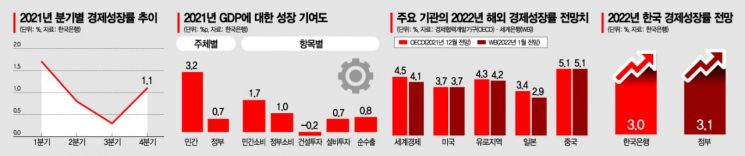
◆Private Consumption Boosted by Fiscal Spending= The 4.0% economic growth rate announced by the Bank of Korea on the 25th for last year is considered a decent performance given the global economic situation caused by the COVID-19 pandemic, with private consumption and exports playing major roles. Private consumption, which had decreased by 5.0% in 2020, turned to an annual increase of 3.6% last year, the highest growth rate since 2010 (4.4%). The contribution of domestic demand also turned positive, rising from -1.4 percentage points to 3.1 percentage points, centered on consumption.
However, most economic experts are cautious about the sustainability of the recovery in private consumption. This is because the government actively supported private consumption through fiscal spending such as disaster relief funds. The government injected about 50 trillion won through two supplementary budgets on top of the 558 trillion won main budget last year. The government consumption growth rate (5.5%) was also higher than the private consumption growth rate (3.6%). Hwang Sangpil, Director of the Economic Statistics Bureau at the Bank of Korea, stated, "Private consumption surged significantly due to the phased return to daily life in October and November last year," adding, "The effect of the 50 trillion won supplementary budget is also partially reflected." Meanwhile, exports increased by 9.7% and facility investment by 8.3%, indicating an overall economic recovery.
◆Will Growth Continue? Concerns Over Livelihood Crisis, Inflation, and G2 Economic Slowdown= Although South Korea succeeded in defending one of the highest growth rates among advanced countries last year through active supplementary budgets and fiscal projects, global uncertainties such as supply chain disruptions, inflation, and concerns over accelerated shifts in U.S. monetary policy are intensifying, potentially hindering further economic rebound. Jeong Gyucheol, Director of the Economic Outlook Office at the Korea Development Institute (KDI), said, "Logistics disruptions caused by global supply chain issues are raising costs and inflation concerns," adding, "With U.S. interest rate hikes, a tightening monetary policy stance, and even quantitative tightening being discussed, emerging markets could be hit hard, making exports difficult."
Jeong added, "If global inflation worsens, liquidity will eventually be reduced," warning, "This could make consumption and investment more difficult and cause market interest rates to rise as a side effect." In fact, rapid expected inflation could reduce real purchasing power and suppress consumption, while increasing anxiety among economic agents, which may also affect investment. Professor Ahn Donghyun of Seoul National University's Department of Economics noted, "Especially in the case of China, which imports many intermediate goods from South Korea, the impact could be significant," and added, "Efforts to diversify exports, such as exploring direct exports to the U.S. from now on, are necessary."
There are also calls for tailored measures considering sectoral recovery disparities to achieve this year's growth target of 3.0% projected by the Bank of Korea. Professor Ahn said, "Looking at the recovery speed by sector, manufacturing producing durable goods continues to perform well despite COVID-19, while the service sector is on the brink of collapse," advising, "Even after full recovery from COVID-19, the degree of shock differs, so package support measures tailored to each situation are needed." He further predicted, "The new government will likely implement additional supplementary budgets," and "Ultimately, growth may be artificially boosted through fiscal policy."
Despite the favorable growth rate, concerns have been raised that the livelihood economy has not improved at all. Although the surge in liquidity boosted domestic consumption and exports achieved record-high performance thanks to large corporations' strong showing, the face-to-face service sector, a barometer of livelihoods, has reached its limit due to prolonged COVID-19 restrictions. Hong Namki, Deputy Prime Minister and Minister of Economy and Finance, also praised the 4% growth on his personal social media on the same day but expressed concern, stating, "Face-to-face service industries, especially accommodation, food, and cultural services, have not yet fully recovered from the COVID shock, and recent prolonged quarantine measures are exacerbating difficulties."
© The Asia Business Daily(www.asiae.co.kr). All rights reserved.

![User Who Sold Erroneously Deposited Bitcoins to Repay Debt and Fund Entertainment... What Did the Supreme Court Decide in 2021? [Legal Issue Check]](https://cwcontent.asiae.co.kr/asiaresize/183/2026020910431234020_1770601391.png)