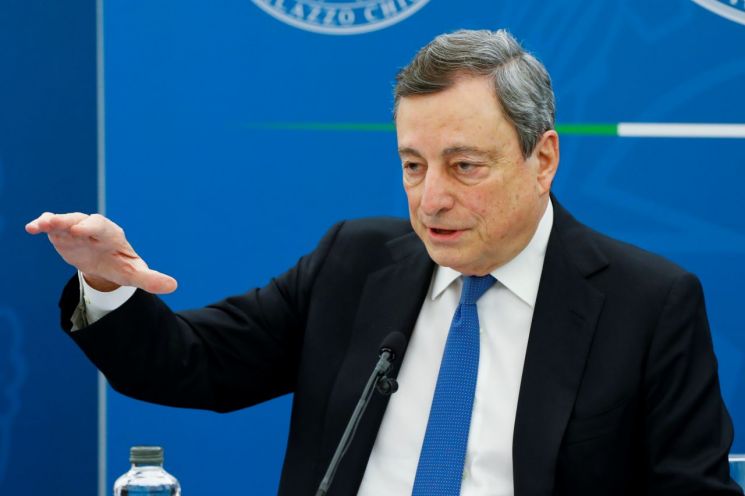
[Asia Economy Reporter Park Byung-hee] Bloomberg News reported on the 24th (local time) that no president was elected in the first round of the Italian presidential election. The Italian president is elected through an indirect election, and Bloomberg analyzed that the failure to elect a president was due to divisions within the parliament.
The Italian parliament convened delegates at the House of Representatives at 3 p.m. that day to conduct the presidential election vote. Of the total 1,009 delegates stipulated by the constitution (951 members of the upper and lower houses, 58 regional representatives), 976 attended the vote, which lasted over five hours.
However, 672 votes, equivalent to two-thirds of the total, were blank. This matches the number of affirmative votes required for a presidential win in the first to third rounds. In rounds 1 to 3, a candidate must receive support from two-thirds of the delegates (672 votes) to be elected, while from the 4th round onward, the threshold lowers to a simple majority (505 votes).
The Italian presidential election proceeds daily without an official candidate list, with delegates writing their preferred names on the ballot until a winner emerges. Local political circles and experts expect a winner to be decided around the 4th or 5th rounds on the 27th or 28th.
There were also 49 invalid votes in the first round.
Among the candidates whose names were written on the ballots, former Constitutional Court Vice President Paolo Madalena received the most votes with 39, followed by current President Sergio Mattarella, who clearly stated he would not seek re-election, with 16 votes. Marta Cartabia, the current Minister of Justice and the first female presidential candidate in constitutional history, received 9 votes, and former Prime Minister Silvio Berlusconi, who declared his withdrawal, received 7 votes. Mario Draghi, considered the most likely winning candidate, received only 1 vote.
The large number of blank ballots in the first round was due to the failure of major parties to agree on a candidate nomination.
In this presidential election, due to the structure of the seats in the upper and lower houses, which make up a large portion of the delegates, neither the left nor right-wing party groups hold a majority, making it necessary to recommend a common candidate through compromise.
Even after the first round began, left and right-wing parties have been actively negotiating and searching for a candidate to support, but no specific names have been mentioned yet. Given the current situation, many forecasts still consider Prime Minister Mario Draghi the most likely presidential candidate.
However, some major parties are reluctant to nominate a candidate due to concerns about potential political instability if Draghi resigns from the prime ministership.
© The Asia Business Daily(www.asiae.co.kr). All rights reserved.
![User Who Sold Erroneously Deposited Bitcoins to Repay Debt and Fund Entertainment... What Did the Supreme Court Decide in 2021? [Legal Issue Check]](https://cwcontent.asiae.co.kr/asiaresize/183/2026020910431234020_1770601391.png)














