2021 Female Employment Rate 57.7%, Recovered to Pre-COVID Level
Employment Rate of Women in Their 20s at 59.6%, Up 2.8%p from Previous Year
Women in Their 30s Decreased from 59.9% Two Years Ago to 57.5%
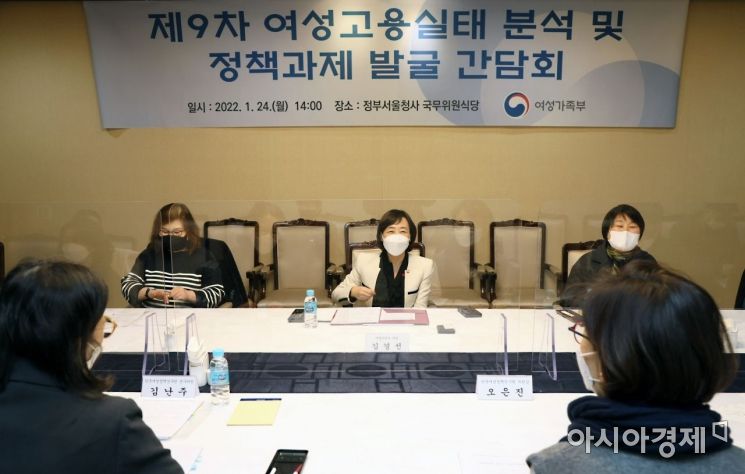 On the afternoon of the 24th, Kim Kyung-sun, Vice Minister of the Ministry of Gender Equality and Family, held the "9th Expert Meeting on Analysis of Women's Employment Status and Policy Task Discovery" at the Government Seoul Office Building to review changes in women's employment over the past two years and discuss policy tasks to eliminate gender gaps in the labor market.
[Asia Economy Reporter Han Jinju] Although the female employment rate has recovered to pre-COVID-19 levels, the employment rate of women in their late 30s has declined for two consecutive years.
On the 25th, the Ministry of Gender Equality and Family held the "9th Expert Meeting on Analysis of Women's Employment Status and Policy Task Development" at the Government Seoul Office Building the previous afternoon.
Kim Nanju, Associate Research Fellow at the Korean Women's Development Institute, who presented the report, analyzed the "2021 Economically Active Population Survey" and revealed that the number of employed women increased by 202,000 last year, and the female employment rate (57.7%) nearly reached the pre-COVID-19 level of 2019 (57.8%).
The female employment rate also varied by age group. The employment rate of women in their 20s rose by 2.8 percentage points from the previous year to 59.6%, surpassing the pre-COVID-19 level (59.0%). Women in their 20s, who had faced difficulties due to the contraction of the hiring market caused by COVID-19, led the recovery of the female employment rate. Notably, employment increases were prominent in the information and communication industry and the science and technology services sector. Permanent positions increased by 56,000 and temporary positions by 52,000, raising concerns that women in their 20s might be more exposed to employment shocks.
The employment rate of women aged 35 to 39 was 57.5%, down 1.1 percentage points from the previous year. This marks a decline for two consecutive years since 2019 (59.9%). This age group is at the stage where career interruptions due to childbirth and childcare are actively experienced, and it is presumed that the increased caregiving burden caused by COVID-19 prevented their return to the workplace.
Additionally, during economic downturns, women who graduate from university tend to lower their expectations, while male university graduates tend to seek jobs that match their expectations even if the job search period is prolonged. Analyzing the "Korean Labor Panel 1st to 22nd waves (1998?2019)," Kwak Eunhye, Associate Research Fellow at the Korea Labor Institute, found that the higher the unemployment rate at the time of graduation, the lower the hourly wage of female university graduates in their first year after graduation. A 1 percentage point increase in the unemployment rate led to a 3.8% decrease in hourly wages for employed women.
Analysis of the "Economically Active Population Survey Youth Supplement (2005?2019)" also showed that the higher the unemployment rate at graduation, the higher the probability that female university graduates under 29 would have temporary jobs and quit their first job due to major mismatch.
On the other hand, for male university graduates, an increase in the unemployment rate in the year of graduation lowered the likelihood of employment from one year after graduation and lengthened the job search period for the first job, but the hourly wage in the first year after graduation actually increased. A 1 percentage point rise in the unemployment rate resulted in a 3.3% increase in hourly wages for employed men.
Kwon Hyeja, Research Fellow at the Korea Employment Information Service, stated, "Since women face different difficulties in the labor market depending on their life cycle, it is important to approach female labor policies by age group, and measures for self-employed workers, including online platform labor, are necessary."
Gil Hyunjong, Senior Research Fellow at the Korea Labor Institute, said, "Job seeking through public employment agencies among unemployed women has greatly expanded during COVID-19," and suggested, "Since the impact of public employment support services on female employment has increased, we need to deeply consider ways to utilize public employment services more effectively."
Based on the "Act on Promotion of Economic Activities of Women with Career Interruptions," revised last year, the Ministry of Gender Equality and Family plans to focus policy efforts on preventing career interruptions to support reemployment of women with career breaks and prevent labor market withdrawal of employed women. The "Women's Employment Retention Service," piloted last year, will be expanded as a specialized pilot project at the metropolitan level in Seoul starting this year.
In addition, policies to reduce disparities in the labor market, such as gender-based occupational segregation and gender wage gaps, will be promoted. The ministry will review improvement plans for the affirmative action system to ease gender-based occupational segregation and proceed after gathering opinions from the Affirmative Action Expert Committee.
Kim Kyungseon, Vice Minister of the Ministry of Gender Equality and Family, said, "To overcome the reality where employment shocks concentrate on women during economic crises, fundamental improvements in the structure of women's jobs are necessary," adding, "We will focus policy efforts on preventing women's career interruptions and improving the quality of vulnerable jobs with a high proportion of female workers, and do our best to enable women to actively enter promising future industries."
© The Asia Business Daily(www.asiae.co.kr). All rights reserved.

![User Who Sold Erroneously Deposited Bitcoins to Repay Debt and Fund Entertainment... What Did the Supreme Court Decide in 2021? [Legal Issue Check]](https://cwcontent.asiae.co.kr/asiaresize/183/2026020910431234020_1770601391.png)














