Many Elderly Want Jobs with High Employment Rate but Low 'Quality of Work'
"Labor Market Reform, Wage Restructuring, Strengthened Job Training, and Pension System Improvement Must Be Pursued"
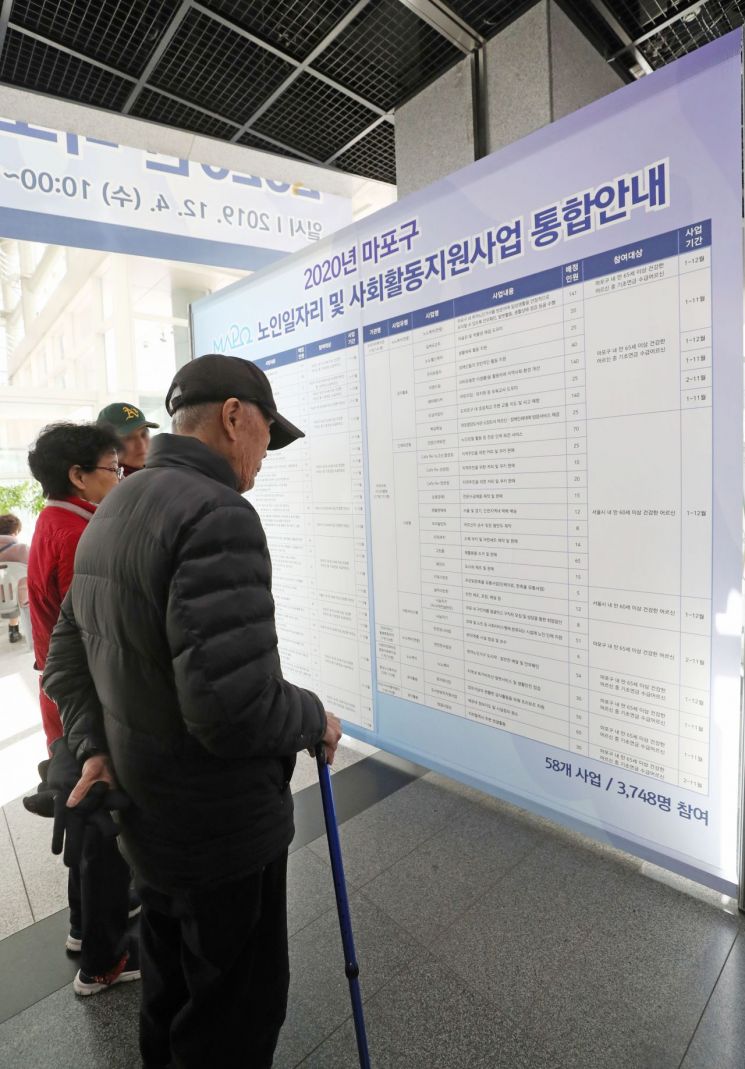
[Asia Economy Reporter Lee Hyeyoung] An analysis revealed that only 9.0% of middle-aged and older Koreans re-enter regular employment within one year after leaving their jobs. While the proportion of middle-aged and elderly people seeking jobs is high compared to major countries, the quality of jobs is low, indicating the need for institutional support.
According to the 'Analysis of Characteristics and Factors of Reemployment of Middle-aged and Older Workers and Implications' released on the 25th by the Korea Economic Research Institute under the Federation of Korean Industries, among OECD member countries, Korea has a high employment rate for middle-aged and older workers, and the employment rate ranking rises as the age group increases.
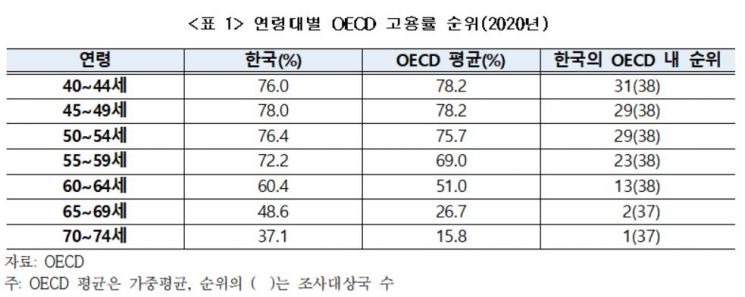
Korea's employment rate for those aged 50-54 was 76.4%, exceeding the OECD average of 75.7%. The ranking within the OECD continued to rise as the age group increased. Among OECD countries, Korea's employment rate for those aged 65-69 was 48.6%, ranking 2nd, and for those aged 70-74, it was 37.1%, ranking 1st. These figures are about twice the OECD average.
Despite this high employment rate among the elderly, Korea's poverty rate for older adults was analyzed to be the highest in the OECD. Based on 2018 data comparable among OECD countries, Korea's elderly poverty rate was the highest among surveyed OECD countries for both the 66-75 age group (34.6%) and those aged 76 and above (55.1%).
High Reemployment Rate but Low Job Quality for Middle-aged and Older Workers Leaving Jobs
According to the Korea Economic Research Institute, despite the high labor market participation rate among the elderly in Korea, the quality of reemployment jobs after leaving a job was low.
The reemployment rate within one year for middle-aged and older workers aged 55-74 at the time of leaving their jobs was 45.3%, and the reemployment rate within five years was 67.6%. Even for those aged 65-74 at the time of leaving, more than half (55.4%) were reemployed within five years.
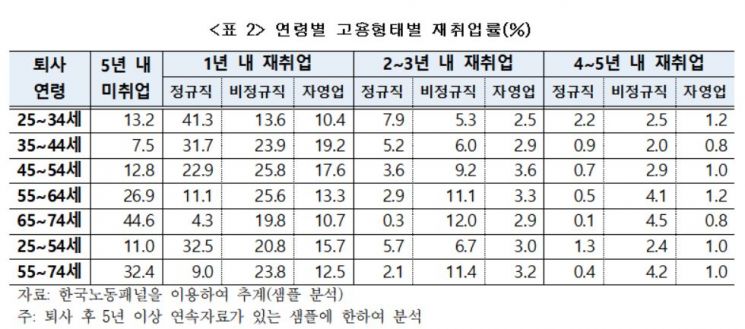
Although the reemployment rate remains high even after leaving a job past age 55, the quality of jobs is low.
Analyzing reemployment jobs by employment type within one year after leaving a job by age group, the regular employment reemployment rate for those aged 55-74 was only 9.0%. This is significantly lower than the non-regular employment reemployment rate (23.8%) for the same age group, indicating that the quality of reemployment jobs is not good.
The reemployment rate within five years after leaving a job for those aged 55-74 was 11.5% for regular employment, 39.4% for non-regular employment, and 16.7% for self-employment, showing that among 10 reemployed individuals, only 1.7 returned to regular employment.
Higher Probability of Regular Employment Reemployment for Highly Educated, Men, and Those Participating in Vocational Training
Analysis by the Korea Economic Research Institute on factors affecting reemployment of middle-aged and older workers showed that ▲ higher education ▲ male gender ▲ participation in vocational training ▲ working as wage workers at the time of leaving a job all increased the likelihood of reemployment in regular employment.
The probability of reemployment in regular employment increased by 65.6% for those with college education or higher compared to those with high school education or less, and by about 43.0% for those participating in vocational training compared to non-participants. Conversely, women had about a 29.4% lower probability of reemployment in regular employment compared to men.
In particular, as age increased, the probability of reemployment in regular employment decreased the most. With each additional year of age, the probability of reemployment in regular employment decreased by 17.9%, while non-regular employment decreased by 11.3%, and self-employment by 10.6% respectively.
"Labor Market Flexibility, Wage System Reform, Strengthening Vocational Training, and Pension System Improvement Needed"
The Korea Economic Research Institute forecasted that to resolve issues of jobs and poverty rates among the elderly in the future, it will be necessary to ▲ ease regulations on the labor market ▲ reform the wage system ▲ strengthen vocational training ▲ improve the pension system.
Researcher Yoo Jinseong of the Korea Economic Research Institute analyzed, "To increase quality jobs for the elderly, it is necessary to enhance employment flexibility by easing employment protection for regular workers and relaxing regulations on non-regular workers."
He added, "Reforming the wage system from a seniority-based system to a job-based and performance-based wage system and expanding the wage peak system can be expected to maintain or expand employment for middle-aged and older workers. To expand access to quality jobs for middle-aged and older workers, it is also necessary to strengthen ongoing vocational training."
Along with this, the Korea Economic Research Institute emphasized that to solve the problem of working poverty among the elderly, it is necessary to improve the pension system in a direction that strengthens old-age life security. They explained that it is necessary to gradually ease the eligibility conditions for public pension systems to eliminate blind spots and expand tax benefits for private pensions to strengthen the function of private pensions such as personal pensions and improve the system.
© The Asia Business Daily(www.asiae.co.kr). All rights reserved.
![User Who Sold Erroneously Deposited Bitcoins to Repay Debt and Fund Entertainment... What Did the Supreme Court Decide in 2021? [Legal Issue Check]](https://cwcontent.asiae.co.kr/asiaresize/183/2026020910431234020_1770601391.png)

















