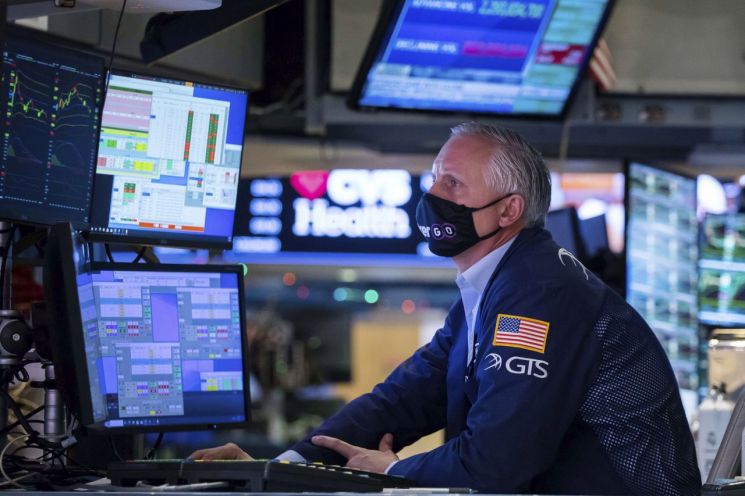
[Asia Economy New York=Special Correspondent Joselgina] The U.S. New York stock market showed a sharp decline during trading on Monday, the 24th (local time). This was due to concerns over early tightening by the U.S. Federal Reserve (Fed), which led last week's market downturn, combined with escalating geopolitical risks surrounding Ukraine. The Dow Jones Industrial Average, composed of blue-chip stocks in the New York market, at one point during trading fell more than 1,000 points.
As of 1:18 p.m. that day, the S&P 500 index, centered on large-cap stocks, was trading at 4,300.98, down 96.96 points (2.20%) from the previous close. The S&P 500 index fell more than 10% from its intraday high, entering a technical correction phase. The Nasdaq index, which had already entered a correction phase last week, was down 315.66 points (2.29%) to 13,453.26.
At the same time, the Dow Jones index was trading at 33,605.10, down 660.27 points (1.93%), marking seven consecutive trading days of decline. The intraday drop, which had exceeded 1,000 points, somewhat eased as it approached 1 p.m. The Russell 2000 index, focused on small and mid-cap stocks, was also down 34.87 points (1.75%) to around 1,953 compared to the previous close.
By individual stocks, big tech companies such as Apple, Microsoft (MS), Amazon, Tesla, and Meta were hit hard again. As of 1:20 p.m., among the top traded stocks, declines were confirmed for Tesla (-5.61%), Nvidia (-6.45%), Apple (-2.86%), MS (-2.68%), Netflix (-7.23%), and Nikola (-4.38%). CNBC reported that only six stocks in the S&P 500 were trading in positive territory.
The S&P 500 index has fallen more than 10% so far this month, recording its worst performance since March 2020. It is the worst January on record. During the same period, the Dow Jones index's decline exceeded 7%. The Nasdaq index plunged by as much as 14%, marking its worst month since the 17.7% drop in October 2008.
This decline is attributed to the tightening fears that have swept the global asset markets since the beginning of the year. The Fed, unable to withstand inflationary pressures, is widely expected to initiate early tightening, leading to massive sell-offs centered on tech stocks. The Chicago Board Options Exchange (CBOE) Volatility Index (VIX), known as Wall Street's "fear index," hit 38 during trading, the highest since November 2020, before falling back to around 35.
The market is currently focusing on hints regarding the timing and magnitude of the Fed's interest rate hike that Fed Chair Jerome Powell is expected to announce at the Federal Open Market Committee (FOMC) meeting on the 25th-26th. According to the CME Group's FedWatch tool, federal funds (FF) futures markets reflect more than a 90% probability of a rate hike by the Fed in March. This probability has sharply increased from the 50% range just a month ago.
Investors are also closely monitoring the potential impact of the Ukraine crisis on the global economy. With Russia recently amassing over 100,000 troops near the Ukraine border, major governments including the U.S. and the U.K. have strengthened preparedness by ordering the families of embassy staff in Ukraine to evacuate. U.S. President Joe Biden is scheduled to discuss the possibility of a Russian invasion of Ukraine with European leaders on the same day.
Earnings results are mixed. Stocks of Goldman Sachs and Netflix plunged after their earnings releases. About one-fifth of companies included in the S&P 500, such as Apple, MS, and Tesla, are expected to report strong earnings this week. However, experts predict that the recent tightening fears in the New York stock market will prevent this from becoming a significant rebound catalyst. Adam Crisafulli, founder of research firm Vital Knowledge, stated, "Investors are now worried even about earnings per share forecasts themselves."
International oil prices showed a downward trend. On the New York Mercantile Exchange (NYMEX) in the afternoon, March delivery West Texas Intermediate (WTI) crude oil was trading at $83.34 per barrel, down 2.10% from the previous close. March Brent crude on the London ICE Futures Exchange was also down about 1.89% to around $86.23. The price of gold, a representative safe-haven asset, rose slightly, recording $1,839.50 per ounce, up 0.43% from the previous trading day.
This week, reports such as the International Monetary Fund (IMF) revised World Economic Outlook, U.S. fourth-quarter GDP, and U.S. personal consumption expenditures (PCE), which the Fed closely watches, are scheduled for release. The IMF had originally planned to release the revised report on the 19th but postponed it by a week to further review the impact of the recent Omicron spread. The key issue is how much the global economic growth forecast will be downgraded.
Meanwhile, as geopolitical tensions surrounding Ukraine and U.S.-originated tightening concerns intensified, major European stock markets also plunged on the 25th (local time).
On that day, Germany's Frankfurt stock market DAX30 index closed at 15,011.13, down 3.80% from the previous day's close. France's Paris stock market CAC40 index ended the session at 6,787.79, down 3.97%. The UK's London FTSE 100 recorded 7,297.15, down 2.63%. The pan-European Euro Stoxx 50 index also fell 4.14% to 4,054.36 compared to the previous close.
© The Asia Business Daily(www.asiae.co.kr). All rights reserved.