'Unification' Emerges as Key Variable... Sharp Exchanges Between Ahn and Lee
Emotional Clashes Like 'Gancheolsu' and 'Patriarchal' After Verbal Fight
Experts Say "Neither Side Seems Willing to Yield the Unified Candidate Spot... Low Possibility of Unification"
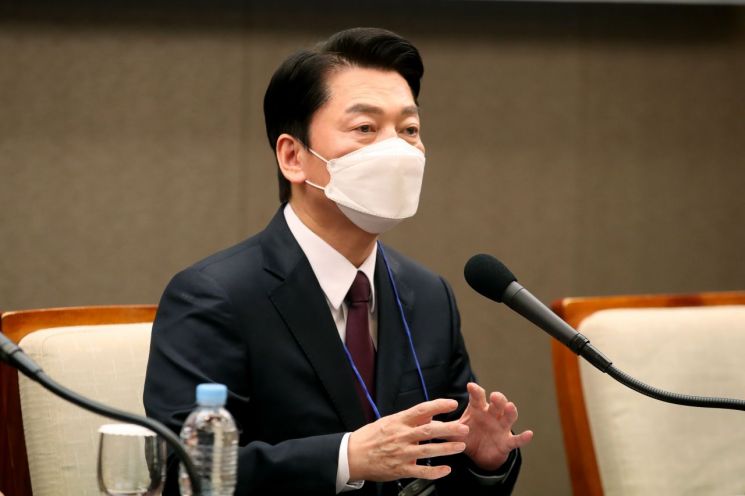 Ahn Cheol-soo, the presidential candidate of the People’s Party, engaged in daily verbal disputes with Lee Jun-seok, the leader of the People Power Party, over the issue of 'opposition unity.'
 [Image source=Yonhap News]
[Asia Economy Reporter Yoon Seul-gi] Ahn Cheol-soo, the presidential candidate of the People’s Party, has recorded support rates of up to 17%, making the 'opposition unification' the biggest variable in the presidential election. However, as candidate Ahn, who has grown in stature, and Lee Jun-seok, the leader of the People Power Party who insists on an 'independent path,' engage in sharp confrontations, there are forecasts that 'opposition unification' will not be easy.
In various opinion polls, candidate Ahn has recorded support rates above 10%, increasing the possibility of regime change if the opposition unifies. According to a survey conducted by Southern Post on behalf of CBS from the 21st to 22nd, targeting 1,002 adult men and women nationwide, the support rates for the next presidential candidates were 34.0% for Lee Jae-myung of the Democratic Party, 32.5% for Yoon Seok-youl of the People Power Party, and 10.7% for candidate Ahn.
In the same survey, when asked about opposition candidate unification, 50.6% responded that they 'agree' with the unification of candidates Yoon and Ahn, while 39.2% opposed it. Among Yoon’s supporters, 86.6% agreed with unification, and among Ahn’s supporters, 62.8% were in favor.
Throughout the presidential race, candidate Ahn firmly maintained a stance of 'no unification,' but recently, the frequency of his mentions of unification has increased, indicating a shift in position. In particular, candidate Ahn left room for opposition unification by coining the term 'Anilhwa' (unification with Ahn Cheol-soo), arguing that overwhelming victory is possible only if he becomes the representative player of the opposition.
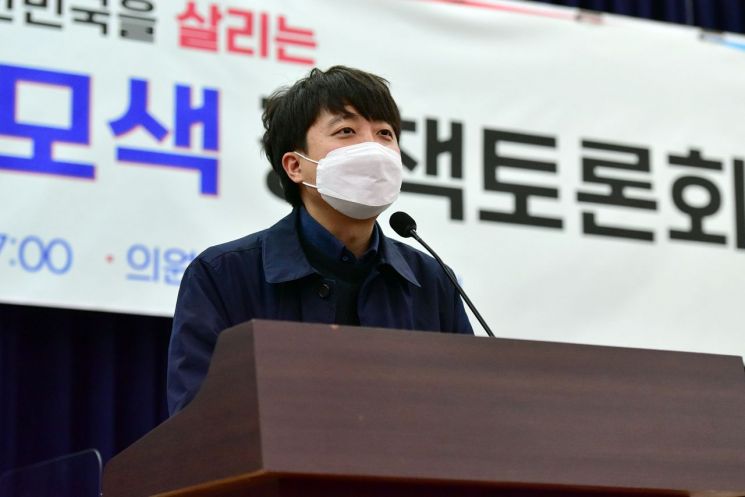 Lee Jun-seok, the leader of the People Power Party, drew a line on the 23rd, stating that there will be no unification with Ahn Cheol-soo, the presidential candidate of the People’s Party.
 [Image source=Yonhap News]
However, Lee Jun-seok expressed discomfort with the 'Anilhwa' claim. On the 19th, appearing on MBC Radio’s 'Kim Jong-bae’s Focus,' Lee said, "'Anilhwa' is not the right term; 'Ganilhwa' (testing unification) is more popular," countering with 'Gancheolsu,' a derogatory nickname reminiscent of candidate Ahn. Recently, as candidate Yoon’s support rate recovered from a decline due to internal party conflicts, Lee seems to have judged that there is a winning chance with Yoon’s independent path without unification with candidate Ahn.
The verbal battle over unification between the two sides continued. On the 23rd, Lee Jun-seok introduced an article on his Facebook where candidate Ahn was asked if he was willing to accept the People Power Party’s unification proposal in front of the Gyeongnam Provincial Assembly in Changwon, Gyeongnam. The article quoted Ahn saying, "Since the (Lee Jun-seok People Power Party) leader opposes it so much, would such a proposal even come?" Lee commented, "The person who says they are not interested in unification (candidate Ahn) talks about unification all day long; it seems their mind is full of unification."
Lee added, "Anyway, in about three months, when you run for Seoul mayor, you will ask for unification again, but even then, there will be no unification."
In response, Shin Na-ri, deputy spokesperson of the People’s Party election committee, criticized Lee in a statement that day. Shin said, "It is painful even to explain who wanted unification more in last year’s Seoul mayoral by-election, a matter known to all Koreans. How can you ridicule candidate Ahn again with unification when he diligently supported Oh Se-hoon’s campaign for the greater cause of regime change?" She raised her voice, demanding, "Immediately stop this outrageous slander."
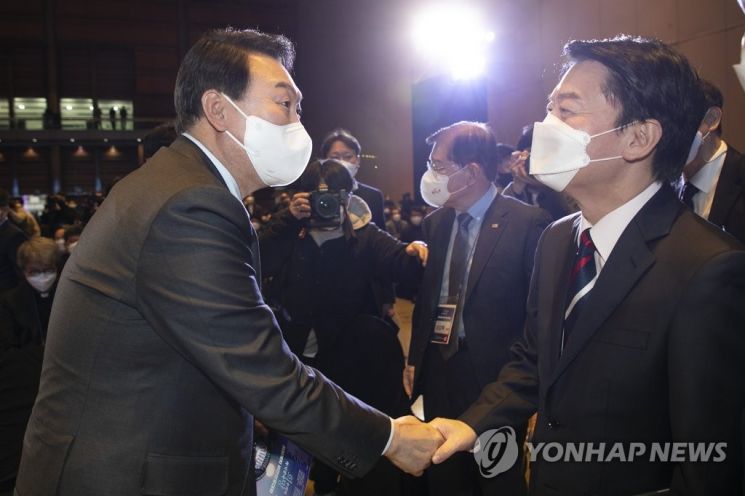 Yoon Seok-yeol, the presidential candidate of the People Power Party, and Ahn Cheol-soo, the presidential candidate of the People Party, are greeting each other at the Social Welfare Vision Declaration Conference held at COEX in Gangnam-gu, Seoul on the 10th. [Image source=Yonhap News]
As a result, the power struggle to gain the upper hand in unification negotiations is turning into an emotional conflict between the two sides. However, with the next presidential election expected to be a close race and consolidating the support base becoming a key task, there are many voices saying that unification between candidate Ahn, who shows no particular momentum for a rebound, and candidate Yoon, who faces controversies such as shamanism, verbal gaffes, and spousal risks, is necessary for regime change.
Experts analyze that the possibility of 'opposition unification' is low in the current situation where neither side seems willing to yield the unified candidate position. Professor Lee Jun-han of the Department of Political Science and Diplomacy at Incheon National University explained, "Pressure for opposition unification is increasing inside and outside the political circle, and related discussions are emerging. This is because the simple sum of the average support rates of candidates Yoon and Ahn is about 50%, but it should also be considered that support rates may decline further upon unification."
Professor Lee added, "Unification requires one candidate to concede, but in this situation where both sides are engaged in severe emotional conflicts, unification is unrealistic. Related discussions will not be easy."
© The Asia Business Daily(www.asiae.co.kr). All rights reserved.
![User Who Sold Erroneously Deposited Bitcoins to Repay Debt and Fund Entertainment... What Did the Supreme Court Decide in 2021? [Legal Issue Check]](https://cwcontent.asiae.co.kr/asiaresize/183/2026020910431234020_1770601391.png)