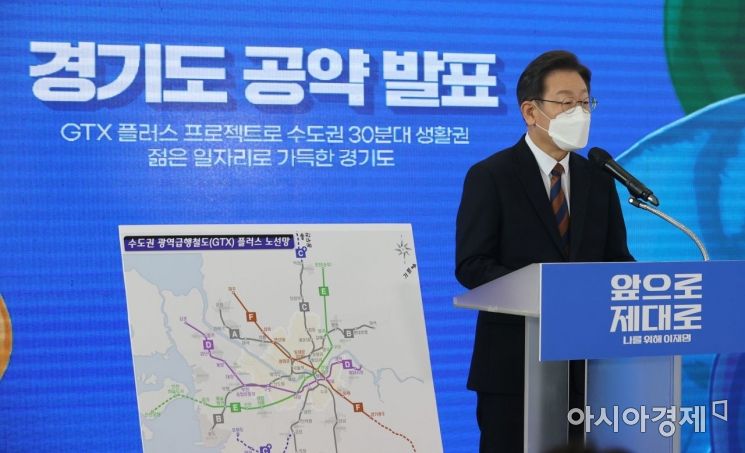
 Lee Jae-myung, the presidential candidate of the Democratic Party of Korea, is announcing Gyeonggi Province policy pledges at Poeun Art Hall in Yongin, Gyeonggi Province on the 24th. Photo by Dongju Yoon doso7@
Promise to Supply 1.07 Million Households in Seoul Alone
More Than Three Times the Volume of 1st Generation New Towns
Residents of Candidate Sites like Gimpo and Yongsan
"Concerns Over Housing Price Drops and Traffic Congestion"
[Asia Economy Reporters Kim Min-young, Moon Je-won] Experts are raising doubts about the feasibility of Lee Jae-myung’s ‘3.11 million household supply bomb’ pledge. In areas proposed as supply candidates such as Yongsan in Seoul and Gimpo in Gyeonggi Province, residents express dissatisfaction, saying, “Don’t make us scapegoats,” worrying about falling housing prices and traffic congestion. Another challenge to overcome is coordinating opinions between local governments and residents regarding future development methods and types of housing supply.
Lee Eun-hyung, a senior researcher at the Korea Construction Policy Institute, said in a phone interview on the 24th, “If the plan to supply 1.07 million households in Seoul is the net increase excluding demolished houses from redevelopment projects, it means supplying a volume exceeding the scale of the 1st generation new towns,” adding, “More concrete implementation plans are needed beyond simple numbers.” He added, “The concept of a supply bomb has already been presented by the current government, so it is difficult to attract market interest.”
On the previous day, Lee Jae-myung, the Democratic Party presidential candidate, announced a plan to supply 3.11 million households, which is 1.05 million more than the government’s original housing plan. In particular, for Seoul, he plans to supply 1.07 million households, which is 480,000 more than the government’s plan. This volume is more than three times the size of the 1st generation new towns, which have about 300,000 households in areas such as Ilsan, Bundang, Jungdong, Pyeongchon, and Sanbon in Gyeonggi Province. To supply 3.1 million households over the next five years of the next government’s term, 620,000 households must be supplied annually, but it is not easy to secure this amount of land in the metropolitan area currently.
Seo Jin-hyung, president of the Korea Real Estate Society and professor at Gyeongin Women’s University, pointed out, “The area near Gimpo Airport is practically impossible for housing supply due to flight altitude restrictions and noise,” adding, “Housing supply through underground railway development is a task that takes at least 10 years, so it is uncertain whether it can be promoted within the term.”
Coordination with local governments is also a challenge to be resolved. Lee proposed national and public land (20,000 households) such as Taereung, Hongneung, and Changdong as a Seoul supply implementation plan, but Seoul City prefers supply through housing redevelopment projects within the city rather than developing land in outer areas.
A Seoul city official said, “The city prefers supply methods through redevelopment and reconstruction within the city, which involve less development area, rather than new land development in outer areas,” showing a difference in opinion.
Residents of areas such as Yongsan and Gimpo are also increasingly dissatisfied with Lee’s housing supply plan. Without specific plans for transportation network and job expansion or residential environment improvement measures, increasing housing supply alone inevitably causes damage such as housing price drops and traffic congestion from the perspective of existing residents. As a result, there are criticisms that Lee has made these areas scapegoats to win the election.
In online communities where Gimpo residents gather, many opinions of “absolutely impossible” have already been raised. One Gimpo resident said, “Is it reasonable to put apartments in Gimpo without improving transportation networks such as the GTX D line?” and criticized, “Gimpo is a sacrifice for the homeless.”
Regarding the plan to supply 100,000 households using part of Yongsan Park land, many local opinions are negative, calling it “violent and unrealistic.” A resident of Yongsan-gu said, “Considering Lee’s existing pledges, a significant number of the newly supplied houses will be rental housing,” adding, “It can be interpreted as effectively giving up on Yongsan’s votes.”
© The Asia Business Daily(www.asiae.co.kr). All rights reserved.