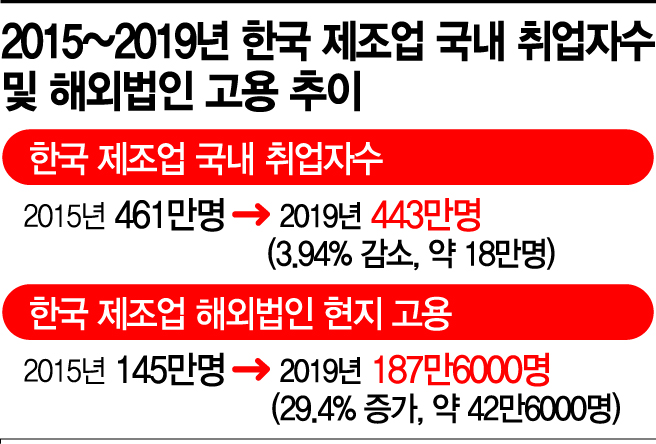
[Asia Economy Reporters Heungsun Kim and Sunhee Son] An analysis has revealed that the number of domestic employees in South Korea's manufacturing sector, once known as a "manufacturing powerhouse," has decreased by approximately 180,000 over the past five years. This figure is comparable to the combined number of domestic employees at Samsung Electronics and Hyundai Motor Company. Conversely, overseas employment in the manufacturing sector has surged. While jobs in key industries have been moving abroad, the proportion of domestic public sector jobs, primarily held by the elderly, has steadily increased, surpassing double digits for the first time.
On the 24th, the Federation of Korean Industries (FKI) conducted a comparative analysis of the manufacturing landscapes over the past five years (2015?2019) among the world's six major manufacturing countries (South Korea, the United States, China, Japan, Germany, and India). The number of manufacturing employees in South Korea decreased from 4.61 million to 4.43 million, a drop of about 180,000 (3.94%). This is roughly equivalent to the combined domestic workforce of Samsung Electronics (109,490 employees) and Hyundai Motor Company (72,020 employees) as of 2020. While domestic manufacturing employment declined, the number of employees at overseas subsidiaries of Korean manufacturing companies increased sharply from 1.45 million to 1.876 million, a rise of 426,000 (29.4%).
While manufacturing jobs are being outsourced overseas, the share of the public sector in the domestic employment market has been increasing annually. According to Statistics Korea, in 2020, public sector jobs totaled 2.766 million, accounting for 10.2% of the total employed population (26.904 million). The increase in public sector jobs from the previous year (6.3%) was also the largest. Notably, among the 164,000 new public sector jobs created in one year, those held by people in their 50s (41,000) and those aged 60 and above (46,000) accounted for more than half. This indicates that the rapid increase in elderly employment, driven by fiscal spending, has significantly expanded the public sector workforce.
Kim Bong-man, head of the International Division at the FKI, stated, "The ratio of overseas investment to domestic investment in our manufacturing sector is increasing," adding, "The government should improve the development of core technologies and the domestic investment environment to ensure that the expansion of overseas investment by domestic manufacturing industries does not shrink domestic employment."
© The Asia Business Daily(www.asiae.co.kr). All rights reserved.
![User Who Sold Erroneously Deposited Bitcoins to Repay Debt and Fund Entertainment... What Did the Supreme Court Decide in 2021? [Legal Issue Check]](https://cwcontent.asiae.co.kr/asiaresize/183/2026020910431234020_1770601391.png)