[Asia Economy (Suwon) = Reporter Lee Young-gyu] Last year, the total volume of real estate transactions in Gyeonggi-do decreased by 12.8% compared to the previous year.
Gyeonggi-do disclosed the results of the "2021 Annual Real Estate Transaction Trends and Realization Rate Analysis" based on taxable data reported for acquisition on the 24th. The realization rate is an indicator showing how much the official price reflects the actual transaction price, referring to the ratio of actual transaction price to the official price.
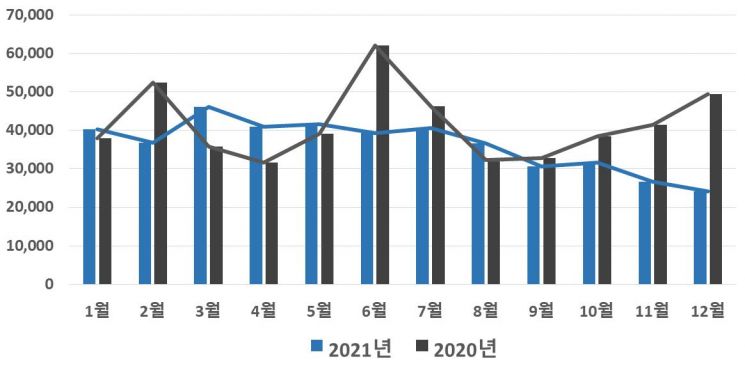
According to the released data, the total volume of real estate transactions in Gyeonggi-do from January to December last year was 435,426 cases, a 12.8% decrease compared to 499,546 cases in 2020.
Real estate transaction volume, which showed a strong trend similar to the previous year until July, shifted to a sharp decline in the second half of the year, mainly in apartments. In the case of multi-family housing, it sharply decreased by 32.6% compared to the previous year.
On the other hand, individual houses, land, and officetels maintained continuous strength despite a decrease in transactions over the recent two months, increasing by 5.7%, 16.5%, and 44.2% respectively compared to the previous year.
Accordingly, the transaction share of multi-family housing, which accounted for the largest portion last year, decreased from 60% to 48%, while the transaction share of land increased from 34% to 45%.
The highest-priced individual house traded last year was a detached house located in Bundang-gu, Seongnam-si, sold for 6.61 billion KRW, and the highest price for multi-family housing was a townhouse in the same area, sold for 3.85 billion KRW.
Meanwhile, analyzing the realization rate of 351,570 real estate transactions last year, the annual average realization rate for multi-family housing and individual houses in the province was 55% and 53%, respectively. Land was at 48%. Compared to the government's target realization rate for 2021, housing was at 70% and land at 94.8%.
Looking at detailed data by transaction amount, for apartments, the average realization rate was 54% for the under 300 million KRW range and 64% for the over 900 million KRW range, whereas for individual houses, it was 58% and 48%, respectively, indicating that the realization rate for high-priced individual houses is relatively lower than that of apartments.
The annual trend of realization rate fluctuation showed a similar trend for land with an average of 49%, but for multi-family housing, the realization rate decreased by 5% since January last year due to continuous price increases.
The annual average realization rate for non-residential real estate was 57%, with factories (including knowledge industry centers) showing a relatively high average realization rate of 61%, while officetels and stores had realization rates of 58% and 57%, respectively.
An official from the province stated, "Gyeonggi-do is the first in the nation to promote monthly analysis of real estate transaction trends and realization rates, and plans to publish a comprehensive white paper in February. We will continue to carry out systematic maintenance work on mismatches in characteristics of housing and land and the price reversal phenomenon where official land prices exceed individual house prices, striving to ensure that official prices reflect appropriate market values."
© The Asia Business Daily(www.asiae.co.kr). All rights reserved.

![User Who Sold Erroneously Deposited Bitcoins to Repay Debt and Fund Entertainment... What Did the Supreme Court Decide in 2021? [Legal Issue Check]](https://cwcontent.asiae.co.kr/asiaresize/183/2026020910431234020_1770601391.png)














