Introducing the New Progressive Value 'A Better Life' and Growth Theory in the Era of Great Transformation
One of the World's Top 5 Economic and Cultural Powers, 'A Better Korea' Through Improved Quality of Life
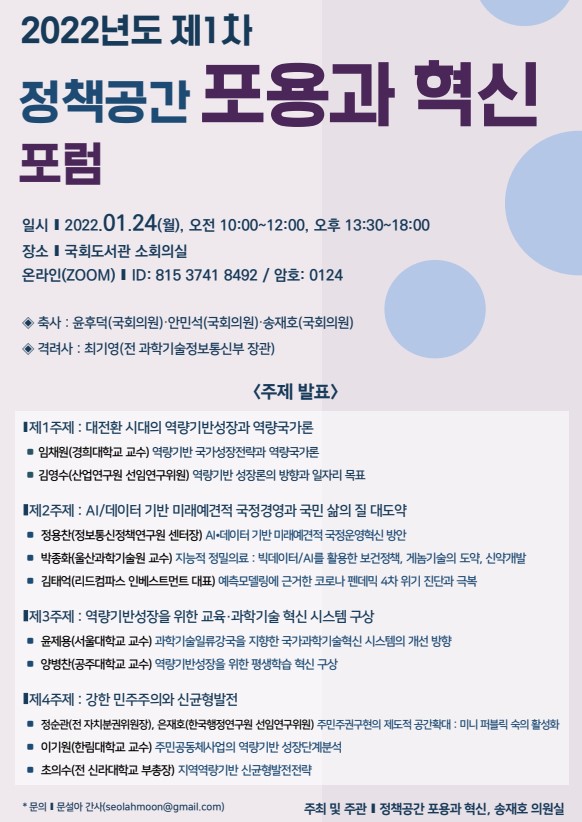
[Asia Economy Yeongnam Reporting Headquarters Reporter Kim Yong-woo] The progressive academic research group ‘Policy Space for Inclusion and Innovation’ is holding its first academic forum of the new year.
On the 24th, from 10 a.m. to 6 p.m., the 2022 1st Academic Forum will be held at the Small Conference Room of the National Assembly Library in Seoul under the theme “Great Leap Forward for the Republic of Korea ? Finding a New Path for Progress.”
Founded last November, this research institute explained the background of holding the academic forum by pointing out the chaos and crisis facing Korean society.
It diagnosed that not only the Republic of Korea but also the world order is shaken by the COVID-19 pandemic, economic uncertainty is increasing, and social inequality and anxiety are worsening.
Adding to this is the environmental crisis, which demands a major transformation across society that has never been experienced since the Great Depression in the early 20th century.
To find an answer to “Where should 21st-century Korea go?” a group of experts from various fields gathered to start discussions, and in November last year, ‘Policy Space for Inclusion and Innovation’ took its first step.
The value the institute aims for is to create “a Republic of Korea where all citizens can enjoy a better life.”
A better Korea encompasses not only economic values centered on GDP but also social and environmental values. To realize these values, it is necessary to introduce customized social policies that can naturally permeate our society.
‘Policy Space for Inclusion and Innovation’ emphasized that for government policies to improve the quality of life of the people, a public forum that involves much deliberation, discussion, and the collection of opinions from various groups is necessary.
This academic forum consists of four topics, and after each main presentation, a free discussion in a roundtable format will follow.
The opening ceremony will be hosted by Professor Jeong Seong-hoon of Daegu Catholic University. Congratulatory speeches will be given by National Assembly members Yoon Hu-deok, Ahn Min-seok, and Song Jae-ho. The welcome address will be delivered by Sung Kyung-ryung, representative of ‘Inclusion and Innovation,’ and the encouragement speech by former Minister of Science and ICT Choi Ki-young.
The first topic is Capability-Based Growth and the Theory of a Capability State in the Era of Great Transformation.
The chair is Professor Kim Yong-jin of Sogang University. Presentations include Professor Lim Chae-won of Kyung Hee University on Capability-Based National Growth Strategy and the Theory of a Capability State, and Senior Research Fellow Kim Young-soo of the Korea Institute for Industrial Economics and Trade on the Direction of Capability-Based Growth Theory and Job Goals. Discussions will be led by National Assembly member Kim Sung-hwan and Professor Joo Byung-ki of Seoul National University.
The second topic is AI/Data-Based Future Predictive National Governance and a Great Leap in the Quality of Life of the People.
The chair is Jeon Young-il, head of the Korea-Canada Pandemic Research Group. Presentations include Jeong Yong-chan, director of the Korea Information Society Development Institute, on AI data-based future predictive national governance innovation plans; Professor Park Jong-hwa of Ulsan National Institute of Science and Technology on intelligent precision medicine ? health policy using big data/AI, genome technology leaps, and new drug development; and Kim Tae-eok, CEO of Lead Compass Investment, on diagnosing and overcoming the fourth COVID-19 pandemic crisis based on predictive modeling. Discussions will be held by former MFDS Commissioner Lee Ui-kyung and Naver AI Research Center Director Ha Jung-woo.
The third topic is the Conceptualization of an Education and Science & Technology Innovation System for Capability-Based Growth.
The chair is former Minister of Science and ICT Choi Ki-young. Presentations include Professor Yoon Je-yong of Seoul National University on improving the national science and technology innovation system aimed at becoming a world-class science and technology powerhouse; Professor Yang Byung-chan of Kongju National University on lifelong learning innovation for capability-based growth. Discussions will be led by Ahn Hyun-sil, head of the AI Economy Research Institute at Korea Economic Daily; Song Byung-guk, dean of the Graduate School of Education at Soonchunhyang University; Kim Tae-eok, CEO of Lead Compass Investment; and Choi Sang-duk, senior research fellow at the Korea Educational Development Institute.
The fourth topic is Strong Democracy and New Balanced Development.
The chair is former president of the Korea Institute of Public Administration Ahn Sung-ho. Presentations include Jeong Soon-gwan, former chairman of the Autonomy and Decentralization Committee, and Eun Jae-ho, deputy director of the Korea Institute of Public Administration, on expanding institutional space for realizing resident sovereignty ? activating mini-public deliberations; Professor Lee Ki-won of Hallym University on capability-based growth stage analysis of resident community projects; and former vice president of Silla University Cho Eui-su on regional capability-based new balanced development strategies.
Discussions will be conducted by former Minister of Land, Infrastructure and Transport Byun Chang-heum, former president of the Korea Research Institute for Human Settlements Kim Dong-joo, standing chairman of the Village Republic National Assembly Lim Jin-cheol, Professor Yoon Hwang of Sun Moon University, and Professor Lee Sang-hoon of Daejeon University, presenting directions Korea should take in all four fields.
Each presentation is the result of the concerns of experts who have long witnessed theory and reality in related fields.
The institute’s goal is to turn the Republic of Korea’s “COVID-19 crisis into an opportunity for great transformation,” create a new growth momentum, and find a new path for a “better Korea” where citizens’ lives improve.
The institute stated, “Since the democratization of 1987, we aim to present the philosophy, values, and policy alternatives of Korean progress in this critical risk situation of the COVID-19 crisis.”
© The Asia Business Daily(www.asiae.co.kr). All rights reserved.
![User Who Sold Erroneously Deposited Bitcoins to Repay Debt and Fund Entertainment... What Did the Supreme Court Decide in 2021? [Legal Issue Check]](https://cwcontent.asiae.co.kr/asiaresize/183/2026020910431234020_1770601391.png)















