NVIDIA, Apple Lead Major Tech Stock Purchases
Despite Net Buying, Valuation Continues to Decline... Cautious Investment Needed
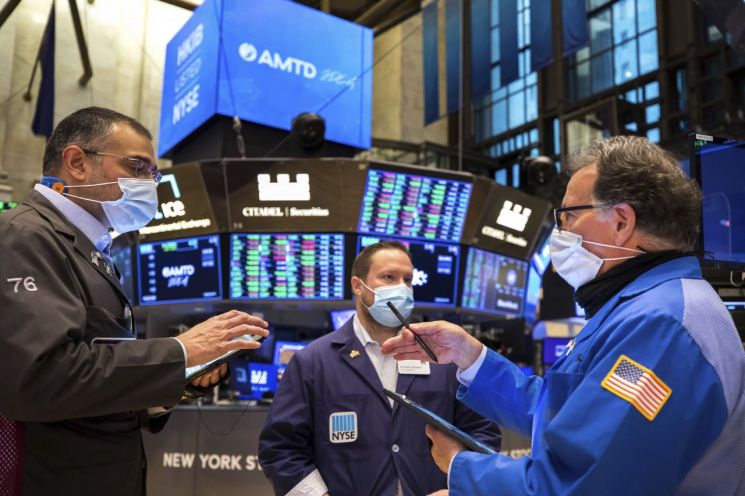 (New York AP=Yonhap News) On the 20th (local time), traders were working on the floor of the New York Stock Exchange (NYSE) in New York, USA. On this day, the New York stock market closed lower as selling pressure centered on technology stocks continued. The Dow Jones Industrial Average fell 0.89%, and the Standard & Poor's (S&P) 500 index dropped 1.1%. The technology-focused Nasdaq index rose more than 2% at one point during the session but closed down 1.3% at 14,154.02.
[Asia Economy Reporter Minwoo Lee] 'Seohak Gaemi' investors who invest in overseas stocks have already purchased more than 2 trillion won worth of U.S. stocks this year after the sharp decline at the beginning of the year. As there is still a possibility of increased volatility, analysts suggest more cautious investment is necessary.
According to the Korea Securities Depository's Securities Information Portal on the 23rd, domestic investors have net purchased U.S. stocks worth $1.71769 billion (approximately 2.0484 trillion won) as of the 21st of this year.
By stock, the most purchased was the exchange-traded fund (ETF) 'ProShares UltraPro QQQ' (PROSHARES ULTRAPRO QQQ). This single item was net purchased at $374.28 million (446.3 billion won).
Next, investors focused on large tech stocks and semiconductor-related ETFs such as Nvidia ($234.41 million), Microsoft ($180.77 million), 'Direction Daily Semiconductor Bull 3x Shares ETF' ($175.56 million), and Apple ($173.10 million). The 'Direction Daily Semiconductor Bull 3x Shares ETF' is an ETF that tracks the Philadelphia Semiconductor Index's returns at three times leverage.
The sharp decline in the U.S. stock market this year is interpreted as prompting bottom-fishing purchases. Among the major 20 countries (G20) stock indices, the U.S. S&P 500 index fell 7.73% as of the 21st this year, the second-largest drop after Russia's 12.15%. The Nasdaq index, which is tech-stock focused, dropped 11.99% compared to the beginning of the year.
Concerns that the U.S. Federal Reserve (Fed) will accelerate its tightening measures have acted as a negative factor. The market expects the Fed to raise interest rates four times this year to curb inflation. Consequently, the U.S. 2-year Treasury yield surpassed 1% for the first time since February 2020.
As a downtrend is expected for the time being, concerns about losses among domestic investors in U.S. stocks, so-called 'Seohak Gaemi,' are growing. The amount of U.S. stocks held by domestic investors decreased by 7.3%, from $67.77871 billion (80.9 trillion won) at the end of last year to $62.8154 billion (75 trillion won) as of the 20th. The holding amount reflects market prices and indicates that despite net purchases by domestic investors, the stock valuation has decreased.
Kim Ilhyuk, a researcher at KB Securities, said, "Since the mid- to long-term supply and demand environment is not very positive, the probability of a strong rebound is low, so investors should avoid chasing purchases hastily during short-term market rebounds." He added, "If concerns about stronger tightening than the market expects ease at next week's Federal Open Market Committee (FOMC) meeting, long-term funds may flow in with expectations of limited further declines. However, due to ongoing concerns about wage increases, the Fed is unlikely to slow the pace of tightening."
© The Asia Business Daily(www.asiae.co.kr). All rights reserved.

![User Who Sold Erroneously Deposited Bitcoins to Repay Debt and Fund Entertainment... What Did the Supreme Court Decide in 2021? [Legal Issue Check]](https://cwcontent.asiae.co.kr/asiaresize/183/2026020910431234020_1770601391.png)