Gyeongbuk Province Transforms Rural Areas into Healing Spaces through Advanced Industries like White Agriculture
[Asia Economy Yeongnam Reporting Headquarters reporters Kim Yong-woo and Kim Gwi-yeol] Gyeongbuk Province has declared an ‘Agricultural Great Transformation’ to industrialize agriculture into a high-tech industry.
As the 4th industrial technologies represented by big data and artificial intelligence (AI) become widespread, the agricultural sector is also entering a period of transformation, and Gyeongbuk Province’s declaration in the New Year work report has drawn attention.
On the 23rd, Gyeongbuk Province announced plans to strengthen agricultural competitiveness by incorporating 4th industrial technologies into existing agriculture and to transform rural areas from mere residential spaces into places that create new value.
The slogan, ‘Agriculture as a high-tech industry, rural areas as healing spaces coexisting with cities,’ reveals the direction of the great transformation that Gyeongbuk Province aims for.
In agricultural production, advanced convergence technologies will be the basis for expanding ‘smart farms,’ ‘plant factories,’ and ‘precision agricultural equipment.’ They will focus on nurturing so-called ‘white-collar farmers’ who professionally operate these technologies and respond to climate change.
In distribution and consumption, they plan to secure a new concept distribution network centered on demand by cooperating with local public delivery apps, thereby establishing a dense distribution network that directly connects producers and consumers.
In rural spaces, they will reset the concept beyond mere settlement by spreading healing agriculture and fully launching healing work that combines work and leisure, transforming rural areas into spaces that create new industrial value.
To lead the agricultural great transformation, Gyeongbuk Province will open the path centered on four major core tasks, aiming to industrialize agriculture into a high-tech industry and make rural areas healing spaces by 2030.
They plan to raise the smartization rate of Gyeongbuk agriculture to 50% by nurturing white-collar farmers.
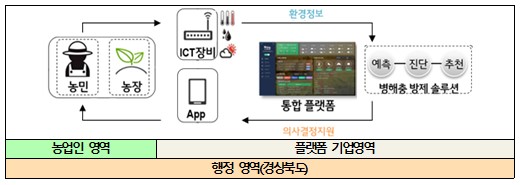
Gyeongbuk Province will build a data-based agricultural platform that enables productivity innovation by utilizing big data, 5G technology, and smartphone apps in existing agriculture.
They plan to nurture white-collar farmers, called ‘Gyeongbuk-type Smart Farmers,’ who skillfully handle this platform and produce agricultural products worth over 100 million KRW per item.
They envision raising the smartization rate of facility greenhouses, which was about 3.1% last year, to 500% by 2030.
They will implement 1.5 generation smartization by combining ICT equipment with sensors and control devices in existing vinyl greenhouses covering about 8,700 hectares and linking them to the data-based agricultural platform.
New farmers, including young farmers, will receive full support from agricultural funds such as the Rural Development Fund from the start to create 2nd generation smart farms with perfect environmental control.
To nurture white-collar farmers proficient in operating smart farms using ICT equipment and data, they will strengthen the Gyeongbuk Smart Farm Innovation Valley training program, completed at the end of last year. They also plan to rapidly train professionals through cooperation with smart farm platform companies.
Gyeongbuk Province expects that through nurturing white-collar farmers and introducing data-based agricultural platforms, they will go beyond benchmarking advanced agricultural countries like the Netherlands and systematically cultivate a new concept smart agricultural environment and workforce suited to local conditions.
Gyeongbuk Province will also build a data-based win-win distribution platform reflecting 4th industrial technologies.
With the spread of COVID-19, non-face-to-face consumption culture has become routine, and local governments have launched public delivery apps. Gyeongbuk Province and Daegu City have launched ‘Meokkebi’ and ‘Daeguro,’ respectively, expanding participating stores and members.
Gyeongbuk Province plans to build the nation’s first demand-centered direct transaction system called the ‘data-based win-win distribution platform’ using local public delivery apps.
They will establish a system that quickly supplies ingredients to stores registered on public delivery apps and supplies fresh and affordable local food in small quantities to members. This strategy aims to overcome growth limits of existing public distribution networks and create a win-win system that increases member satisfaction and usage rates of public delivery apps.
The initial delivery system currently being planned is a triangular cooperation system among local food direct stores, public delivery apps, and regional delivery specialists. After a pilot project, they plan to expand it mainly in urban areas depending on consumer satisfaction.
They will also create a ‘Food Valley’ near the new airport that can simultaneously handle agricultural food development, processing, and logistics, establishing a system that allows excellent local agricultural products to be quickly exported overseas.
Gyeongbuk Province plans to set the standard for future public distribution networks through the triangular distribution network of public delivery apps, Saeso, and Food Valley.
They also have plans to turn climate change into an opportunity by fostering subtropical crops.
Gyeongbuk is the largest domestic production area, accounting for 31% of the nation’s fruit production and serving as a vitamin warehouse, but climate change such as global warming is expected to bring significant changes to Gyeongbuk’s fruit industry.
Seeing climate change as an opportunity, Gyeongbuk Province established the ‘5-Year Comprehensive Plan for Fostering Subtropical Crops in Gyeongbuk’ last year. They completed preliminary procedures such as enacting the ‘Gyeongsangbuk-do Subtropical Agriculture Promotion and Support Ordinance’ to provide support grounds for farmers.
Starting this year, they will begin creating three specialized subtropical crop complexes (each over 1 hectare) grouped by region for the first time in Gyeongbuk. By 2025, they plan to invest 28.5 billion KRW to create a total of 19 specialized complexes to actively respond to climate change.
Rural areas will transform from residential spaces into healing spaces.
Gyeongbuk Province plans to innovate rural spaces, which have been interpreted as limited to production and residential spaces, into healing spaces where leisure, tourism, healing, care, culture, and welfare are harmoniously combined.
They will use 20 healing farms established by the province by region and the rural integrated care farm valley, currently preparing for a central government contest this year, as innovation hubs for change.
They plan to expand the healing project throughout Gyeongbuk, develop programs and content linked to regionally specialized resources and environments, and nurture related professionals, turning healing agriculture, which has so far been limited to simple agricultural activities, into a high value-added industry.
Breaking away from existing experience villages, they will introduce the nation’s first Healing-Work, where whole families can stay and enjoy work and vacation together, creating a new concept space that can coexist with cities.
Healing-Work is a concept that provides network facilities and workspaces in leisure villages, which will greatly help companies that require telecommuting and seek creative and flexible work environments.
Gyeongbuk Province plans to continuously expand healing agriculture and the new concept Healing-Work to transform rural areas beyond the concepts of residence and production into healing spaces that coexist with cities.
An eco-friendly smart livestock project will also be implemented.
Livestock farming, which has grown into an important industry for the national economy, currently causes conflicts with local residents and society due to odor and environmental pollution.
Gyeongbuk Province plans to introduce ESG management into livestock farming to establish a sustainable livestock environment in Gyeongbuk.
To create a clean livestock environment with residents, the province will build its own livestock big data platform to establish a Gyeongbuk-type eco-friendly smart livestock system, and will also work on reducing greenhouse gases and removing odors in the livestock sector through the development and industrialization of low-methane mixed feed.
They plan to revitalize material industries such as solid fuel, biochar, and green hydrogen using livestock manure, converting livestock waste into eco-friendly energy resources and returning them to the local community.
Kim Jong-su, Director of the Agriculture, Livestock, and Distribution Bureau of Gyeongbuk Province, said, “In the era of the 4th Industrial Revolution dominated by big data and artificial intelligence, agriculture must change or it will inevitably lose competitiveness,” adding, “We will transform Gyeongbuk agriculture into digital agriculture and create an environment that can lead change first.”
© The Asia Business Daily(www.asiae.co.kr). All rights reserved.

















