Rapid Increase in Traffic at Jeju Airport Due to COVID-19
Domestic Traffic Up 18.9%, Reaching an All-Time High
International Traffic Rises Only 1.8% Despite Recovery Efforts
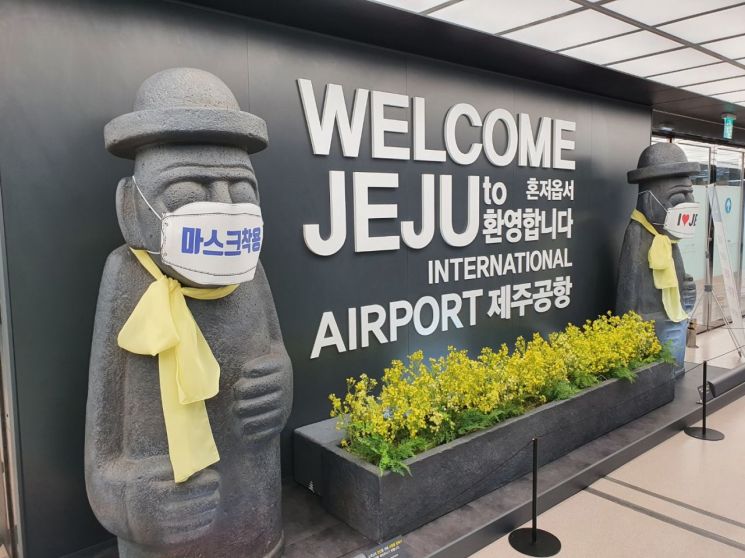
Last year, the total number of flights using South Korea's airspace was approximately 465,000. Domestic traffic surged by 18.9% compared to the previous year, but international flights increased by only 1.8% due to the impact of COVID-19. Jeju Airport was identified as the airport with the highest number of flights.
The Ministry of Land, Infrastructure and Transport announced the results of the "2021 Air Traffic Volume" survey on the 23rd. The total air traffic volume reached about 465,000 flights, marking a 10.8% increase compared to the previous year. This averages to about 1,275 flights per day.
The expansion of domestic routes connecting regional airports centered around Jeju Airport, the commencement of operations by new airlines, and increased traffic at regional airports such as Yangyang and Yeosu led to an 18.9% increase in domestic traffic compared to the previous year, setting a record high.
On the other hand, international traffic increased by only 1.8% compared to the previous year, despite recovery efforts such as the promotion of travel bubbles and increased demand for cargo transport, due to the spread of COVID-19 variants like Delta and Omicron.
However, following the transfer of control of the Jeju southern air corridor (China-Japan) on March 25 last year, air traffic between China and Japan, which had not previously been counted as South Korean traffic, was newly included as overflight traffic. As a result, overflight traffic increased 2.8 times compared to the previous year.
Jeju Airport was the busiest airport in South Korea last year due to the expansion of domestic flights and increased demand for domestic travel. The average number of flights per day was 455, surpassing Gimpo Airport (421 flights) and Incheon Airport (418 flights).
Before 2015, the ranking was Incheon Airport, Gimpo Airport, and Jeju Airport, but from 2016 to 2020, it changed to Incheon Airport, Jeju Airport, and Gimpo Airport. Last year, the ranking shifted to Jeju Airport, Gimpo Airport, and Incheon Airport, with Jeju Airport taking the top spot.
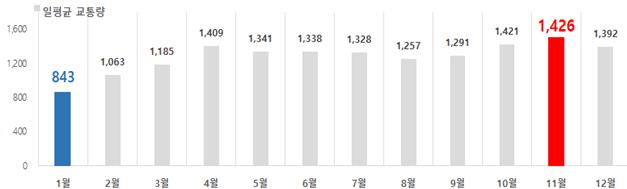 Average Daily Air Traffic Volume by Month in 2021 (Data Provided by the Ministry of Land, Infrastructure and Transport)
The busiest air route in South Korea was the "Seoul-Jeju·Southeast Asia" route, with an average of 545 flights per day, a 21.7% increase compared to the previous year. This accounted for about 43% of all flights.
The highest average monthly traffic was recorded in November, with an average of 1,426 flights per day, and the highest daily traffic was on Friday, October 15, with 1,599 flights.
Jang Chang-seok, Director of the Aviation Traffic Division at the Ministry of Land, Infrastructure and Transport, said, "Last year, South Korea's air traffic volume showed a gradual recovery compared to the sharp decline in 2020 due to COVID-19," adding, "We will continue to monitor air traffic trends and thoroughly manage and supervise air traffic control facilities to provide safe and efficient air traffic services."
© The Asia Business Daily(www.asiae.co.kr). All rights reserved.