At the Game Special Committee, 'Gender' Removed
Childcare Pledges Categorized as 'Living Pledges'
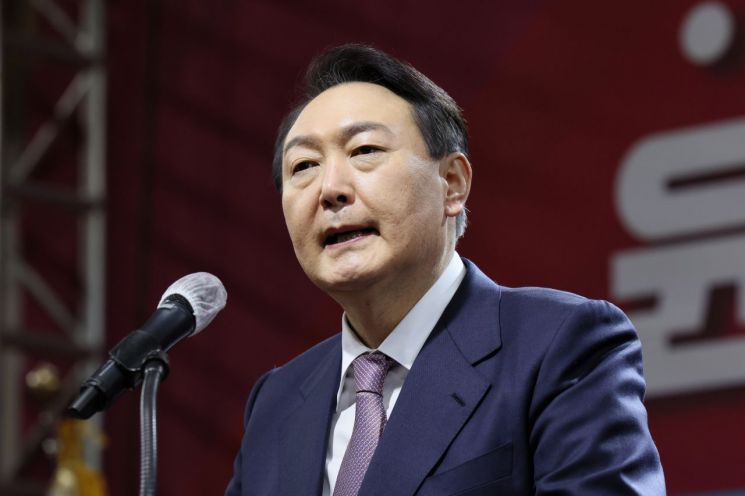
[Asia Economy Reporter Park Jun-yi] As Yoon Seok-yeol, the People Power Party's presidential candidate, continues his policy moves following the reorganization of the election campaign headquarters, there are criticisms that he is relatively downplaying policies for female voters. This is because, while he continues to focus on targeting the votes of the 2030 generation, especially the ‘I-dae-nam (men in their 20s)’, the emphasis on policies aimed at women is being reduced.
After the reorganization of the campaign headquarters, Candidate Yoon has consecutively introduced youth-tailored policies. He attracted attention by unveiling pledges such as ‘abolishing the Ministry of Gender Equality and Family’ and ‘raising soldiers’ monthly pay to 2 million won’ in the form of ‘one-line messages,’ and then reinforced his stance by announcing policies on gaming and virtual assets in a press conference format.
However, there have been ongoing criticisms that these policies are excessively skewed toward men in their 20s and 30s. When asked the same question at the New Year press conference on the 11th, Candidate Yoon denied this, saying, "I have never once said that I would target the 2030 generation to win their votes," and insisted that he is not focusing solely on men or youth. His explanation is that policies on military welfare and virtual assets are not only beneficial to certain groups, but most of these pledges concern issues that attract higher interest from men.
Alongside this, the People Power Party appears to be downplaying ‘women.’ The ‘Gender and Gaming Special Committee’ proposed by party leader Lee Jun-seok to Candidate Yoon’s side started as the ‘Gaming Special Committee’ without the ‘gender’ part, and it now comprehensively addresses issues relevant to the 2030 generation such as gaming, gender, and hair loss. Regarding this, Ha Tae-kyung, chair of the Gaming Special Committee, explained in a phone interview, "We handle various youth-related issues, and since there are so many, we included only gaming, which is a representative product."
The pledges follow the same pattern. The ‘Childcare Support’ pledge announced by Candidate Yoon on the 20th is effectively a policy targeting female voters but was released under the name ‘Living Policies’ along with year-end tax adjustments and pet policies. A policy official from the campaign headquarters explained, "The intention is not to group women’s policies under ‘women’ but to present policies for both men and women," adding, "Policies for female voters will be released as a series, including childcare, women’s safety, and measures against career interruptions."
Candidate Yoon’s approach is interpreted as aiming to ‘eliminate gender distinctions and view issues from an integrated perspective,’ but there is a clear difference in the order and manner of announcements, showing a significant disparity in the emphasis on issues of interest to men versus women. This is understood to be because the votes of men in their 20s and 30s are recently seen as a crucial factor in recovering Candidate Yoon’s approval ratings. Highlighting ‘women’ too much could risk losing their votes.
Focusing on a specific demographic may temporarily boost approval ratings, but whether it leads to sustainable growth is uncertain. Park Sang-chul, a professor at Kyonggi University Graduate School of Policy, evaluated Candidate Yoon’s recent policies by saying, "Who would cheer for the abolition of the Ministry of Gender Equality and Family? Surely not women." He added, "If you choose only one side, you risk losing the votes of those who reject that strategy," and pointed out, "It is a time when ‘balance’ is needed rather than ‘divisive politics.’"
© The Asia Business Daily(www.asiae.co.kr). All rights reserved.