Social Distancing 'Gatherings of 6, Business Hours Until 9 PM' Applied for 3 Weeks Until Next Month 6
Half of Office Workers "Will Visit Hometown This Lunar New Year Holiday"
Health Authorities "Please Refrain from Meeting Family and Relatives"
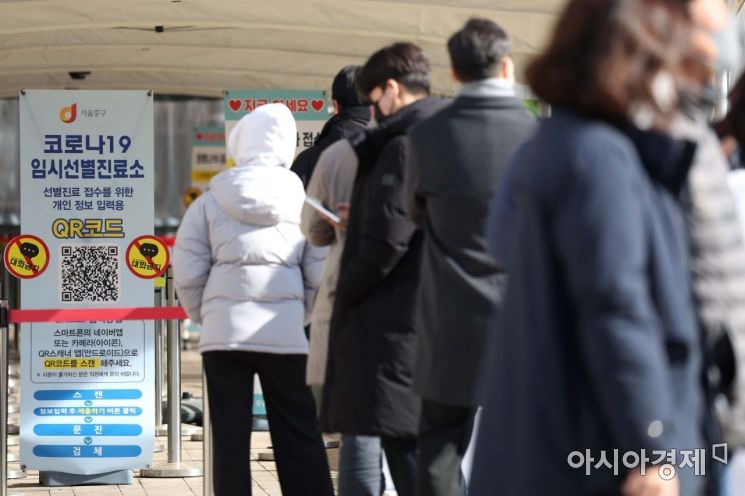 On the 21st, citizens are lining up at a temporary screening clinic in front of Seoul City Hall. The photo is unrelated to specific expressions in the article. Photo by Moon Honam munonam@
[Asia Economy Reporter Heo Midam] "I couldn't go home last year because of COVID-19, but this time I have to go home.", "I'm afraid I might spread COVID-19."
Recently, as the Lunar New Year holiday approaches, more citizens are contemplating whether to return to their hometowns. Since the holiday only comes twice a year, some citizens choose to visit their families, while others have decided to forgo visiting their hometowns to prevent the spread of the rapidly spreading Omicron variant. Currently, health authorities are recommending refraining from visiting hometowns to stabilize COVID-19.
Jeon (26), an office worker living alone in Mapo-gu, Seoul, recently booked a bus ticket to his hometown, Busan. Jeon said, "It's difficult to visit my hometown while working unless it's during Lunar New Year or Chuseok. Since the distance to my hometown is far, I have to use annual leave to visit, but I feel pressured by my boss to do so."
He added, "Last year, I couldn't visit my hometown during the holidays because of COVID-19. But since I don't know when COVID will end and it's been a long time since I saw my relatives, I decided to go home after all."
Meanwhile, about half of office workers plan to return to their hometowns during this Lunar New Year holiday. According to a survey by Saramin of 2,044 office workers about their 'Lunar New Year holiday plans,' 50.6% answered that they would 'return home.' This is a 14 percentage point increase compared to last year's survey result (36.6%).
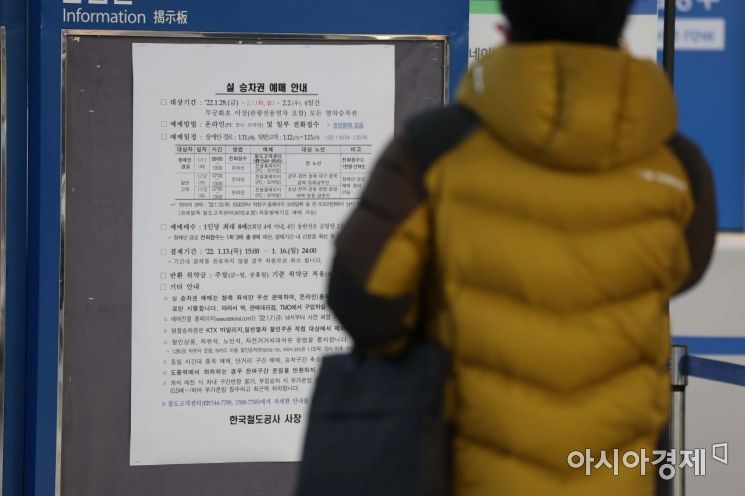 On the first day of non-face-to-face reservation for 2022 Lunar New Year train tickets, related notices were installed at the Seoul Station ticket office on the 11th. The photo is unrelated to specific expressions in the article. Photo by Moon Honam munonam@
On the other hand, among the 741 respondents who will not visit their hometowns during the Lunar New Year holiday, the top reason was 'concern about moving and gathering of relatives due to COVID-19' (65.5%, multiple responses allowed). This was followed by 'wanting to rest comfortably' (31.2%), 'burden of expenses' (16.2%), and 'worry about traffic chaos' (8.8%).
Another office worker, Park (25), plans to visit his hometown before the Lunar New Year holiday to see his relatives. Park said, "Many people go to their hometowns during the holidays, so I was worried about getting infected with COVID-19 on public transportation. I plan to see my family and relatives before the holiday."
He added, "It's a pity not to feel the Lunar New Year atmosphere at home, but it can't be helped. I hope COVID ends this year so that next year I can spend the holiday with peace of mind."
Among them, some were worried about possibly transmitting COVID-19 to their parents as the virus spreads mainly in the metropolitan area. University student Lim (24) said, "People in their 20s and 30s are mostly asymptomatic or have mild symptoms, so many don't realize they have COVID-19. I decided to spend this Lunar New Year holiday alone because I would feel guilty if I unknowingly infected my parents by going home."
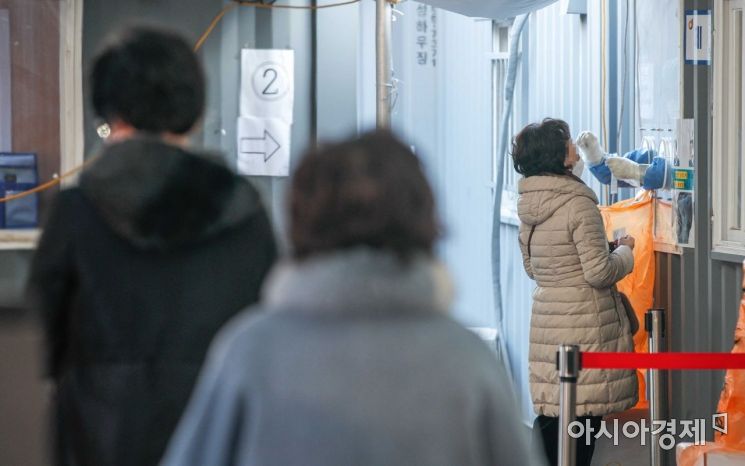 On the 21st, citizens visiting the temporary screening clinic at Sogang University Station in Mapo-gu, Seoul, are undergoing tests. Photo by Jinhyung Kang aymsdream@
Recently, as the Omicron variant of COVID-19 spreads rapidly, citizens' anxiety is increasing. The Central Disease Control Headquarters announced that as of midnight on the 21st, there were 6,769 new confirmed cases, bringing the total to 719,269. There were 6,482 domestic cases and 287 imported cases. By region, 1,552 cases in Seoul, 2,431 in Gyeonggi, and 452 in Incheon, totaling 4,435 cases (65.5%) in the metropolitan area.
Given this situation, health authorities are currently recommending refraining from visiting hometowns during the Lunar New Year holiday. They forecast that if the spread of Omicron is not controlled during the holiday period at the end of this month and early next month, daily new cases could reach between 10,000 and 15,000 by the end of February.
As the spread continues, the government decided to maintain the current social distancing measures that limit restaurant and cafe operating hours to 9 p.m. until February 6. However, considering the hardship caused by prolonged strengthened measures, the limit on private gatherings will be adjusted from 4 to 6 people.
Prime Minister Kim Boo-kyum recently announced the extension of these distancing measures, saying, "We again ask you to refrain from visiting hometowns and meeting with family and relatives during this Lunar New Year holiday. We apologize to the public and ask for your participation and cooperation in quarantine for the safety of the community while hoping for a hopeful spring."
Meanwhile, the government expects the Omicron variant to surpass the Delta variant and reach a share of 80-90% after the Lunar New Year holiday.
Lee Ki-il, the first controller of the Central Disaster and Safety Countermeasures Headquarters, said at a regular briefing on the 21st, "An increase in confirmed cases is inevitable due to the dominance of Omicron. During the 1-2 weeks including this Lunar New Year holiday, Omicron will replace Delta and probably reach 80-90%."
He added, "To respond effectively to Omicron, limited quarantine and medical resources must be used efficiently. Instead of controlling the total number of confirmed cases, it is necessary to focus on rapid diagnosis and treatment of high-risk groups."
© The Asia Business Daily(www.asiae.co.kr). All rights reserved.

![User Who Sold Erroneously Deposited Bitcoins to Repay Debt and Fund Entertainment... What Did the Supreme Court Decide in 2021? [Legal Issue Check]](https://cwcontent.asiae.co.kr/asiaresize/183/2026020910431234020_1770601391.png)
















