3 Major Credit Rating Agencies' Outlook
Negative Outlooks Decrease Compared to Last Year
Upgrades in Construction, Shipping, and Steel Sectors
[Asia Economy Reporter Minji Lee] It has been found that the credit ratings of most companies have been on the rise since the COVID-19 pandemic. However, downward pressure on ratings is expected to increase in industries such as aviation, film, and hotels, which are experiencing prolonged difficulties.
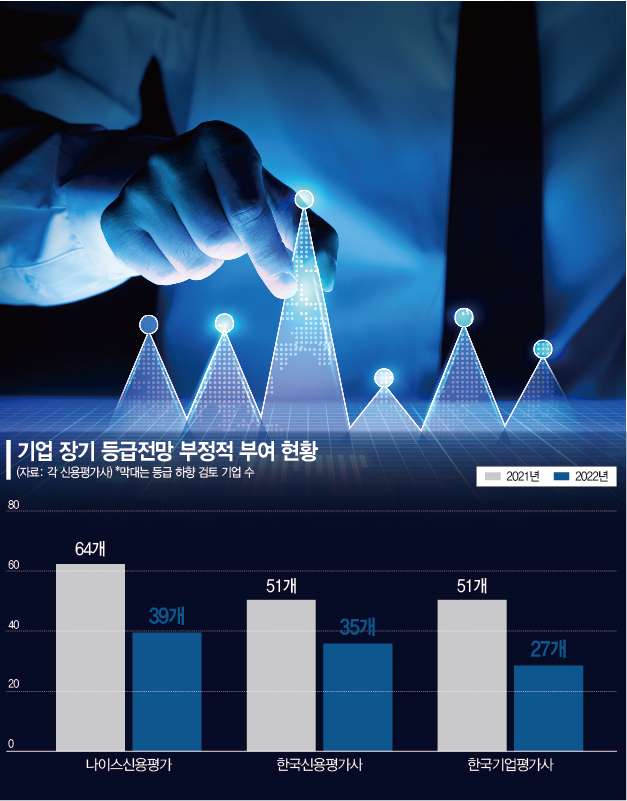
According to Korea Ratings on the 21st, among 501 companies that received long-term rating outlooks as of the end of last year, 27 companies (5.4%) were given a negative outlook. On the other hand, 29 companies (5.8%) received a positive outlook. In the previous year, 51 companies (10%) had negative rating outlooks, which was more than the 23 companies (4.8%) with positive outlooks, but this shifted to a positive outlook dominance within one year. Other credit rating agencies also saw a significant decrease in companies with negative outlooks. Korea Credit Rating reduced from 51 companies in 2020 to 35, and NICE Credit Rating decreased from 64 to 39.
Long-term rating outlooks indicate the future direction of ratings. Companies with positive outlooks may see their ratings upgraded by one notch during the regular credit rating season in April-May, while those with negative outlooks may see downgrades. Last year, due to active fiscal and monetary policies worldwide, the global economic recovery continued, strengthening the outlook for credit rating upgrades. Many companies already had their credit ratings upgraded. According to Korea Ratings’ evaluation, the ratio of companies with rating upgrades to downgrades was 1.3 times, a significant increase compared to 0.4 times last year. This surpasses the levels of 2018 (1.0 times) and 2019 (0.6 times).
This year, the construction, shipping, and steel sectors are expected to be candidates for rating upgrades. Despite strengthened real estate regulations, the construction sector is expected to benefit positively from a favorable housing market due to rising housing prices and reduced exposure to overseas construction risks. Korea Credit Rating upgraded the outlooks of Hanshin Engineering & Construction (BBB Stable → Positive) and GS Engineering & Construction (A Stable → A+ Stable), while NICE Credit Rating raised the ratings and outlooks of Daewoo Engineering & Construction (A- Stable → Positive) and Heunghwa (BBB Negative → Stable). The petrochemical and steel industries are predicted to maintain solid performance supported by the recovery in demand from upstream industries amid the strengthening global economic recovery. The shipping industry is benefiting from increased cargo volumes and the easing of global supply chain bottlenecks.
On the other hand, industries such as aviation, hotels, and auto parts, which have not returned to normal operations since COVID-19, are expected to continue facing downward rating pressure this year. For airlines, credit ratings of low-cost carriers (LCCs) may continue to decline until passenger demand recovers to pre-COVID-19 levels. Major carriers (FCCs) are posting strong results due to increased cargo demand, but ultimately, the direction of their ratings will depend on the recovery of passenger demand. Korea Credit Rating assigned a B rating with a downgrade review to T’way Holdings and gave negative outlooks to Korean Air (BBB Negative) and Hanjin KAL (BBB Negative). For customer-attracting facilities such as movie theaters and hotels, credit outlooks are expected to vary depending on the effectiveness of COVID-19 treatments.
Despite the recovery in finished car demand, auto parts companies are expected to face increased financial burdens due to semiconductor supply shortages and rising raw material prices. The semiconductor supply issue, which is key to credit recovery, is predicted to be resolved only in the second half of this year. Korea Ratings changed Kumho Electric’s rating outlook from ‘B- Stable’ to ‘Negative’ and assigned negative outlooks to Hanon Systems (AA) and Sungwoo Hitech (A-). Lee Kyunghwa, a research fellow at NICE Credit Rating’s Evaluation Policy Department, said, “Volatility in raw material prices, shortages in automotive semiconductor supply, and supply chain risks are major factors that could affect companies’ credit ratings this year. The hotel, aviation, and dining sectors, which rely on face-to-face consumption, and small to medium-sized auto parts companies with potentially high financial burdens will be key monitoring targets.”
© The Asia Business Daily(www.asiae.co.kr). All rights reserved.
![User Who Sold Erroneously Deposited Bitcoins to Repay Debt and Fund Entertainment... What Did the Supreme Court Decide in 2021? [Legal Issue Check]](https://cwcontent.asiae.co.kr/asiaresize/183/2026020910431234020_1770601391.png)