Gwangju, Jeonnam, Pyeongtaek, Anseong Limit PCR Test Eligibility... Quarantine Period Reduced from 10 to 7 Days
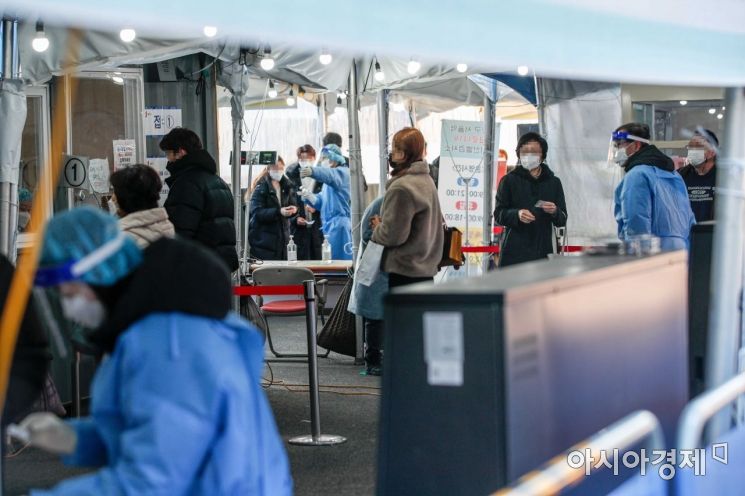 On the 21st, when 6,769 new COVID-19 cases were reported, citizens visiting the temporary screening clinic at Sogang University Station in Mapo-gu, Seoul, are waiting to get tested. Photo by Jinhyung Kang aymsdream@
As the detection rate of the Omicron COVID-19 variant in South Korea has surged to 47.1%, health authorities will prioritize implementing a new testing and treatment system centered on 'Omicron-dominant areas.' Starting from the 26th, in Gwangju, Jeonnam, Pyeongtaek, and Anseong, individuals under 60 years old or those without epidemiological links who show simple symptoms will undergo PCR testing only if they test positive through self-test kits or rapid antigen tests.
On the 21st, Lee Ki-il, the 1st Controller of the Central Disaster and Safety Countermeasures Headquarters (CDSCH), stated at a regular briefing, "To effectively respond to Omicron, we must efficiently utilize limited quarantine and medical resources. Instead of controlling the total number of confirmed cases, it is necessary to focus on rapid diagnosis and treatment of high-risk groups."
Simple Symptomatic Individuals Cannot Receive PCR... Rapid Antigen Test '5,000 KRW Consultation Fee'
Accordingly, from the 26th, the 'Omicron Response Quarantine Medical System' will be first applied in Omicron-dominant regions such as Gwangju, Jeonnam, Pyeongtaek, and Anseong. The Omicron variant has 2 to 3 times higher transmissibility compared to Delta, making it impossible to handle the current PCR testing capacity if confirmed cases surge.
Under the existing system, PCR tests at screening clinics are applied only to high-risk groups. High-risk groups are limited to ▲elderly aged 60 and above ▲those with epidemiological links ▲individuals with a doctor's note indicating the need for a COVID-19 test ▲and those who test positive via self-test kits or rapid antigen tests.
If one does not belong to the high-risk group, even if they visit a screening clinic, they cannot immediately receive a PCR test; PCR testing is only available if a self-test kit provided shows a positive result.
If symptoms are present and the individual visits a respiratory-specialized clinic, they will receive a professional rapid antigen test after a doctor's consultation. If positive, the institution will conduct a PCR test. While the test itself is free, the consultation fee is 5,000 KRW at clinics, which the patient must bear. This is the first instance of out-of-pocket expenses related to COVID-19 testing and treatment, which had previously been fully covered by health insurance.
For unvaccinated individuals, the negative confirmation certificate required to access facilities under the quarantine pass system will also be replaced by a negative result from a self-test kit or rapid antigen test conducted at screening clinics. However, the validity period will be shortened from the existing 48 hours to 24 hours. The certificate can be issued if the self-test kit is conducted under the supervision of screening clinic administrators or if a professional rapid antigen test is performed after a doctor's consultation at a respiratory-specialized clinic and the result is negative.
"Nationwide Omicron Detection Rate at 47%... Expected to Become Dominant Next Week"
There are a total of 43 respiratory-specialized clinics conducting testing and treatment: 23 in Gwangju, 15 in Jeonnam, 2 in Pyeongtaek, and 3 in Anseong. If a positive diagnosis is made at a clinic, non-face-to-face health monitoring will be conducted there. If other outpatient treatment needs arise, a system linking testing and treatment will allow patients to receive care at hospital outpatient centers.
Epidemiological investigations will also shift from the previous full-scale investigation policy to focusing on high-risk groups (priority testing groups) such as family members. The isolation period for vaccinated confirmed cases will be shortened to 7 days. Accordingly, from the 26th, vaccinated confirmed cases will have their isolation lifted immediately after 7 days during home treatment or other treatment processes.
Lee said, "The dominant strain is expected next week. The current 7,000 confirmed cases have not yet been reached. Around next Wednesday, we expect to see 7,000 cases." He added, "For other regions where the testing system transition is currently being implemented, it will inevitably be applied in due course."
He continued, "This week, the Omicron variant's share reached 47.1%. It is expected to become the dominant strain next week," adding, "We will first apply this system in four regions and gradually expand it considering the Omicron quarantine situation and the medical community's preparedness."
© The Asia Business Daily(www.asiae.co.kr). All rights reserved.