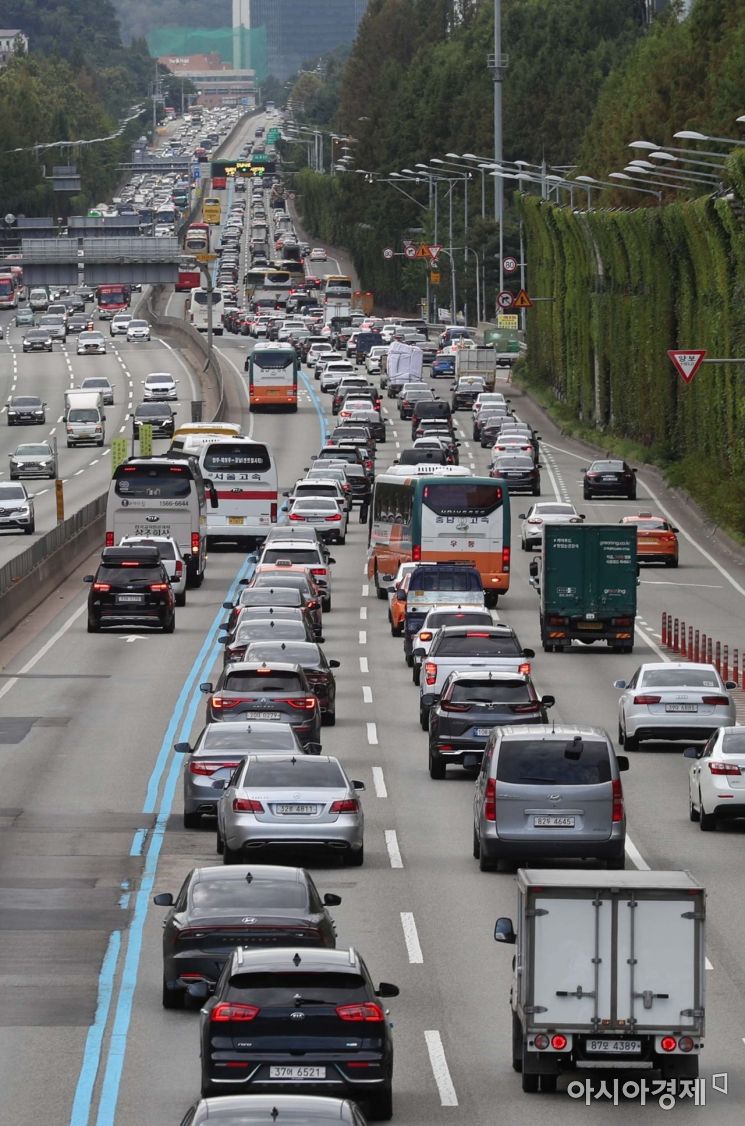
 On September 17, one day before the Chuseok holiday, vehicles were lined up moving on the southbound lanes of the Gyeongbu Expressway near Jamwon IC in Seocho-gu, Seoul. According to the Korea Transport Institute, the average daily traffic volume during this holiday is expected to increase by 3.5% compared to last year's Chuseok and by 31.5% compared to this year's Seol holiday. Since most people are expected to use private cars, highway congestion is anticipated. The return trip to hometowns is expected to be most congested on the morning of September 20, one day before Chuseok, and the return trip home is expected to be most congested on the afternoon of September 21, the day of Chuseok. Photo by Moon Honam munonam@
[Asia Economy Reporter Jeong Dong-hoon] Bae Gyuseong (35), who is from Jinju, Gyeongnam, decided to spend the Lunar New Year holiday at his home in Seoul with his parents this year. Since he couldn't book either bus or KTX tickets, his parents decided to make a 'reverse return trip.' Bae said, "All transportation options during key times like Friday evening and Saturday morning, when the holiday begins, were sold out, so I gave up on going home. I couldn't visit during last Chuseok either, but I thought I must spend this Lunar New Year together, so we decided to meet in Seoul."
Lee Jeongpyo (33) couldn't get a bus ticket to his hometown in Gyeongnam, so he rented a car to head home. Lee said, "Due to COVID-19, the number of route buses has been reduced to about 5-6 times a day, making it harder to go home. I couldn't get tickets for additional buses either, so this Lunar New Year, I decided to carpool with friends living nearby to go home."
As the Lunar New Year holiday approaches, those who couldn't get KTX or bus tickets are resorting to desperate measures like reverse return trips or carpooling while waiting to reunite with family. With reduced travel due to COVID-19, the frequency of buses and trains has decreased, and with an increase in domestic travelers during the holiday, it has become difficult to get KTX and bus tickets for peak times. Citizens facing their third Lunar New Year since COVID-19 are lamenting the arduous journeys home and back. As of the morning of the 21st, all KTX tickets departing Seoul Station for Busan on the 29th, when the holiday begins, have been sold out. On the 28th, the day before the holiday, no KTX tickets were available after 9:30 a.m. For express buses, some seats are available during late-night hours, but tickets for peak times are hard to find.
According to Korea Railroad Corporation (Korail), based on the results of 100% non-face-to-face Lunar New Year ticket reservations conducted over three days starting the 11th, Korail expects the highest number of travelers using trains to be on the 29th. The downward-bound reservation rate was 83.1% (Gyeongbu Line 85.9%, Honam Line 94.2%). The return reservation rate was highest on the 2nd of next month for the upward-bound line at 85.8% (Gyeongbu Line 90.0%, Honam Line 94.8%).
Health authorities have urged people to refrain from traveling to prevent the spread of COVID-19 during the Lunar New Year holiday. However, with a five-day holiday and an increase in both return and outbound travelers as well as domestic tourists, using public transportation has become even more difficult. Jang Seongmin (31), whose hometown is Mokpo, Jeonnam, said, "During last Chuseok, I took the KTX home, but many people seemed to be tourists rather than returning home. Since only window seats were sold to reduce the number of travelers going home and there were many tourists, going home has become even tougher."
© The Asia Business Daily(www.asiae.co.kr). All rights reserved.

![User Who Sold Erroneously Deposited Bitcoins to Repay Debt and Fund Entertainment... What Did the Supreme Court Decide in 2021? [Legal Issue Check]](https://cwcontent.asiae.co.kr/asiaresize/183/2026020910431234020_1770601391.png)