Ministry of Science and ICT Announces Government-wide Joint 'Metaverse New Industry Leading Strategy'

[Asia Economy Reporter Eunmo Koo] The government has unveiled a blueprint to secure leadership in the metaverse (extended virtual world) sector, which is gaining attention as a future industry in the global IT industry. The government plans to focus on creating a sustainable metaverse ecosystem based on public-private cooperation, actively supporting collaboration between companies, technology development, and regulatory innovation so that companies can challenge new types of platform businesses and compete with global enterprises.
On the 20th, the Ministry of Science and ICT, together with related ministries including the Ministry of Culture, Sports and Tourism, Ministry of Education, Ministry of the Interior and Safety, Ministry of Trade, Industry and Energy, Ministry of SMEs and Startups, and the Korea Communications Commission, announced the ‘Metaverse New Industry Leading Strategy’ at the 53rd Emergency Economic Central Countermeasures Headquarters meeting to respond to the economic and social changes brought by the metaverse and prepare for the future.
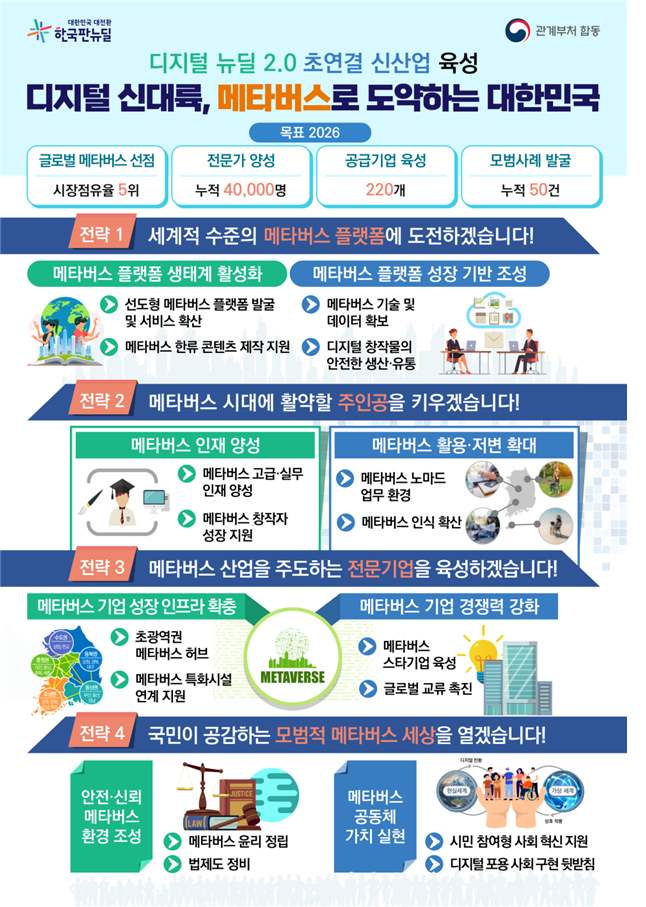
This strategy is the first comprehensive plan established at the pan-government level to foster ultra-connected new industries under Digital New Deal 2.0, consisting of four pillars: ▲challenging world-class metaverse platforms ▲training metaverse talent ▲fostering metaverse specialized companies ▲creating a safe and trustworthy metaverse environment. Through this, the government aims to achieve goals such as ranking 5th in the global metaverse market share, training 40,000 experts, and nurturing 220 supply companies by 2026.
First, the government will discover and support new types of metaverse platforms differentiated from existing platforms in various areas such as daily life and economic activities. At this time, creative and innovative platform projects based on private sector demand will be identified, focusing on creating a sustainable ecosystem where creators can produce content and generate revenue. In addition, the government plans to support the development of five core technologies including digital humans and hyper-realistic media to realize future metaverse services and establish a mid- to long-term metaverse research and development (R&D) roadmap to secure technological competitiveness in the metaverse.
Efforts will also be made to train talent who will play active roles in the metaverse era. A Metaverse Academy will be newly established to train 180 practical experts this year, and practical competency enhancement education will be provided to 700 current employees and prospective hires. Furthermore, support will be given within the year to establish and operate a convergent graduate school uniting metaverse element technologies and humanities and social sciences departments from four-year universities, and a ‘Metaverse Lab’ for master's and doctoral students will be operated to assist in metaverse solution development, startup, and commercialization.
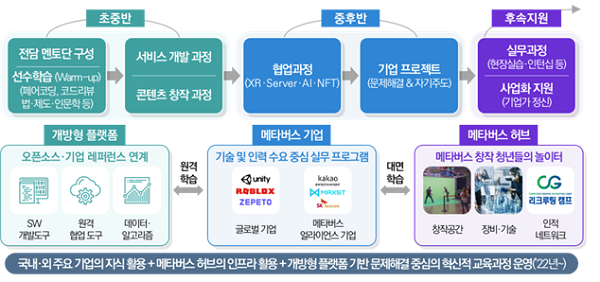
Specialized companies leading the metaverse industry will also be fostered. First, the growth infrastructure for metaverse companies will be expanded. The ‘Metaverse Hub (Pangyo)’ as an integrated support base for metaverse companies will be expanded to four major super metropolitan areas, providing demonstration facilities necessary for metaverse service development and spaces for company growth and talent training. Along with this, specialized facilities such as metaverse and hologram content production and demonstration, quality improvement of XR (extended reality) materials, parts, and equipment companies’ products, and infrastructure for commercialization of XR device finished products will be linked and supported.
Moreover, to strengthen the competitiveness of metaverse companies, promising companies with global competitiveness will be discovered and supported with one-stop services including technology development, demonstration, and commercialization to grow into unicorn companies. A metaverse fund will be established to support mergers and acquisitions (M&A) activation, and investments in metaverse-related ventures and startups will be promoted using resources from the Smart Korea Fund for non-face-to-face sectors and the Korean New Deal policy fund. Co-growth will also be supported by building a ‘K-Metaverse Global Network’ among domestic platform companies, local content companies, and universities centered on overseas strategic bases.
Finally, a safe and trustworthy metaverse environment will be created. First, ‘Metaverse Ethical Principles’ will be established as autonomous norms, and specific ethical principle implementation guidelines will be derived and dissemination plans prepared. Along with this, principles of self-regulation, minimal regulation, and proactive regulatory innovation will be established to promote innovation and social acceptance of metaverse platforms. A pan-government consultative body will be formed and operated to study legislative improvements related to unethical and illegal acts, digital assets, copyrights, and to review and improve related regulations.
Minister of Science and ICT Hyesook Lim stated, “Through this strategy, we will closely cooperate with related ministries to ensure that Korea can emerge as a global leader in the metaverse by steadily implementing various support measures such as revitalizing the industrial ecosystem, talent training, fostering specialized companies, and regulatory innovation.”
© The Asia Business Daily(www.asiae.co.kr). All rights reserved.