All 5 Major Commercial Banks Apply Full Increase in Deposit and Savings Interest Rates
Loan Rates Likely to Rise Later... "Narrowing the Loan-Deposit Rate Gap Is Difficult"
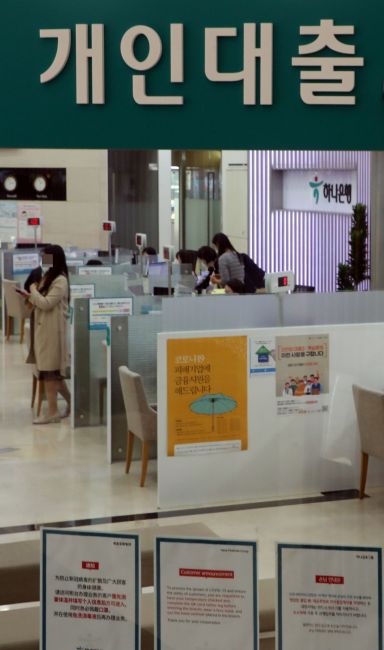
[Asia Economy Reporter Park Sun-mi] Although the five major commercial banks have fully applied the increased interest rates on savings and time deposits, it is expected to be difficult to narrow the loan-deposit interest rate spread (loan interest rate minus deposit interest rate) due to the rapid rise in loan interest rates. While putting money into bank time deposits still yields a meager interest rate in the 1% range, the interest rate on unsecured loans is about to surpass 5% per annum, raising concerns that banks will continue to profit excessively.
According to the banking sector on the 20th, all five major banks?KB Kookmin, Shinhan, Hana, Woori, and NH Nonghyup?have reflected the Bank of Korea’s 0.25 percentage point base rate hike by raising the interest rates on savings and time deposit products by up to 0.4 percentage points. The fastest banks began applying the increases from the 17th, and even the slowest have applied them as of today. This is a deposit interest rate increase larger than the base rate hike.
However, banks have applied the 0.4 percentage point increase only to a few products, and the rate hikes vary by product, so most remain close to the base rate increase level. Except for some high-interest special promotional products, regular time deposits generally offer interest rates in the 1% range, and installment savings accounts are in the 2% range.
When the base rate rises, savings and time deposit rates increase first, followed by loan interest rates after a time lag to reflect the rise in funding costs. Therefore, loan interest rates are likely to rise further soon. Currently, mortgage loan rates at commercial banks have exceeded the mid-5% range as the COFIX (Cost of Funds Index), which affects variable mortgage loan rates, has risen rapidly, and unsecured loan rates are also about to break through the 5% per annum mark. Since the COFIX rate reflects the cost banks incur to raise funds through savings, time deposits, and bank bond issuance, it rises along with deposit interest rates.
The loan-deposit interest rate spread has already been widening during this rate hike period. According to the latest data from the Bank of Korea, as of November last year, the loan-deposit interest rate spread based on bank balances was 2.19 percentage points, expanding by 3 basis points from the previous month. The spread, which was 2.05% at the end of 2020, increased to 2.14% in September 2021, 2.16% in October, and 2.19% in November.
A representative from a commercial bank explained, "Since loan interest rates are already rising rapidly, and loan rates inevitably rise as deposit rates increase, it is structurally difficult to narrow the loan-deposit interest rate spread gap for the time being." Because banks consider maintaining a certain level of net interest margin when setting savings and time deposit rates, a partial increase in deposit rates alone does not lead to a noticeable easing of the loan-deposit interest rate spread for consumers.
The problem is that there is no clear breakthrough to resolve this, so the increased burden on consumers due to the widening loan-deposit interest rate spread and the additional profits for financial companies may continue for the time being. Although financial authorities are closely monitoring the trend of the loan-deposit interest rate spread, it is practically difficult to interfere with banks’ interest rate decisions, which are left to their discretion.
Eventually, the political sphere has even proposed pledges to address the expanded loan-deposit interest rate spread. Yoon Seok-yeol, the presidential candidate of the People Power Party, announced through his "Heart-throbbing Pledge" yesterday that "commercial banks will be required to periodically disclose the gap between deposit and loan interest rates," and "if the loan-deposit interest rate spread rises sharply following changes in the base rate, we will closely examine whether there are elements of collusion to protect financial consumers."
© The Asia Business Daily(www.asiae.co.kr). All rights reserved.