"Children often find it difficult to distinguish from food aversion"
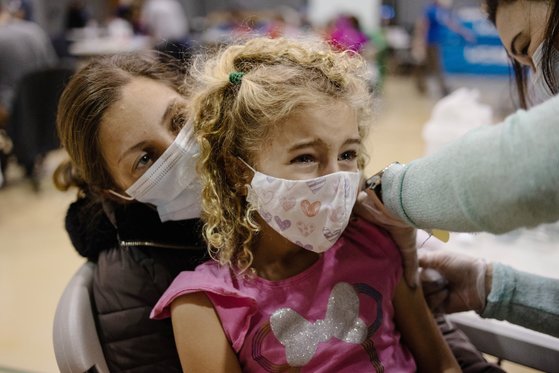 A 6-year-old girl receiving a COVID-19 vaccine in Lansdale, Pennsylvania, USA. Not related to the article. Photo by Yonhap News.
[Asia Economy Reporter Na Ye-eun] A study has revealed that children infected with COVID-19 may experience "parosmia" (a distortion of the sense of smell) as a side effect.
According to CNBC, on the 18th (local time), experts in the UK warned that "children who have recovered from COVID-19 may experience parosmia, which can make it difficult for them to eat food."
Parosmia is a common side effect of COVID-19, and so far, it is known that 250,000 adults in the UK have suffered from parosmia after testing positive for COVID-19. The media reported, "These people may smell rotten cabbage from a lemon or gasoline from chocolate."
Experts pointed out, "In the case of children, unlike adults, it is difficult for them to express themselves, making it hard to distinguish between parosmia and food aversion."
Professor Carl Philpott, a leading ENT specialist at the University of Norwich Medical School in the UK, and the UK charity Fifth Sense have released guidelines to help parents and healthcare professionals distinguish between parosmia and food aversion in children.
Professor Philpott explained, "Parosmia causes our olfactory system to respond only to certain components when smelling," adding, "Since COVID-19 swept through schools last September, awareness has grown that children can also experience these symptoms."
He continued, "It is especially difficult to identify parosmia in children who already avoid certain foods or have autism," and added, "We want to share more information with healthcare professionals about this issue so they can recognize that these symptoms may indicate a bigger problem."
Professor Philpott and Fifth Sense advised, "To determine if children are experiencing parosmia, it is important to listen carefully to what they say," and "For parents, keeping a record of the types of foods their children avoid when eating can be helpful."
Professor Philpott said, "Parents should encourage their children to eat foods with less odor, such as pasta and bananas, or foods with minimal smell but essential nutrients, like vitamins and milkshakes." He also instructed, "If all methods fail, try feeding the children food after blocking the smell."
Finally, he recommended, "To cure parosmia, use familiar-smelling foods to conduct 'smell training' with children," suggesting, "Have them smell eucalyptus, rose, cinnamon, chocolate, coffee, or lavender during olfactory training."
© The Asia Business Daily(www.asiae.co.kr). All rights reserved.