Rising Raw Material Prices and Shipping Freight Increase Costs
Union 1 Approaches Korean Confederation of Trade Unions...Stock Plunge and Industry-wide Disruptions in Case of Strike
[Asia Economy Reporter Ki-min Lee] For the first time since its founding 60 years ago, the number of union members in the Korean Metal Workers' Union (KMWU) branch at Hankook Tire, affiliated with the Korean Confederation of Trade Unions (KCTU), has surpassed the number of union members in the Korean Rubber Workers' Union under the Federation of Korean Trade Unions (FKTU), which was previously the No. 1 union. With the KMWU, known for its hardline stance, taking the forefront, conflicts between labor and management as well as inter-union disputes are expected to intensify. This is likely to negatively impact Hankook Tire's performance and stock price, raising concerns about shareholder losses.
According to Hankook Tire on the 19th, the KMWU branch at Hankook Tire, under the KCTU, demanded wage and collective bargaining negotiations for 2022 and stated that their union membership stands at 2,500. If this number is accurate, the FKTU-affiliated Rubber Workers' Union, which had about 4,000 members, has shrunk to around 2,100, increasing the likelihood of losing its status as the No. 1 union. An industry insider said, "With more union members on the KCTU side, it seems the KMWU will become Hankook Tire's representative union," adding, "Considering the KCTU's hardline nature, there are concerns about escalating strikes and intensified labor-management conflicts."
◆Inevitable Negative Impact on Performance Due to Hardline Union's Obstruction Risk= Amid ongoing rises in raw material prices and shipping freight rates, the emergence of a hardline union is highly likely to adversely affect this year's performance. Hankook Tire is already facing a very challenging business environment. Prices for key raw materials such as natural rubber, synthetic rubber, and carbon black have surged sharply. In the second quarter of last year, when the world was hit hard by COVID-19, prices per ton for natural rubber, synthetic rubber, and carbon black were $1,107, $974, and $184 respectively; by the third quarter of last year, these had risen to $1,659, $2,037, and $481 respectively. Shipping freight rates have also increased similarly. The Shanghai Containerized Freight Index (SCFI) stood at 5,094.36 points on the 14th of this month, more than 5.7 times higher than the 890.37 points recorded on April 3, 2020. Because tires are bulky and cannot be shipped with other cargo, securing a dedicated container is necessary, making additional costs unavoidable.
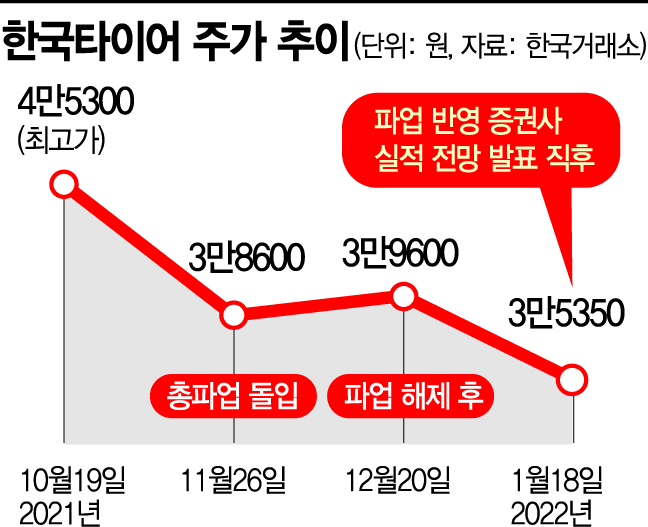
Meanwhile, the KCTU side, dissatisfied with last year's wage and collective bargaining agreement process, is refusing to accept the company's proposals and is preparing for a strike. According to financial information provider FnGuide, securities firms forecast that Hankook Tire's operating profit for the fourth quarter of last year will decline by 23.35% to 174.3 billion KRW compared to 227.6 billion KRW in the fourth quarter of 2020. The lowest forecast for fourth-quarter operating profit by securities firms is 80 billion KRW, about one-third of the previous year.
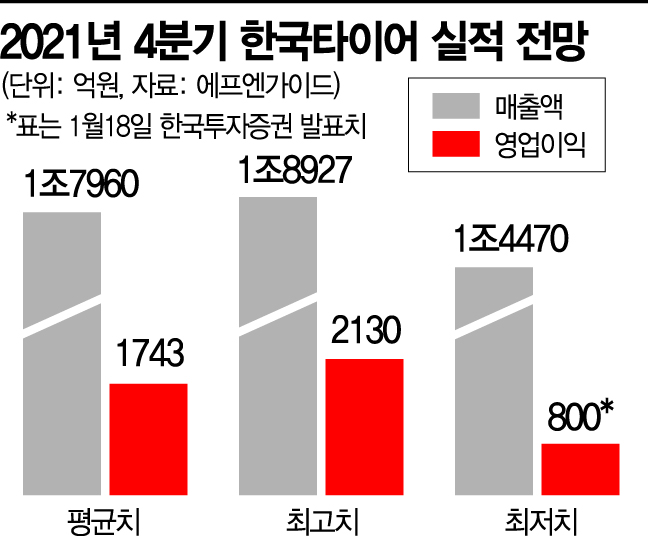
◆Significant Shareholder Losses Due to Sharp Stock Price Drop= If the hardline union gains dominance at Hankook Tire, shareholders are also expected to suffer losses. Hankook Tire's stock price hit a record high of 45,300 KRW on October 19 last year but plunged to 38,600 KRW on November 26 when the union launched a general strike. The stock price has shown no signs of recovery even after the strike ended.
Following the release of securities firms' earnings reports reflecting the damage caused by the strike the previous day, the stock price fell further to 35,350 KRW. Korea Investment & Securities reported that the Daejeon and Geumsan plants, which account for about 40% of Hankook Tire's total production, conducted a full strike for 26 days starting November 26 last year, disrupting about one-third of domestic factory shipments and causing an estimated 12% hit to fourth-quarter sales volume.
An industry insider said, "If another strike occurs at Hankook Tire, the business situation will worsen compared to the fourth quarter of last year, causing damage to shareholders," adding, "Moreover, since Hankook Tire, which accounts for 35% of domestic demand, halted operations during the previous strike, it disrupted tire supply to automakers, so the strike inevitably affects automobile manufacturers as well."
During the Hankook Tire strike, some automakers stopped requesting tire supplies from Hankook Tire to avoid production disruptions and urgently sought alternative brands. Additionally, some Hankook Tire dealerships suffered in December, the peak season for tire retail sales, due to winter tire stock shortages.
© The Asia Business Daily(www.asiae.co.kr). All rights reserved.

![User Who Sold Erroneously Deposited Bitcoins to Repay Debt and Fund Entertainment... What Did the Supreme Court Decide in 2021? [Legal Issue Check]](https://cwcontent.asiae.co.kr/asiaresize/183/2026020910431234020_1770601391.png)