News of New Station Stops
Areas with Significant House Price Increases Last Year
Now Showing Stable or Declining Trends This Year
Incheon Songdo Apartments: All 5 Transactions This Year Declined
Prices Dropped by 150 Million KRW in One Month
[Asia Economy Reporter Kim Hyemin] The positive impact of the Metropolitan Area Express Train (GTX) is disappearing from the real estate market. Major areas in Gyeonggi-do, where housing prices surged significantly last year just on the news of station stops, have either remained flat or turned downward this year. Analysts suggest that buyer sentiment has weakened, leading to a correction phase centered on regions where prices had risen excessively.
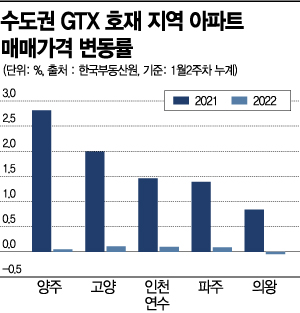
According to the Korea Real Estate Board on the 19th, apartment sale prices in GTX-benefited areas such as Yangju, Goyang, Yeonsu in Incheon, and Paju in Gyeonggi-do have maintained a rise rate in the 0% range this year. Uiwang recorded a 0.02% decline compared to the previous week as of the 10th, turning negative.
These areas showed the highest price increases in Gyeonggi-do last year. Yangju rose 0.01% this year compared to 2.81% during the same period last year. Goyang (1.99%), Yeonsu in Incheon (1.46%), and Paju (1.39%) also exceeded the Gyeonggi-do average increase rate (0.72%) last year. However, this year, except for Goyang (0.05%), they are below the Gyeonggi-do average increase rate (0.04%).
In Songdo-dong, Yeonsu-gu, Incheon, where the GTX-B line stops, all five transactions this year were at lower prices. For example, the Songdo SK View apartment with a net area of 84㎡ dropped from 1 billion KRW in December last year to 850 million KRW on the 5th of this month, a decrease of 150 million KRW in just over a month. The The Sharp Expo 9 Complex with a net area of 126㎡ was traded at 1.2 billion KRW this year, which is lower than the auction winning bid price of 1.2171 billion KRW in October last year.
Some places have fallen more than 300 million KRW from their record highs. In Anyang-si Dongan-gu near Indeogwon Station on Subway Line 4 and Uiwang-si, housing prices surged last year as the GTX-C line stop became visible. Dongan-gu in Anyang rose 33.81% cumulatively last year, and Uiwang recorded 38.56%, the highest increase rate in the metropolitan area. These areas saw average price increases of 200 to 300 million KRW last year alone, but the number of units traded at lower prices has noticeably increased since December last year.
An apartment in Indeogwon Daewoo, Dongan-gu, Anyang-si, with a net area of 84㎡, which was traded at 1.24 billion KRW in August last year, dropped to 900 million KRW in four months. For the same floor, the average transaction price fell by about 50 million KRW. The Uiwang Naeson e-Pyeonhansesang apartment with a net area of 84㎡ in Naeson-dong, Uiwang-si, also declined from 1.12 billion KRW in July last year to 910 million KRW in December.
Unlike GTX-A, the B and C lines have not yet begun construction. Due to the rapid price increases in these areas, concerns about overheating were widespread. Ultimately, as the real estate market has been in a slump since the end of last year, the heat seems to be cooling first in these areas where price fluctuations were large.
Ye Kyung-hee, senior researcher at Real Estate R114, said, "Buyer sentiment is weakening more than in other regions due to fatigue from the excessive price increases combined with loan regulations and interest rate hikes," adding, "With the market in its off-season and a major political issue like the presidential election ahead, active transactions are unlikely unless they are urgent sales." This implies a high possibility of entering a correction phase where the bubble is deflating.
© The Asia Business Daily(www.asiae.co.kr). All rights reserved.

















