Samsung Electronics, Kakao, and Celltrion Heavily Bought Over the Last 3 Trading Days
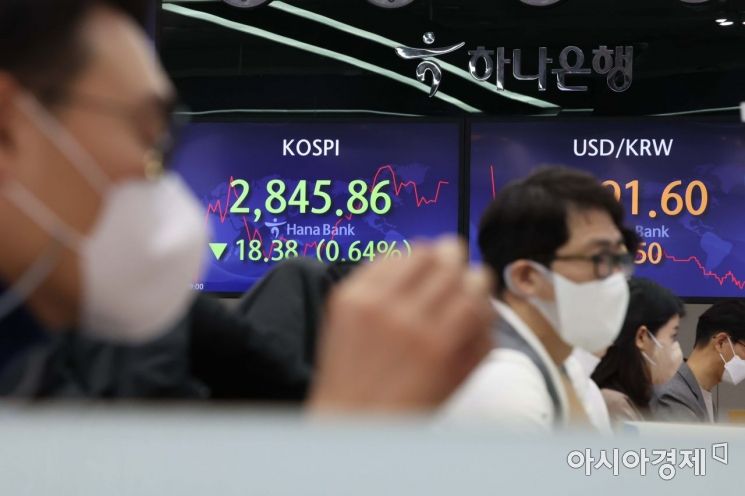 On the 19th, dealers were working in the dealing room of Hana Bank in Euljiro, Seoul. On that day, the KOSPI index opened at 2,840.34, down 23.90 points (0.83%) from the previous session. The won-dollar exchange rate started at 1,195.0 won, up 4.9 won. Photo by Moon Honam munonam@
[Asia Economy Reporter Minwoo Lee] As the KOSPI entered a downward trend, individual investors mainly purchased large-cap stocks at the top of the market capitalization rankings, which had recently stalled. This is interpreted as a decision to buy at a low point in a stable investment destination amid market sentiment shaken by domestic and international tightening moves.
According to the Korea Exchange on the 19th, individual investors bought stocks worth 1.4883 trillion KRW on the KOSPI over three trading days from the 14th to the previous day. They particularly focused on large-cap stocks at the top of the market capitalization rankings. Excluding the exchange-traded fund (ETF) ‘KODEX Leverage (297.4 billion KRW)’, Samsung Electronics, ranked first in market capitalization, was the most purchased individual stock (151.5 billion KRW). This was followed by Kakao (131.3 billion KRW), Celltrion (125.1 billion KRW), and KakaoBank (121.1 billion KRW). Large-cap stocks accounted for one-third of the total net purchase amount during the period.
Except for Samsung Electronics, most of these stocks had recently shown a sharp decline. Kakao continued its downward trend after being embroiled in a moral hazard controversy due to a large stock sale by Kakao Pay management. It fell about 4.5% from the 14th to the previous day. During the same period, KakaoBank also dropped 11.4%, losing its position as the largest financial stock by market capitalization. Celltrion plunged a staggering 18.2% during the period. All of these declines exceeded the KOSPI’s 3.3% drop during the same period. Only Samsung Electronics limited its decline to 1.2%, outperforming the market return.
As the market was shaken by domestic and international variables, it is interpreted that investors moved to buy somewhat stable large-cap stocks at low points. The U.S. Federal Reserve (Fed) signaled a shift to aggressive tightening policies, and international oil prices rose more than expected, fueling ongoing inflation concerns and dampening investor sentiment, leading to a continued decline in the U.S. stock market. The domestic stock market also continued its recent sluggishness due to the Bank of Korea’s rate hike forecast, the impact of the U.S. stock market decline, and supply-demand concentration caused by the LG Energy Solution subscription. Early in the trading session, the KOSPI fell to 2,837.82, dropping below the 2,830 level for the first time since December 1 of last year. The KOSDAQ also fell to 932.44 early in the session, threatening to break below the 930 level. The KOSDAQ recording in the 930s was the first in about three months since October 13 of last year.
© The Asia Business Daily(www.asiae.co.kr). All rights reserved.
![User Who Sold Erroneously Deposited Bitcoins to Repay Debt and Fund Entertainment... What Did the Supreme Court Decide in 2021? [Legal Issue Check]](https://cwcontent.asiae.co.kr/asiaresize/183/2026020910431234020_1770601391.png)