Bitcoin Falls 9.2% This Month... Similar Trend to Domestic and Global Stock Markets
Bitcoin and S&P 500 Correlation Coefficient Rises 0.35 in 2 Years
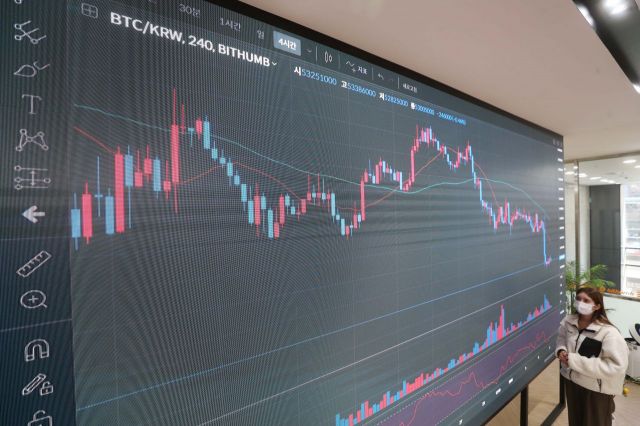 On the 7th, as the cryptocurrency prices continue to decline, the Bitcoin price is displayed on the price board at Bithumb Gangnam Customer Center in Seoul. Photo by Mun Honam munonam@
[Asia Economy Reporter Gong Byung-sun] Last year, Bitcoin, the representative cryptocurrency that was regarded as a safe asset, has been falling at a similar rate along with the stock market. Analysts suggest this is because the time given and the fundamentals are somewhat insufficient to consider it a safe asset.
According to Upbit, a domestic cryptocurrency exchange, Bitcoin has dropped 9.42% since the beginning of this month. The price is hovering around the 50 million KRW range. The domestic and international stock markets show similar trends. During the same period, the KOSPI and KOSDAQ fell by 3.81% and 8.71%, respectively. The S&P 500 and the tech-heavy Nasdaq also declined by 2.41% and 7.79%. The correlation coefficient between Bitcoin and the S&P 500, which was only 0.01 from 2017 to 2019, rose to 0.36 from 2020 to last November, showing increasingly similar movements.
As recently as last November, Bitcoin was spotlighted as a hedge against inflation losses. With logistics bottlenecks caused by COVID-19 and the U.S. Consumer Price Index (CPI) rising for four consecutive months, Bitcoin also rose accordingly. Between August and November last year, Bitcoin increased by 47.36%, reaching an all-time high of 82.7 million KRW. During the same period, the KOSPI fell by 9.15%.
However, experts point out that many still view it as a risky asset. Gold, considered a representative safe asset, holds trust derived from nearly 4,000 years of history, whereas Bitcoin has only been around for 10 years since its launch. Additionally, as the number of listed companies dealing with non-fungible tokens (NFTs) increases, more stocks are reacting significantly to cryptocurrency price movements.
Professor Lee Byung-wook of Seoul National University of Science and Technology said, "Unlike gold, which has a long history, and the dollar, which is backed by U.S. credit, Bitcoin still has a long way to go for verification," adding, "If Bitcoin crashes again like in 2018, it will be difficult to trust it as an asset anymore."
There is also an analysis that it is hard to even consider Bitcoin a risky asset and that it is merely influenced by word of mouth amid rapidly increasing liquidity. If it rises coincidentally during inflation, it is judged as a hedge, and if it moves due to positive factors related to NFTs or the stock market, it is seen as a risky asset. In fact, Bitcoin's fundamentals are unclear, and the predicted Bitcoin prices suggested by the U.S. financial sector this month range widely from $30,000 (35.75 million KRW) to $100,000.
Professor Hong Ki-hoon of Hongik University’s Department of Business Administration said, "Bitcoin is searching for value but remains unanchored," and added, "The fact that it moves tied to the stock market itself signifies the limitations of cryptocurrency."
© The Asia Business Daily(www.asiae.co.kr). All rights reserved.

![User Who Sold Erroneously Deposited Bitcoins to Repay Debt and Fund Entertainment... What Did the Supreme Court Decide in 2021? [Legal Issue Check]](https://cwcontent.asiae.co.kr/asiaresize/183/2026020910431234020_1770601391.png)














