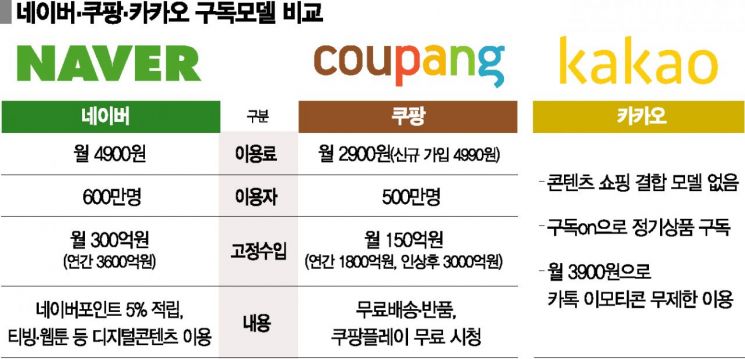
As big tech companies strengthen their subscription service models, an intense behind-the-scenes battle for market dominance is underway. Naver is estimated to generate fixed annual revenue of 350 billion KRW, while Coupang is estimated to earn 180 billion KRW annually. Kakao, which does not have a separate paid membership service, is investing company-wide efforts to enhance its subscription platform by continuously launching subscription services for products, content, and emoticons.
Rapid Growth of Subscription Services
On the 19th, an estimate of Naver’s ‘Naver Plus Membership’ revenue showed it amounts to about 30 billion KRW per month. This figure is calculated simply by multiplying the 4,900 KRW monthly fee by 6 million subscribers. On an annual basis, this reaches 360 billion KRW. Paid subscribers receive various digital content benefits, including points accumulation when shopping, and access to TVING, Naver Movies, Webtoons, Web Novels, and Sports. The subscription service for daily necessities and products, launched last August, is also growing rapidly. A Naver official stated, "Compared to the initial launch, the number of sellers has increased by 333%, and cumulative users have steadily grown by 515%."
In the case of Coupang, it is estimated that the Wow Membership generates at least 15 billion KRW monthly and 180 billion KRW annually. The number of Coupang Wow Membership subscribers is reported to have exceeded 5 million. Last month, Coupang raised the Wow Membership fee for new members from 2,900 KRW to 4,990 KRW. Based on 5 million members, Coupang’s annual paid membership revenue could increase to 300 billion KRW. Wow Membership offers benefits to attract users, such as Rocket Fresh dawn delivery and free viewing of Coupang Play, an online video streaming service (OTT).
Kakao launched ‘Subscription ON,’ which allows users to subscribe to intangible services such as daily necessities, cleaning, and laundry. It also introduced the ‘View’ service, where users can subscribe to content within KakaoTalk and earn money through curation. There is no monthly fee. Kakao only has a subscription service limited to emoticons, priced at 3,900 KRW per month. However, since Kakao started its business with the free messenger KakaoTalk and grew from there, it is highly likely that it will first secure a subscription user base and gradually integrate paid services.
Capturing Loyal Users
Big tech companies’ subscription models also show a high ‘lock-in effect’ that keeps users engaged. According to Naver, the average monthly Naver Pay transaction amount of Naver Plus Membership members is about 2.5 times higher than that of regular users. Shopping and content activities such as receiving store notifications, wishlisting, and watching shopping live streams are more than twice as high compared to free members.
According to the KT Economic Management Research Institute, the domestic subscription economy market, including rentals, grew by more than 50% from 25.9 trillion KRW in 2016 to 40.1 trillion KRW in 2020. The industry estimates that the market will reach 100 trillion KRW by 2025. Professor Wi Jeong-hyun of the Department of Business Administration at Chung-Ang University said, "Since Naver and Kakao have monopoly platforms, it is easier for them to enter the market. As the subscription economy market continues to grow, it is highly likely that (Naver and Kakao) will launch various types of services in the future."
© The Asia Business Daily(www.asiae.co.kr). All rights reserved.
![User Who Sold Erroneously Deposited Bitcoins to Repay Debt and Fund Entertainment... What Did the Supreme Court Decide in 2021? [Legal Issue Check]](https://cwcontent.asiae.co.kr/asiaresize/183/2026020910431234020_1770601391.png)