Reduction of Late Fees During Infectious Disease Outbreaks Such as COVID-19
Daily Calculation of Late Fees and Other System Improvement Recommendations
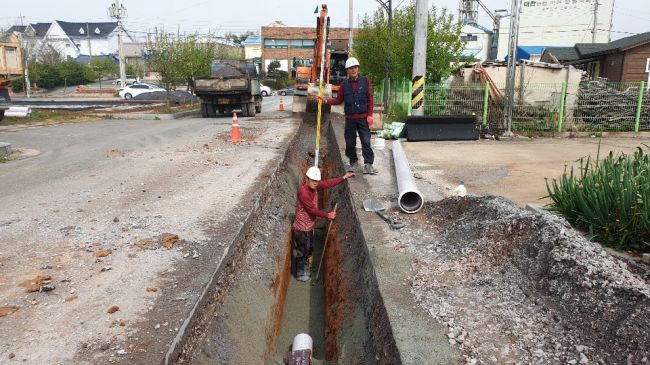 Water supply and sewage maintenance in rural villages of Naju-si, Jeollanam-do. (Photo by Asia Economy DB)
[Sejong=Asia Economy Reporter Moon Chaeseok] A plan to reduce public charge late fees from a maximum annual interest rate of 17% to within 6%, and to cut late fees in case of infectious disease outbreaks such as COVID-19, has been proposed. Late fees for water and sewage charges, TV license fees, environmental improvement charges, and others are expected to decrease.
The Anti-Corruption and Civil Rights Commission announced on the 19th that it has prepared the "Public Charge Late Fee Burden Reduction Plan" and recommended institutional improvements to 13 central administrative agencies including the Ministry of Economy and Finance, the Ministry of Land, Infrastructure and Transport, and the Ministry of Environment.
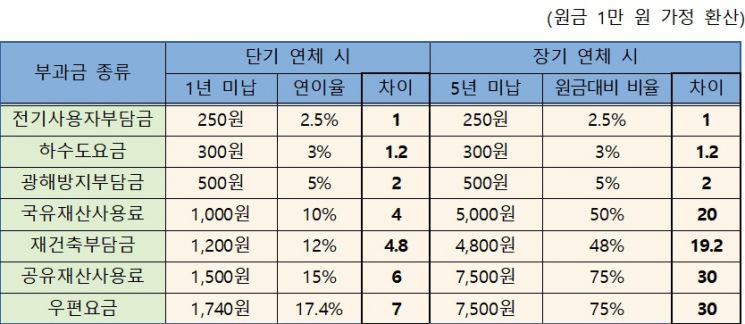 Comparison of Public Charges Delinquency Levels. (Source: Korea Anti-Corruption and Civil Rights Commission)
The Commission stated that according to a survey, there are 119 types of public charges, and if they are not paid by the deadline, a certain amount is added as late fees. In the case of national and public property, the annual usage fee is about 1 trillion won, and as of September last year, unpaid usage fee late payments amounted to 37.9 billion won (41,877 cases). The level of late fees for public charges varied by about seven times, ranging from 2.5% to 17% annually. For cases of long-term arrears over five years, the difference was about 30 times, ranging from 2.5% to 75%. There were no reduction regulations even when infectious diseases such as COVID-19 occurred, limiting the implementation of support policies. There were cases where late fees for one month were charged even if delayed by only one day, and cases were found where late fees were arbitrarily set by the charging authority without legal grounds.
Accordingly, the Commission has set the late fees for 19 public charges such as postage fees (17.4% per year), public property usage fees (15% per year), and reconstruction charges (12% per year) to within 6% annually, and the late fee cap to less than 30% of the principal. It also established measures to reduce the burden by cutting late fees in case of infectious disease outbreaks such as COVID-19. The calculation of late fees will be switched to a daily basis, and the legal grounds for imposing late fees will be clearly stipulated by law. Yang Jong-sam, Director of the Policy Improvement Bureau at the Commission, said, "We hope that the rational improvement of public charge late fees, which differ by up to 30 times, will reduce the economic burden on the public during the COVID-19 situation."
© The Asia Business Daily(www.asiae.co.kr). All rights reserved.