Ulsan National Institute of Science and Technology-Korea Institute of Energy Research
Development of Perovskite Device Solar Cells
Achieves High Efficiency with Large-Scale and World’s Highest Efficiency Record
Solves Stability and Heat Resistance Issues
[Asia Economy Reporter Kim Bong-su] Korean researchers are overcoming the barriers to the commercialization of next-generation solar cell materials, perovskite solar cells. They have achieved world-leading photovoltaic efficiency even with large-scale modules and resolved issues related to long-term stability and heat resistance.
Ulsan National Institute of Science and Technology (UNIST) announced on the 18th that, in joint research with the Korea Institute of Energy Research, they have set a new record for the highest efficiency of perovskite solar cells scaled up in module form. These research results were published on the 17th in the international journal Nature Photonics.
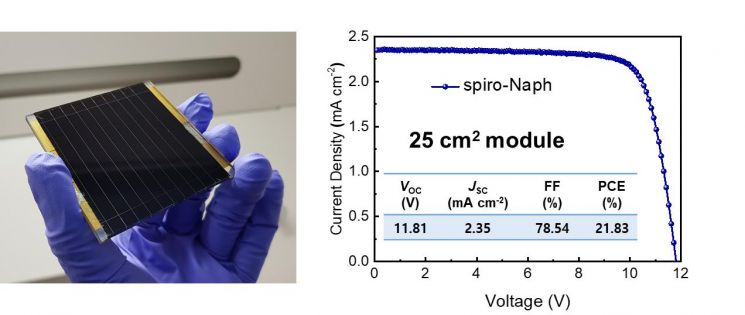
The joint research team led by Professor Yang Chang-deok of UNIST and principal researchers Kim Dong-seok and Lee Chan-woo of the Korea Institute of Energy Research developed a new organic material for the hole transport layer (HTL) of perovskite solar cells. They succeeded in maintaining high efficiency in converting light energy into electricity even as the cell size increased. For commercialization, it is essential to maintain high efficiency at larger sizes, and the perovskite solar cells made with this material achieved a high efficiency of 21.83% even when expanded into module form. This is the highest global record for perovskite material-based solar cells. Furthermore, long-term stability and heat resistance were significantly improved, brightening the prospects for the commercialization of perovskite solar cells, which are considered next-generation solar cells.
The key was the development of an organic material for the hole transport layer (HTL) of perovskite solar cells. The HTL is one of the critical components determining cell efficiency, playing an important role in transferring photogenerated charge carriers (holes) to the electrode. Existing materials had issues with vulnerability to moisture and heat due to the additives (doping) used to enhance hole transport performance.
The developed HTL material withstands high temperatures and is resistant to moisture. It is similar to the spiro-OMeTAD material used in ultra-high-efficiency solar cells but differs in that a naphthalene structure is attached to the molecular structure's terminal. Introducing the naphthalene structure into the molecular framework enhances hydrophobicity, effectively preventing moisture absorption. Additionally, increased molecular interactions improve charge transport performance and raise the glass transition temperature. The glass transition is a phenomenon where the material's properties shift closer to rubber-like behavior, causing the optimized molecular arrangement to deteriorate and reducing hole transport performance.
Perovskite solar cells using the developed HTL material demonstrated significantly improved performance compared to existing materials in thermal stability tests operating above 60°C and long-term durability evaluations over 2,000 hours. Moreover, when the cell size was expanded to 25 cm² and fabricated in module form, it achieved a high efficiency of 21.83%, which is among the highest reported photovoltaic conversion efficiencies for modules worldwide.
Kim Dong-seok, principal researcher at the Korea Institute of Energy Research, stated, "To commercialize perovskite solar cells, overcoming the heat stability issue is essential. This research developed an HTL material that is very stable even above 60°C, laying the groundwork for the commercialization of perovskite solar cells."
Jung Min-gyu, first author and a doctoral candidate in the Department of Energy Chemical Engineering at UNIST, explained, "We solved the stability problem, a major obstacle to the commercialization of perovskite solar cells, through a material design strategy involving the introduction of a naphthalene structure."
© The Asia Business Daily(www.asiae.co.kr). All rights reserved.
![User Who Sold Erroneously Deposited Bitcoins to Repay Debt and Fund Entertainment... What Did the Supreme Court Decide in 2021? [Legal Issue Check]](https://cwcontent.asiae.co.kr/asiaresize/183/2026020910431234020_1770601391.png)