Hate Crimes Surge Worldwide... Violence Against Zainichi Koreans in Japan
Asian Hate Crimes in the US Rose 77% Last Year Compared to Previous Year
Experts Say "Hate and Discrimination Divide Society... Ultimately a Loss for the Entire Community"
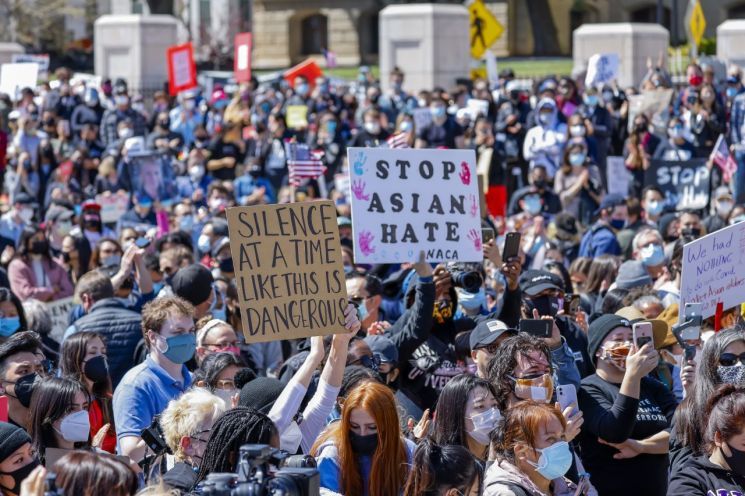 On March 20 last year (local time), citizens participated in a protest condemning hate crimes against Asians, holding placards with the phrase "StopAsianHate" in front of the Georgia State Capitol building in Atlanta, Georgia, USA. Atlanta, USA = EPA Yonhap
Photo by EPA Yonhap
[Asia Economy Reporter Park Hyun-joo] Hate crimes are occurring one after another around the world. An Asian woman waiting for a train suddenly fell onto the tracks and died after being pushed by a Black man. The suspect who committed this brutal crime showed no remorse, even mocking the victim toward the camera. In Japan, horrific crimes such as assaults targeting Korean residents in Japan have been occurring, and statistics have shown a significant increase in hate crimes.
Recently, in New York, USA, an Asian woman was killed after being hit by a running train. According to local media including the New York Post on the 15th (local time), around 9:40 a.m., at a subway station between Times Square and 42nd Street, a Black man pushed the victim in front of an oncoming train. The suspect, Simon Marshall (61), showed anger among citizens by sticking out his tongue to mock the press and police while being arrested and taken away.
The New York Police Department criticized at a press conference that afternoon, saying, "The victim had no connection to deserve such an incident," and "This is purely ignorant violence."
Some are expressing concerns that this might be a 'hate crime.' A Chinese American organization in New York issued a statement condemning Asian hate crimes immediately after the incident, appealing, "Another terrible incident has occurred. We must create safe streets and subways for all citizens, including Asian women." Hate crimes refer to criminal acts of violence against people belonging to specific groups based on race, gender, nationality, religion, sexual orientation, and so on.
In fact, hate crimes targeting Asians are spreading across the United States. According to the Federal Bureau of Investigation (FBI), there were 279 hate crimes against Asians in the U.S. last year, a 77% increase compared to the previous year (158 cases).
In response, in March last year, street protests urging the end of Asian hate were held in major U.S. cities such as New York and Pittsburgh. This movement began following a shooting incident in Atlanta, Georgia, in the same month, where four Korean American women were killed. Citizens held signs with the slogan "StopAsianHate" and condemned hate crimes against Asians.
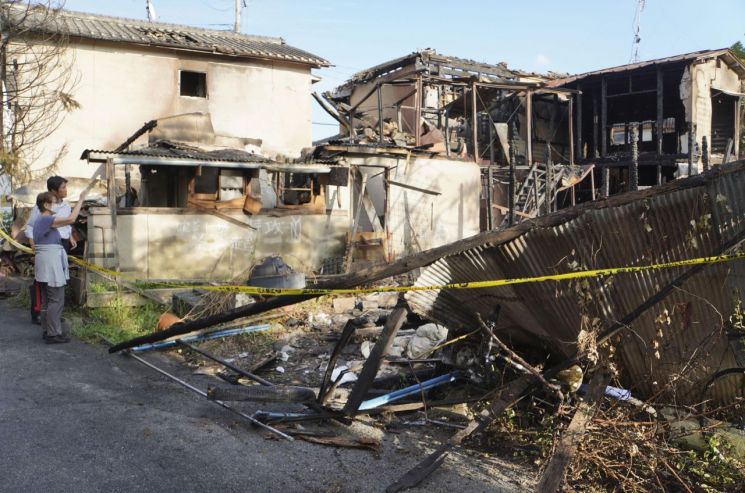 On August 31 last year, an official is inspecting the site destroyed by a fire that occurred the previous day in the Utoro district of Iseda-cho, Uji City, Kyoto Prefecture, Japan. [Image source=Yonhap News]
Such hate crimes have also become a major issue in Japan. Crimes such as assault and arson targeting Korean residents in Japan have been occurring one after another.
On the 10th, Asahi Shimbun mentioned a man in his 20s who committed arson in the Utoro district, a Korean resident village in Kyoto Prefecture, in an editorial titled "Hate crimes against Korean residents in Japan cannot be forgiven." It was reported that the man stated his motive as "I hated Korea." Due to this fire, about 50 historical materials showing the history of the Utoro village, including the Seum signboards stored in warehouses, were destroyed.
The newspaper pointed out, "It is unacceptable to tolerate such vile crimes that cause anxiety among residents," and added, "The phenomenon of voices affirming the crime or blaming the victims rampant on the internet is extremely serious. We cannot help but worry that behind these incidents lies hatred and discrimination against Korean residents in Japan."
Experts explained that hatred toward specific groups stems from social emotions based on power relations between groups. Criminologist Bae Jeong-hwan, in his paper titled "Hate and Hate Crimes against Asians in the U.S. during the COVID-19 Era: Discussions on Racist Discourse and Social Control," elaborated, "It is necessary to consider social structural factors formed under the perception that the dominant group is superior to the less powerful group, including historical, political, and economic backgrounds."
He also suggested the need to pay attention to discrimination and hatred against marginalized groups within Korean society. Dr. Bae pointed out that during the early spread of COVID-19 in Korea, terms like 'Wuhan pneumonia' and 'Wuhan corona' fueled prejudice against China, expressing concern that "Hatred and discrimination against specific groups divide society and create instability, ultimately causing losses to society as a whole."
© The Asia Business Daily(www.asiae.co.kr). All rights reserved.
![User Who Sold Erroneously Deposited Bitcoins to Repay Debt and Fund Entertainment... What Did the Supreme Court Decide in 2021? [Legal Issue Check]](https://cwcontent.asiae.co.kr/asiaresize/183/2026020910431234020_1770601391.png)
















