Last Quarter GDP Barely Defends 4%, Annual Basis Holds at 8.1%
The Problem Starts This Year... China Stimulates Economy by Injecting Funds into Infrastructure Investment
[Asia Economy Beijing=Special Correspondent Jo Young-shin] China's fourth-quarter economic growth rate slowed significantly last year. As the Chinese economy rapidly cooled down, the possibility of adversely affecting the global economy increased. The People's Bank of China, the country's central bank, also cut the Medium-term Lending Facility (MLF) loan interest rate for the first time in 21 months, considering the slowdown in growth.
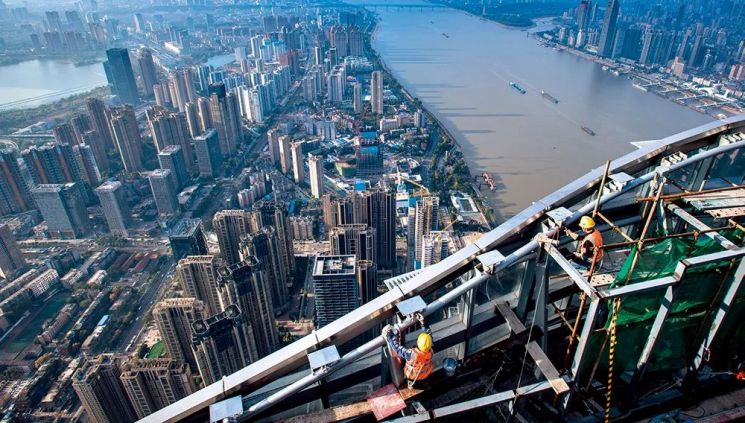
China's National Bureau of Statistics announced on the 17th that the domestic gross domestic product (GDP) growth rate for the fourth quarter of last year was 4%. The growth rate in the fourth quarter dropped sharply due to a combination of domestic and international adverse factors such as rising international raw material prices, power shortages caused by coal shortages, and partial resurgence of COVID-19.
However, the annual growth rate was recorded at 8.1%, achieving the Chinese government's initial target of "above 6%." China's economic growth rate appeared to recover from the COVID-19 shock in the first and second quarters of last year, recording 18.3% and 7.9% year-on-year growth, respectively. But from the third quarter of last year, the growth rate sharply declined, showing a typical "high start, low finish" pattern. At that time, the dominant expectation was that the Chinese economy would achieve more than 5% growth in the third quarter, but it fell short, growing only 4.9%. Even considering the base effect, growth in the 4% range indicates that momentum is rapidly weakening.
Warning signs of the slowdown in China's economic growth in the fourth quarter had already appeared in various areas. Interest rates are a representative example. The People's Bank of China lowered the one-year Loan Prime Rate (LPR), which is the benchmark interest rate, by 0.05 percentage points in December last year. When the economy was severely shaken by the COVID-19 outbreak, the People's Bank of China had lowered the LPR by 0.20 percentage points in April 2020. Previously, the reserve requirement ratio (RRR) was also cut by 0.5 percentage points. Depending on the economic situation in the first quarter of this year, the Chinese government has expressed its intention to inject more money and support the economy through additional interest rate cuts.
Three pressures facing the Chinese economy
Chinese President Xi Jinping diagnosed at the Central Economic Work Conference held in December last year that the Chinese economy in 2022 faces triple pressures of "demand contraction," "supply shocks," and "weakened expectations." The fact that such concerns came from President Xi indicates that the Chinese economy could face serious risks.
In fact, on the 17th, the People's Bank of China cut the interest rate on the Medium-term Lending Facility (MLF) loans, which are policy funds supplied to banks and other financial institutions, from the previous 2.95% to 2.85%, a 0.1 percentage point reduction. This is the first MLF rate cut in 21 months since April 2020.
Chinese Premier Li Keqiang instructed local governments to expedite the issuance of special bonds after the Central Economic Work Conference. This is an effort to stimulate the economy by injecting funds. The economic growth target for China this year is expected to be "above 5%," which is 1 percentage point lower than last year's target of "above 6%."
China's economy, a global economic time bomb, warning lights on
Warning signs about the Chinese economy emerged from the third quarter of last year. The GDP growth rate in the third quarter was 4.9%. Expectations that it would easily surpass 5% collapsed instantly. In the fourth quarter, adverse factors such as rising international raw material prices and coal shortages emerged. In October last year, China's Manufacturing Purchasing Managers' Index (PMI) plummeted to 49.2. In China, which heavily depends on thermal power generation, the coal inventory shortage dealt a direct blow to manufacturing.
The Chinese government lowered the reserve requirement ratio (RRR) and the Loan Prime Rate (LPR) in December last year. The Chinese government's monetary easing policies were measures aimed at 2022. It usually takes two to four weeks for the market to respond to LPR and RRR cuts. Considering the growth rate up to the third quarter, it appears that the timing of the LPR and RRR cuts was adjusted based on the judgment that there would be no problem achieving the initial 2021 target of "above 6%." Inside China, the dominant view is that additional interest rate cuts are likely in the first quarter of this year depending on the economic situation. The sudden MLF rate cut is in line with this context.
China moves to stimulate the economy
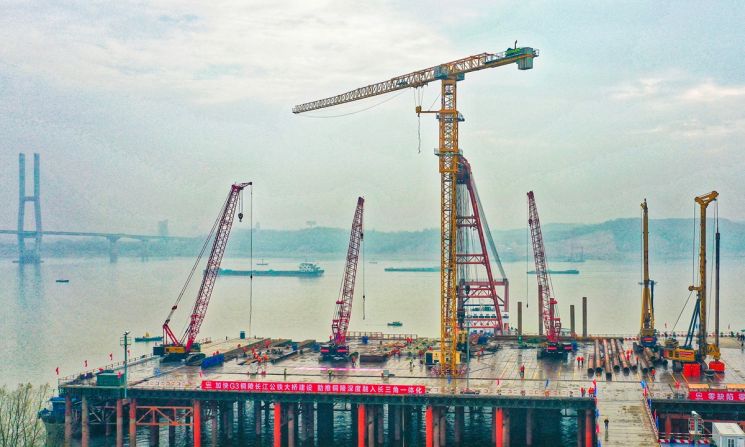
Interest rate cuts mean injecting money. In fact, the Chinese government explicitly instructed local governments to expedite the issuance of special bonds and to invest in infrastructure. Following the central government's directive, Shanghai, Sichuan Province, Jiangsu Province, Hebei Province, and seven other provinces, municipalities, and autonomous regions announced infrastructure investment plans totaling 3 trillion yuan (about 560 trillion KRW). Most of these projects are related to transportation such as airports, roads, and ports.
After the National People's Congress and the Chinese People's Political Consultative Conference (the "Two Sessions") scheduled for March, local governments across China are expected to announce fixed asset investment plans, including infrastructure, one after another.
Tang Duoduo, director of the Economic Research Institute at the Chinese Academy of Social Sciences, said, "When infrastructure investment such as real estate increases in China's macro data, it signals that the Chinese economy is not doing well."
The trap of large-scale infrastructure investment
Chinese economic experts have criticized that although the Chinese government announced last year that it would pursue an active fiscal policy, the actual execution was not proactive. The government did not inject money to curb the real estate market.
According to the Ministry of Finance of China, as of the end of October, the scale of newly issued bonds by local governments was 3.513 trillion yuan (about 656 trillion KRW), of which special bond issuance was only 2.7578 trillion yuan, 76% of the target. If money flows into fixed asset investment, real estate prices could rise again. Large-scale infrastructure investment could weaken the Chinese government's determination to control the real estate sector, which has been identified as a gray rhino within three years.
Another concern is the unexpected challenge of rising inflation. Both the Producer Price Index (PPI) and Consumer Price Index (CPI) are rising, which internally negatively affects livelihood stability and externally can induce manufacturing price increases. Rising manufacturing prices lead to higher export prices, which affect the production and consumer prices of importing countries.
© The Asia Business Daily(www.asiae.co.kr). All rights reserved.
![User Who Sold Erroneously Deposited Bitcoins to Repay Debt and Fund Entertainment... What Did the Supreme Court Decide in 2021? [Legal Issue Check]](https://cwcontent.asiae.co.kr/asiaresize/183/2026020910431234020_1770601391.png)
















