Massive Costs, Regional Disparities, and Populism Criticisms Make It Difficult Within the Term
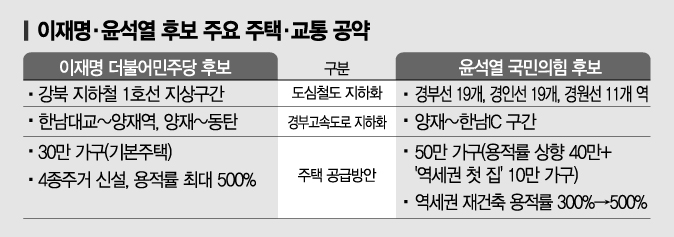
Ruling and opposition presidential candidates are proposing unprecedented infrastructure investment plans worth tens of trillions of won solely for Seoul, including the underground relocation of aboveground railroads and highways. However, some critics argue that these promises are populist pledges with little chance of realization, given the enormous costs involved, the difficulty of completing them within a single term, and the risk of further widening the gap between Seoul and other regions.
According to political sources on the 17th, Yoon Seok-yeol, the People Power Party candidate, announced a pledge the previous day to underground aboveground railroads and highways in the metropolitan area and to significantly increase the floor area ratio for private reconstruction near subway stations to supply 500,000 new housing units in Seoul. The plan involves relocating 49 subway stations underground?including 19 stations from Dangjeong Station on the Gyeongbu Line to Seoul Station, 19 stations from Guro Station to Dowon Station on the Gyeongin Line, and 11 stations from Cheongnyangni Station to Dobongsan Station on the Gyeongwon Line?to secure land for housing. The goal is to supply 400,000 new housing units in Seoul within his term to stabilize the real estate market. Additionally, 100,000 units near stations are planned to be publicly sold targeting youth, newlyweds, and low-income households without homes. He also pledged to underground the highway section from Yangjae to Hannam IC.
Candidate Lee has also repeatedly expressed his intention to underground the Gyeongin Line and Seoul Subway Line 1 and supply housing on the land thus secured. In response, the Democratic Party recently rallied support by having 36 ruling party lawmakers, including Kim Kyung-hyup, propose a “Special Act for the Undergrounding of Metropolitan Railroads and Integrated Development of Aboveground Land.”
Market observers express concerns that such competitive infrastructure investment pledges by candidates may instead cause further concentration in Seoul and the metropolitan area, thereby widening the gap with other regions.
In fact, Yoon’s camp estimated the total project cost at 23.855 trillion won. They explained that the budget would be raised through government bond issuance and that if the estimated 18.14 trillion won in development gains from aboveground land rights materializes, the government’s fiscal burden would not be significant. However, Seoul City estimated the budget required for the aboveground railroad undergrounding project at 38 trillion won based on a feasibility study conducted in 2013. Critics point out that concentrating astronomical infrastructure investments in the metropolitan area contradicts the candidates’ pledges to strengthen regional competitiveness.
The feasibility of completing the projects within a single term is also questionable. Planning and starting construction for railroad and highway undergrounding projects are likely to take several years. If delayed, the promised housing supply will inevitably be affected. For example, the “Sinwol?Yeoui Underground Road,” which involves undergrounding part of the Gyeongin Expressway, began construction in 2015 and only opened in April last year, six years later. Traffic congestion caused during construction is also cited as a problem.
An industry insider said, “Undergrounding aboveground railroads has been a campaign pledge in every election but remains unresolved. Without practical feasibility, it could ultimately only stimulate housing prices.”
© The Asia Business Daily(www.asiae.co.kr). All rights reserved.