[Asia Economy Reporter Ryu Tae-min] "At one time, the premium rose up to 30 million KRW, but now there are so many listings that don't take any premium because there is no one willing to buy. Some sellers are even rushing to sell at a loss of over 10 million KRW." (An official from A Real Estate Agency in U-dong, Haeundae-gu, Busan)
The transaction market for income-generating real estate such as officetels and residential-type lodging facilities, which experienced a nationwide subscription frenzy, is also freezing up. This is interpreted as due to the soaring premiums increasing price burdens, combined with loan regulations and rising interest rates, causing buying demand to disappear.
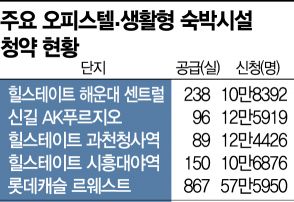
According to the industry on the 17th, the H residential-type lodging facility located in U-dong, Haeundae-gu, Busan, has premiums attached to the pre-sale rights reaching up to 80 million KRW, but actual transactions are hardly taking place. This complex recorded an average competition rate of 455.4 to 1 with 108,392 applicants for 238 units during the subscription in December last year. Since resale is possible after paying a 10% deposit, investment demand poured in from all over the country. Right after the winner announcement in December last year, the most popular high-floor units had premiums ranging from 50 million to 80 million KRW. However, despite these high asking prices recently, transactions are virtually halted, according to local real estate offices in the area.
The same goes for mid-floor units with relatively moderate premiums of 10 million to 30 million KRW. On online real estate communities, there are numerous posts about rushing to sell mid-floor units in this complex at 'mupi' (no premium, at the original pre-sale price). There are even urgent sale posts where a 64㎡ (exclusive area) unit is listed at 15 million KRW 'mapi' (below pre-sale price), accepting losses. An official from A Real Estate Agency in U-dong said, "When the competition rate reached hundreds to one, the asking prices initially soared, but since there is no demand to buy as expected, owners are lowering the premiums," adding, "Most listings now have no premium, and recently, urgent sales at negative premiums have increased."
The situation is similar for the S officetel in Siheung-si, Gyeonggi-do, which held subscriptions in December last year. With 150 units and 106,876 applicants, it recorded an average competition rate of 712.5 to 1, but currently, low- and mid-floor units are seeing a decrease in purchase inquiries, resulting in an accumulation of 'mupi' listings without premiums. In Seoul, the L residential-type lodging facility, which saw competition rates rise to as high as 140 to 1 in July last year, even has owners rushing to sell 21.48㎡ units at about 3 million KRW below the pre-sale price. The representative of B Real Estate in Daeya-dong, Siheung, explained, "For complexes with high competition rates, the initial asking prices are excessively high, so the buying sentiment aimed at investment seems to have shrunk rapidly."
Seo Jin-hyung, president of the Korea Real Estate Society (professor at Gyeongin Women's University), said, "Recently, due to loan regulations and interest rate hikes, the real estate market has contracted, and non-residential products such as officetels and residential-type lodging facilities appear to have been hit first," advising, "If you recklessly purchase products with high premiums and the market further stagnates later, you could suffer significant losses, so it is important to approach cautiously."
© The Asia Business Daily(www.asiae.co.kr). All rights reserved.