Half Right and Half Wrong
Two Applications for Suspension of Execution
Irreparable Damage
'Infringement of Fundamental Rights and Inconvenience'
Different Arguments Lead to Different Outcomes
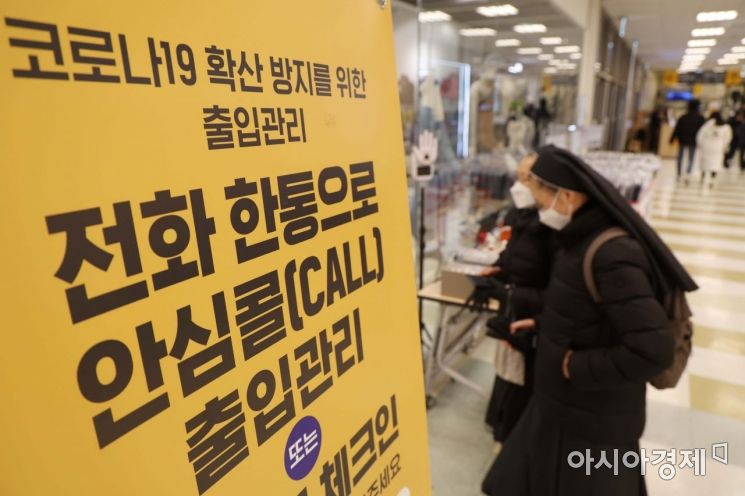 The government has decided to lift the quarantine pass for facilities with a low risk of COVID-19 transmission, such as large supermarkets, movie theaters, museums, private academies, and reading rooms. On the 17th, citizens were moving to shop at a large supermarket in Seoul. Photo by Mun Honam munonam@
[Asia Economy Reporter Seongpil Jo] Conflicting court rulings regarding the effectiveness of the vaccine pass (proof of vaccination or negative test) for large supermarkets have caused confusion on the ground. On the 14th, the Seoul Administrative Court's Administrative Division 4 (Presiding Judge Han Won-kyo) partially accepted the injunction request filed by 1,023 citizens, including Professor Doohyung Cho of Yeungnam University College of Medicine, against the Minister of Health and Welfare, while the same day, the Administrative Division 13 (Presiding Judge Jang Nak-won) dismissed the request filed by Hwang Jang-soo, leader of the Revolution 21 party.
Immediately after the court decisions, the government side, as the defendant, stated that "the court rulings (decisions) were conflicting," which further intensified public confusion. So why did conflicting conclusions arise? We examined the two rulings. To put it simply, different conclusions were inevitable. It is ambiguous to definitively say that "the court rulings were conflicting." In other words, the government's statement can be interpreted as "half correct and half incorrect."
First, looking at the nature of the two cases, both were injunction requests. Since the main lawsuit would take a long time to conclude, the applicants requested that the administrative agency's disposition be suspended until then. The key criterion is whether irreparable harm occurred due to the administrative disposition. In these cases, the court's judgment focused on whether the vaccine pass applied to large supermarkets caused any irreparable harm. However, the purpose of the requests in the two cases differed significantly, ultimately leading to completely opposite conclusions.
Professor Cho and others claimed "violation of fundamental rights due to forced vaccination" as irreparable harm. Based on the premise that the vaccine pass effectively coerces vaccination, they sought a judgment on whether it infringed on constitutional rights of self-determination. The Administrative Division 4, which heard the case, included this judgment in its decision. It stated, "The vaccine pass exerts pressure on unvaccinated individuals to complete vaccination, and there is a possibility that the applicants suffer irreparable harm." However, it ruled to partially accept the request only for large supermarkets, stores, and department stores, judging that the public interest of the vaccine pass outweighed concerns in other multi-use facilities such as restaurants and cafes.
On the other hand, Representative Hwang cited "significant inconvenience in purchasing daily necessities" as irreparable harm. This was a very limited request, confined to himself as an unvaccinated person against COVID-19. The court's judgment aligned with this. The Administrative Division 13 dismissed the request, citing reasons such as ▲the vaccine pass does not prohibit entry to large supermarkets but provides an alternative method by presenting paper proof ▲the vaccine pass does not apply to small stores or traditional markets ▲the applicant, familiar with the online environment through operating a YouTube channel, can sufficiently purchase goods online.
However, the two courts made truly different judgments regarding the administrative disposition. The Administrative Division 4 ruled that the Ministry of Health and Welfare's "additional special quarantine measures" did not constitute an administrative disposition and accepted only the request against the Seoul city announcement. This was based on the reasoning that government quarantine measures take effect only through local government announcements, so the suspension of effectiveness should be limited to local government announcements. Conversely, the Administrative Division 13 viewed the Ministry of Health and Welfare's quarantine measures as effectively administrative dispositions subject to litigation. The conflict between these judgments is likely to continue in the main lawsuit as well. Ultimately, it is expected to be resolved only at the Supreme Court level.
© The Asia Business Daily(www.asiae.co.kr). All rights reserved.