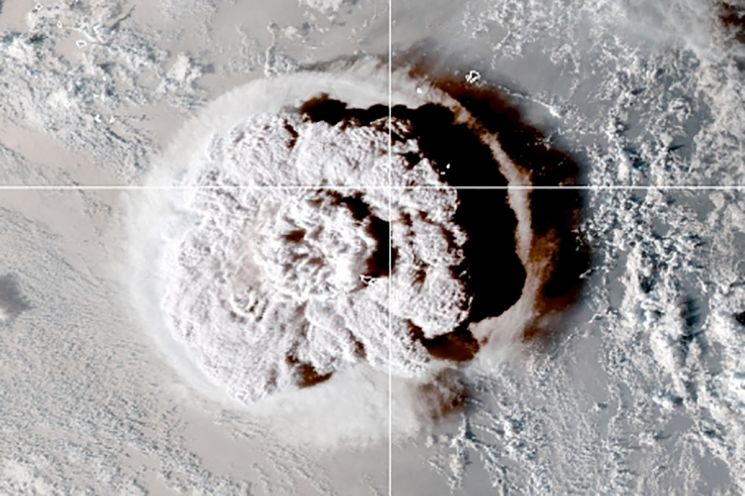
 Underwater volcano eruption in the South Pacific captured by satellite (Photo by Reuters, Yonhap News)
[Asia Economy Reporter Ryu Taemin] Following the eruption of an underwater volcano in the South Pacific, a massive tsunami struck the island nation of Tonga, and fluctuations in sea levels were also observed in Seogwipo, Jeju Island, and along the southern coast of Korea. However, the impact of this volcanic eruption on Korea is expected to be minimal.
According to major foreign media, the Pacific Tsunami Warning Center (PTWC) announced around noon on the 16th that the risk of tsunamis caused by the Tonga underwater volcanic eruption affecting Pacific coastal countries such as Japan and the United States had passed.
Earlier, the Japan Meteorological Agency issued successive tsunami warnings and advisories starting from 12:15 a.m. on the 16th, mainly for Pacific coastal areas. The agency warned that tsunamis up to 3 meters high could occur on some southwestern islands. Subsequently, at 2 p.m. on the 16th, the Japan Meteorological Agency lifted all tsunami-related special warnings.
The highest tsunami observed in Japan was 1.2 meters at Kominato (小湊) in Kagoshima (鹿兒島) Prefecture, followed by 1.1 meters at Kuji (久慈) Port in Iwate (岩手) Prefecture, with sea level changes around 1 meter recorded nationwide.
The Korea Meteorological Administration reported that between 2:30 a.m. and 5 a.m. on the 16th, approximately 13 hours and 20 minutes after the volcanic eruption, sea levels in Seogwipo and Moseulpo, Jeju, fluctuated by about 15 cm and 10 cm, respectively.
However, considering that sea levels typically fluctuate within 20 cm due to weather conditions, the impact of the Tonga underwater volcanic eruption is considered negligible. This is likely because Japan lies between the South Pacific and Korea, and the tsunami energy decreased and its propagation speed slowed while passing through the shallow southern sea with depths less than 200 meters.
The Meteorological Administration further explained that since the volcano exploded underwater and is located in the Southern Hemisphere, considering atmospheric circulation, the likelihood of volcanic ash traveling to Korea and causing harm is low.
© The Asia Business Daily(www.asiae.co.kr). All rights reserved.

![User Who Sold Erroneously Deposited Bitcoins to Repay Debt and Fund Entertainment... What Did the Supreme Court Decide in 2021? [Legal Issue Check]](https://cwcontent.asiae.co.kr/asiaresize/183/2026020910431234020_1770601391.png)














