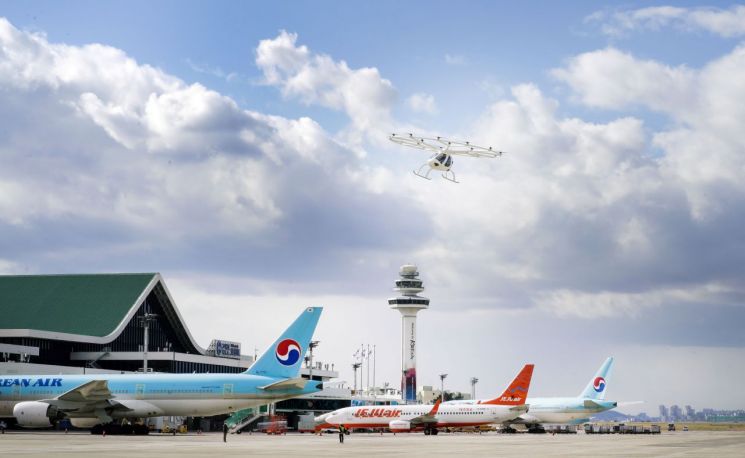
[Asia Economy Reporter Eunmo Koo] The domestic telecommunications industry is accelerating the commercialization of the so-called ‘Flying Car’ urban air mobility (UAM) business, leveraging advanced communication network design and construction expertise. Although UAM is not a technology ready for immediate commercialization, research and development have become more concrete, and services are coming into visible range, attracting growing market interest beyond past imagination.
Telecom Companies Enter UAM Business… SKT and KT Race to Capture Market
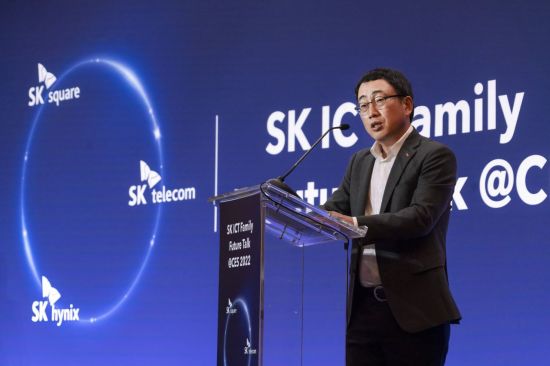
The most proactive player is SK Telecom. According to SK Telecom on the 15th, a CEO-direct UAM Business Promotion Task Force (TF) was recently established. The TF has appointed executives responsible for various areas such as strategy, external partnerships, business, infrastructure & technology, solutions, and service development, who hold weekly regular meetings to make decisions related to UAM strategies and plans.
Within the TF, comprehensive discussions are held on elements necessary for the UAM business, including government demonstration projects, post-commercialization business models, research & development (R&D), technology, and infrastructure. Industry insiders interpret the establishment of a new business organization directly under the CEO and the simultaneous placement of key executives from major internal organizations as reflecting CEO Yoo’s strong commitment to the UAM business.
UAM is a transportation system utilizing electric vertical takeoff and landing vehicles (eVTOLs). It flies at a lower altitude of 300 to 600 meters compared to conventional aircraft and produces noise levels below 63 decibels (dB). As UAM travels through the sky, it is gaining attention as an alternative to improve mobility convenience and efficiency in large cities suffering from severe traffic congestion. When UAM reaches maturity, it is expected to reduce congestion on regular roads, thereby lowering social costs related to emissions and traffic jams.
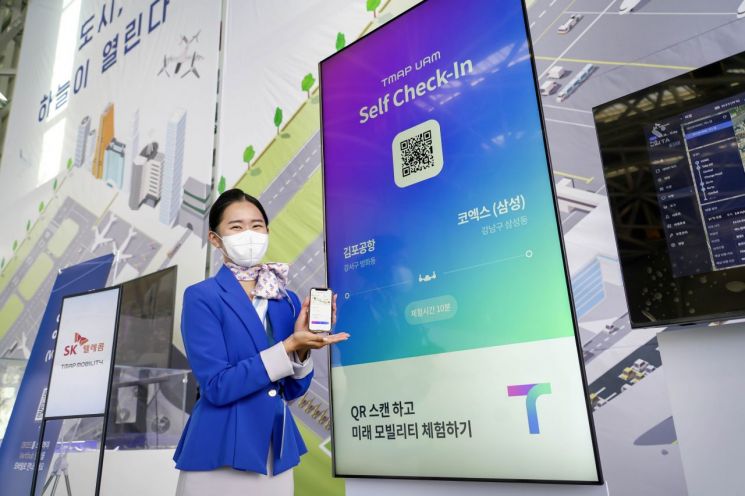
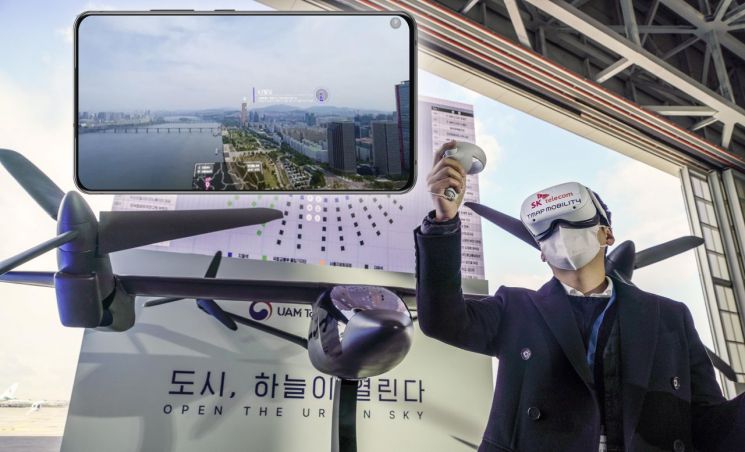
SK Telecom views the UAM business not merely as a new venture but as a ‘future core business.’ Since accessibility and convenience as a mobility service will be the most critical factors after commercialization, the company aims to be a provider that integrally offers the service elements necessary for boarding. An SK Telecom official stated, “Specifically, we aim to provide a seamless connection between ground transportation and UAM in the air through cooperation with T map Mobility,” adding, “To this end, we plan to apply SK Telecom’s technological capabilities in telecommunications and artificial intelligence (AI), as well as service capabilities in subscription, media, and mobility to UAM.”
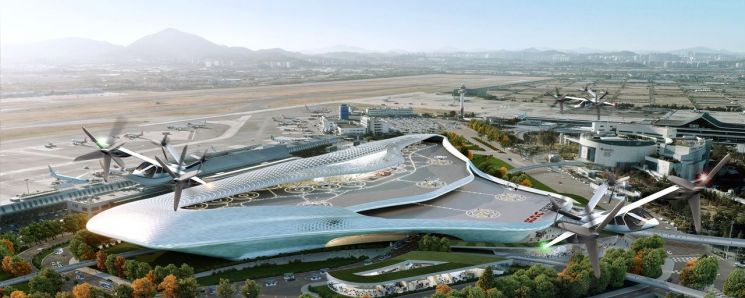
KT is also accelerating UAM commercialization as much as SK Telecom. KT is conducting the business by forming a consortium with Hyundai Motor Company, Hyundai Construction, Korean Air, and Incheon International Airport Corporation. In November last year, KT successfully demonstrated traffic management by linking UAM and autonomous flying drones with the airport control system at Incheon International Airport. This showcased an integrated control environment managing multiple types of aircraft beyond single-vehicle control, bringing commercialization one step closer.
Like SK Telecom, KT is developing UAM communication infrastructure, data platforms, and traffic management systems. Based on demonstration experience, KT plans to proactively propose platform directions and actively participate in the early realization of urban air mobility commercialization.
UAM as Future Growth Engine… Telecom Companies’ Role in Controlling Air Routes
The reason telecom companies are actively entering the UAM industry is undoubtedly its high market potential. According to global investment bank Morgan Stanley, the global UAM market size is expected to grow from $7 billion (about 8.3 trillion KRW) in 2020 to $1.474 trillion (about 1,756 trillion KRW) by 2040. Samjong KPMG Economic Research Institute also forecasts that the global UAM passenger count will increase from 12 million in 2030 to 445 million by 2050.
Advanced communication network construction is essential for operating this promising industry. Various data processing necessary for UAM to safely operate without deviating from designated routes is based on communication networks. Since aerial communication networks must be built differently from terrestrial networks, communication technology capabilities are crucial. Telecom companies with expertise in communication network design and construction are expected to contribute to building UAM communication systems.
Currently, technology development is being reviewed for communication systems between aircraft and control centers based on 5G, as well as communication services for passengers inside the aircraft. When evolving to 6G in the future, it is expected to become a critical UAM communication system with higher stability and lower latency than 5G.
Additionally, the government’s active promotion of the UAM industry is accelerating telecom companies’ movements. The government started demonstration projects this year, aiming for commercialization by 2025. The full-scale commercialization target is 2030, with plans to expand UAM routes to 10 by 2030 and 100 by 2035. To this end, the Ministry of Land, Infrastructure and Transport established a dedicated UAM organization in 2019 and formed and operates the UAM public-private consultative body (UAM Team Korea) led by the ministry. Both SK Telecom and KT are included in Team Korea.
© The Asia Business Daily(www.asiae.co.kr). All rights reserved.
![User Who Sold Erroneously Deposited Bitcoins to Repay Debt and Fund Entertainment... What Did the Supreme Court Decide in 2021? [Legal Issue Check]](https://cwcontent.asiae.co.kr/asiaresize/183/2026020910431234020_1770601391.png)


















