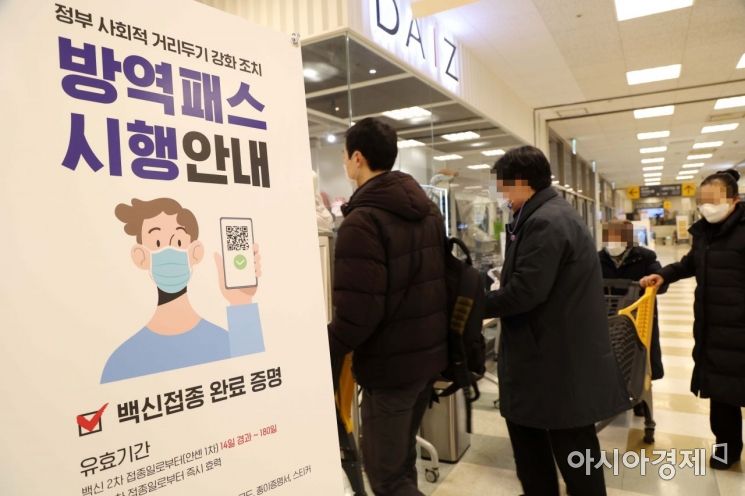
 On the 10th, citizens at a large supermarket in Seoul checked the validity of their quarantine passes to enter, following the addition of large-scale stores such as shopping malls, marts, department stores, agricultural and marine products distribution centers, and bookstores with an area of 3,000㎡ or more to the mandatory quarantine pass application targets. The one-week guidance period will operate until the 16th, and from the 17th, individuals will be fined 100,000 KRW per violation. Photo by Moon Honam munonam@
[Asia Economy Reporter Seongpil Cho] The court has suspended the effectiveness of the government's vaccine pass (proof of vaccination or negative test) policy, implemented under the pretext of protecting unvaccinated individuals from COVID-19, only for large supermarkets, stores, and department stores in Seoul.
The Administrative Court of Seoul, Administrative Division 4 (Chief Judge Han Won-kyo), on the 14th, partially accepted the injunction request filed by 1,023 citizens including Professor Doohyung Cho of Yeungnam University College of Medicine against the Mayor of Seoul. Accordingly, the effectiveness of the vaccine pass applied to stores, marts, and department stores over 3,000㎡ in Seoul will be suspended until 30 days after the ruling date of the main lawsuit. The vaccine pass will continue to be effective for restaurants and cafes. However, the vaccine pass for adolescents aged 12 to 18 in Seoul will be suspended in all facilities.
The court stated, "Although stores, marts, and department stores may gather many people, there are ways to reduce risk more than restaurants and cafes where eating mainly takes place," and added, "Including them uniformly as subjects of the vaccine pass is an excessively excessive restriction." Furthermore, the court said, "It is difficult to see a reasonable basis for including adolescents aged 12 to 18, who have a significantly low rate of severe COVID-19 cases and no deaths, as subjects of the vaccine pass," and "Not applying the vaccine pass to adolescents does not appear to cause significant adverse effects on public welfare."
This decision pertains to the Seoul city announcement and does not apply to other regions. The court dismissed the request filed against the Minister of Health and Welfare and the Director of the Korea Disease Control and Prevention Agency, judging that there was no proper defendant. This effectively accepted the Ministry of Health and Welfare’s argument that "government guidelines are not administrative dispositions, and without local government announcements, the vaccine pass has no effect."
Since the court judged the suspension of effectiveness regarding the local government (Seoul city) announcement rather than the government (Minister of Health and Welfare and Director of the Korea Disease Control and Prevention Agency) guidelines, similar lawsuits will inevitably be affected. Lawsuits related to the vaccine pass filed against the Minister of Health and Welfare and the Director of the Korea Disease Control and Prevention Agency in courts nationwide may be dismissed as of this decision. Dismissal means concluding the case without substantive judgment because the lawsuit does not meet procedural requirements.
Accordingly, lawsuits against metropolitan local government heads as defendants are expected to continue in courts nationwide. So far, about 10 lawsuits seeking cancellation of vaccine pass dispositions naming metropolitan local government heads as defendants have been filed in courts nationwide.
Earlier, Professor Cho and others filed an administrative lawsuit on December 31 of last year requesting cancellation of the vaccine pass application and applied for an injunction to suspend its effectiveness. At that time, they argued, "The government is forcing vaccination without proper clinical trials, producing severe patients and deaths," and "Unvaccinated individuals are discriminated against without reasonable grounds, excessively infringing on fundamental rights."
© The Asia Business Daily(www.asiae.co.kr). All rights reserved.