BOJ Signals Additional Rate Hike, Increasing Stock Market Pressure
Foreigners and Institutions Both Sell... All Top 10 Market Cap Stocks Decline
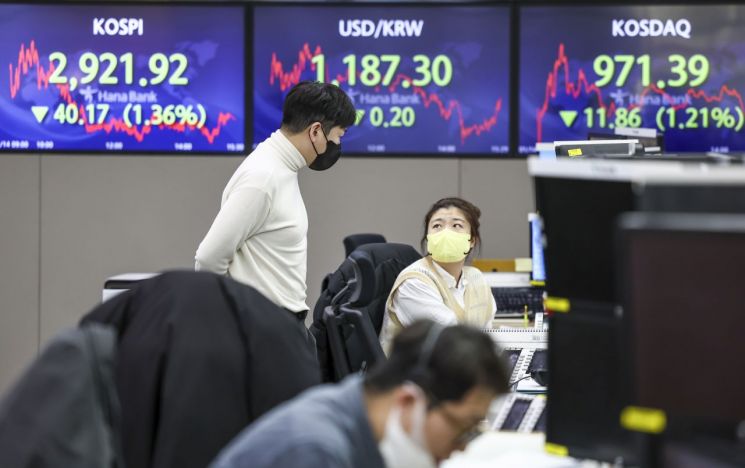 On the afternoon of the 14th, when the KOSPI closed lower, an employee is working in the Hana Bank dealing room in Jung-gu, Seoul.
 [Image source=Yonhap News]
[Asia Economy Reporter Minwoo Lee] Both the KOSPI and KOSDAQ markets fell by more than 1%. This is interpreted as the result of overlapping burdens on the market, as members of the U.S. Federal Reserve (Fed) shifted to a hawkish stance and the Bank of Korea's Monetary Policy Committee also hinted at further interest rate hikes.
On the 14th, the KOSPI closed at 2,921.92, down 1.36% (40.17 points) from the previous day. This contrasts with the previous day when it had risen to the 2,980 level. After opening slightly lower at 2,937.61, it gradually widened its losses without any significant rebound.
Foreigners and institutions concentrated their selling. They net sold 245.7 billion KRW and 600.4 billion KRW worth of stocks, respectively. Individual investors alone net bought 813.6 billion KRW.
All sectors declined. The medical precision sector had the largest drop at -4.52%. This was followed by pharmaceuticals (-3.85%), banking (-3.75%), construction (-2.18%), electricity and gas (-2.17%), and chemicals (-2.16%).
All of the top 10 market capitalization stocks also fell. LG Chem had the largest decline at -5.17%. This was followed by Kakao (-2.90%), Samsung SDI (-2.85%), POSCO (-2.45%), Samsung Biologics (-1.73%), NAVER (-1.72%), Kia (-1.30%), Samsung Electronics (-0.77%), SK Hynix (-0.77%), and Hyundai Motor (-0.48%).
The KOSDAQ closed at 971.39, down 1.21% (11.86 points) from the previous day. It opened at 971.11, down 1.23% from the previous day, and closed slightly higher than the opening price but still failed to break above the 970 level.
Again, foreigners and institutions net sold 111.1 billion KRW and 65.2 billion KRW, respectively. Only individual investors bought 171.7 billion KRW worth of stocks.
Most sectors declined. The distribution sector fell sharply by 6.54%. This was followed by broadcasting services (-2.29%), pharmaceuticals (-2.27%), computer services (-2.21%), and telecommunications and broadcasting services (-2.11%).
All of the top 10 market capitalization stocks also fell. Celltrion Healthcare (-12.39%) and Celltrion Healthcare (-12.00%) showed double-digit declines. This was followed by Wemade (-4.26%), CJ ENM (-2.88%), HLB (-2.67%), EcoPro BM (-2.28%), Chunbo (-1.40%), Kakao Games (-0.42%), L&F (-0.41%), and Pearl Abyss (-0.09%).
The Bank of Korea's Monetary Policy Committee raised the base interest rate from 1.00% to 1.25% at its first rate-setting meeting of the year, which appeared to weigh on the market. This marks another rate hike following November last year. It is the first time in about 14 years since August 2007 that the Monetary Policy Committee has raised the base rate twice consecutively.
The concern is that the rate hikes may not end here. Bank of Korea Governor Lee Ju-yeol said at a press conference after the Monetary Policy Committee meeting, "Considering the current situation and future outlook of growth and inflation, the level is still accommodative compared to the real economy." He added, "It seems that the market's expectation for the base rate is around 1.50 to 1.75%, and if there is a large gap between the Monetary Policy Committee's view and the market's expectations, we plan to actively communicate to narrow the gap."
Thus, the burden of additional rate hikes affected the stock market. Kim Seok-hwan, a researcher at Mirae Asset Securities, explained, "The rate hike by the Monetary Policy Committee was within the expected range, but the indication of further hikes weighed on the market." He added, "Most Fed officials shifted to a hawkish stance the day before, leading to a decline in the U.S. stock market, which also influenced the overall decline in Asian markets."
© The Asia Business Daily(www.asiae.co.kr). All rights reserved.

















