In the Era of Autonomy and Decentralization 2.0, the First Step of Cooperation Taken Together by Central and Local Governments
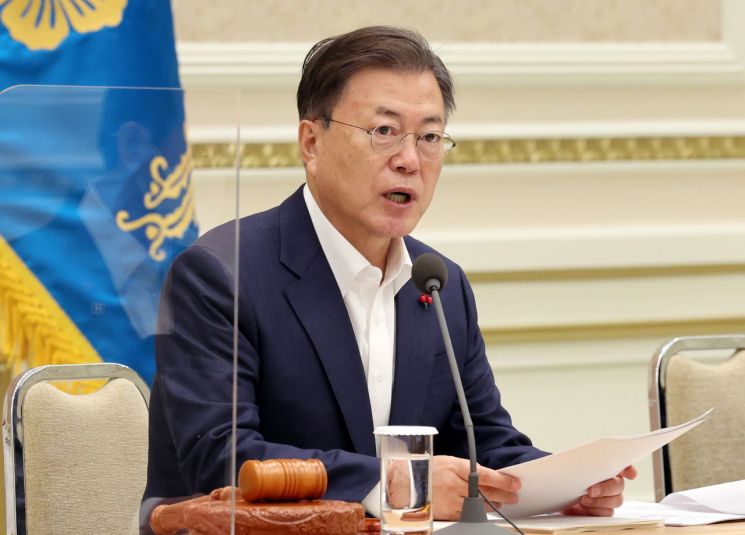
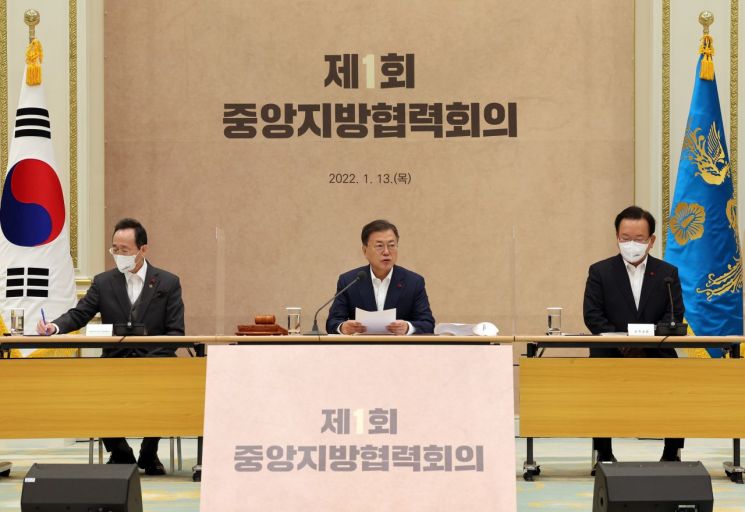
[Asia Economy Reporter Lim Cheol-young] On the 13th, the government held the "1st Central-Local Cooperation Meeting" at the Blue House State Guest House, where it resolved the operational plan for the Central-Local Cooperation Meeting and reported on measures to revitalize the regional economy, the current status and future plans for super-regional cooperation, and the achievements and development tasks of autonomous decentralization in the 2.0 era.
The government has been promoting the introduction of the "2nd Cabinet Meeting," a presidential pledge, as a national agenda to enhance local participation in national governance, and enacted the "Central-Local Cooperation Meeting Act" last July to embody this purpose. By holding the 1st meeting on this day, the government fulfilled its promise to the public to introduce the "2nd Cabinet Meeting" within its term.
Under the vision of "A Republic of Korea where the central and local governments coexist in solidarity and cooperation," the government and local governments decided to operate the Central-Local Cooperation Meeting focusing on three aspects. The government plans to operate the Central-Local Cooperation Meeting as the highest national decision-making body on matters related to local areas. Additionally, the meeting will be managed as a forum for communication, cooperation, and public discourse between the central and local governments. In particular, the results of the Central-Local Cooperation Meeting will be managed systematically and efficiently.
Following the resolution on the operational plan, the government included tasks based on two policy directions?▲complete normalization of the regional economy and ▲response to structural changes in the regional economy?in the "Regional Economy Revitalization Plan" discussed together with local governments to achieve the vision of "a country strong in regions, a balanced Republic of Korea."
The government will promote the complete normalization of the regional economy, which has been stagnant due to the COVID-19 crisis. Compared to last year's main budget, this year’s local allocation tax will increase by 25.1 trillion won to significantly strengthen local finances as a catalyst for regional economic recovery. In addition, the government plans to expand balanced development fiscal investment by investing 13.1 trillion won of national funds in the regional balanced New Deal.
Support will also be provided to respond to structural changes in the regional economy, such as regional extinction. The government will focus on nurturing promising industries by discovering and supporting 100 regional innovation leading companies, utilizing special zones such as regulatory free zones as hubs for regional innovation, continuously supporting industrial crisis areas, and establishing a stepwise response system for industrial crises. The government will support a local extinction response fund of about 1 trillion won annually, provide corporate support packages in urban convergence special zones, and improve residential conditions in innovation cities through the Innovation City 2.0 Top 10 Brand Projects (77.1 billion won) to respond to the risk of regional extinction.
Furthermore, the government and local governments reviewed the current status and future plans for super-regional cooperation. After reporting on the super-regional cooperation support strategy, they checked the progress and future plans of super-regional cooperation in regions such as Busan, Ulsan, and Gyeongnam (Bu-Ul-Gyeong) and discussed directions for the success of super-regional cooperation. They agreed to continuously develop support measures for region-led super-regional cooperation centered on the intergovernmental super-regional support council, which has been operating since November last year.
In the case of Bu-Ul-Gyeong, discussions are underway on the draft agreement among the three cities and provinces, coordination of state delegated affairs, and the establishment of the Bu-Ul-Gyeong super-regional development plan, aiming for the launch of the Bu-Ul-Gyeong Special Local Government in February. Daegu, Gyeongbuk, and other three major super-regions are also working on forming promotion systems and discovering cooperative projects with the goal of launching special local governments, and are pushing forward plans that include strategies by sector such as space, industry, and people.
For the Gangso area, since December last year, a cooperation system with the central government has been established, and a specialized development plan differentiated from super-regional cooperation is being pursued. The government and local governments agreed on the importance of region-led initiatives, rapid establishment of promotion systems, selection and concentration, and securing consistency with national plans and other super-regional and Gangso area plans for the success of super-regional cooperation.
Next, the government and local governments shared opinions on major achievements and development tasks in the era of Autonomous Decentralization 2.0. As legislative achievements in the Autonomous Decentralization 2.0 era, they completed six laws on autonomous decentralization that realize resident sovereignty in response to changes in the local administrative environment, establish cooperative governance between central and local governments, and harmonize local autonomy and responsibility. Financial achievements include expanding local taxes through two phases of fiscal decentralization, discovering functions of national affairs close to local communities, and establishing a local extinction response fund for regional balanced development. Policy achievements include introducing a prior consultation system for autonomous decentralization to ensure rational distribution of affairs and guarantee autonomy between central and local governments, super-regional cooperation based on inter-regional cooperation, and expanding pilot areas for resident autonomy councils to revitalize resident autonomy.
Discussions on development tasks for the Autonomous Decentralization 2.0 era continued. First, they examined ways to activate resident participation systems to establish resident-centered local autonomy suitable for the 2.0 era, and to expand the practical roles and authority of local governments through the transfer of affairs. They also explored ways to enhance local organizational autonomy based on accountability, and discussed continuous fiscal decentralization measures such as securing local finances based on the achievements of the first and second phases of fiscal decentralization. Additionally, they discussed ways to activate solidarity and cooperation between central and local governments or among local governments, and the constitutional amendment for autonomous decentralization reflecting the value of autonomous decentralization.
Meanwhile, the matters deliberated at this 1st meeting will be documented as task management cards and managed, with action plans and implementation results reported at the next meeting. Minister Jeon Hae-cheol said, "Today, the day the 1st Central-Local Cooperation Meeting was held, is a meaningful day as it marks the enforcement of the Local Autonomy Act, fully revised for the first time in 32 years, and is also the starting point of 'Autonomous Decentralization 2.0,' which shifts local autonomy to be resident-centered." He added, "I hope that the Central-Local Cooperation Meeting will establish itself as a communication forum that jointly addresses national agendas related to regions such as population decline and economic revitalization, and become a driving force for the central and local governments to create the future together."
© The Asia Business Daily(www.asiae.co.kr). All rights reserved.
![User Who Sold Erroneously Deposited Bitcoins to Repay Debt and Fund Entertainment... What Did the Supreme Court Decide in 2021? [Legal Issue Check]](https://cwcontent.asiae.co.kr/asiaresize/183/2026020910431234020_1770601391.png)
















