After Hearing Remarks, National Bond Yields Fall... New York Stock Market Turns Up
"Inflation Concerns Remain but Will Decline"
"Monetary Policy Normalization Is a Long Journey"
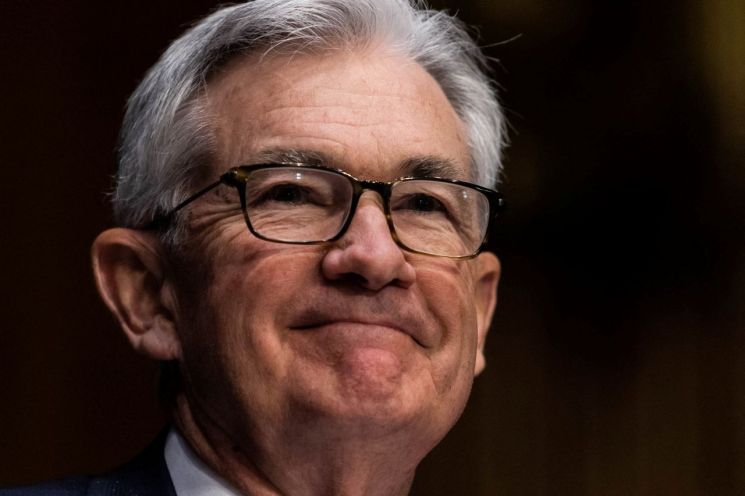
[Asia Economy New York=Correspondent Baek Jong-min] Jerome Powell, Chairman of the U.S. Federal Reserve (Fed), has signaled that tapering will be completed in March, followed by interest rate hikes and quantitative tightening.
He expressed a strong determination to raise interest rates to curb inflation, stating that no further economic stimulus is necessary. He also emphasized that controlling inflation is a mission for workers.
At a Senate confirmation hearing on the 11th (local time), Powell said, "If the situation unfolds as we expect, we will complete asset purchase tapering in March and raise interest rates throughout this year."
He added, "At some point in the second half of the year, quantitative tightening will also begin. This is the path toward normalizing monetary policy."
Powell stated, "We will use the tools necessary to reverse inflation," and asserted, "The path to normalization is long."
He diagnosed, "The economy is expanding rapidly and the labor market remains strong, but problems such as high inflation and mismatches between supply and demand persist."
Powell had made similar remarks in a written statement released the day before. During the Q&A session with lawmakers, he also emphasized an active response with interest rate hikes. Furthermore, he evaluated that achieving maximum employment and inflation stability simultaneously is the Fed's task this year.
Powell said that a long economic expansion is necessary to raise employment rates, but price stability must support it. He reiterated that "high inflation is a serious threat to achieving full employment" and that controlling inflation is important for lowering unemployment.
He diagnosed, "If inflation takes root in our economy and people's expectations, a much longer period of tight monetary policy will be required, which is worse for workers." He explained the need for a prompt response to inflation. Powell also forecasted, "In my view, we need to act humbly and nimbly."
The New York Times (NYT) reported that Powell's remarks reflect the Fed's position that curbing inflation benefits workers.
On the same day, senior Fed officials also indicated interest rate hikes in March. Loretta Mester, President of the Cleveland Fed, classified as a "hawk," argued that the first rate hike should occur in March, followed by three more hikes within the year. Raphael Bostic, President of the Atlanta Fed, also stated that a rate increase in March is appropriate.
NYT predicted that the Consumer Price Index (CPI) inflation rate for December last year, to be released on the 12th, will serve as a trigger for solidifying the March rate hike decision at the Federal Open Market Committee (FOMC) regular meeting scheduled for the end of this month. According to Bloomberg's compilation, the December CPI is expected to rise by 7.0%, marking the largest increase in 40 years.
On the same day, Republican figures including Representative Pat Toomey criticized Powell for delaying the response to inflation due to his focus on employment. CNBC reported that despite some Republican concerns, Powell's confirmation is expected to proceed smoothly.
Regarding lawmakers' criticism of inappropriate behavior by senior Fed officials, including Vice Chairman Richard Clarida who announced his resignation the day before amid stock trading controversies, Powell explained, "We will soon establish regulations to prevent similar incidents."
Meanwhile, following Powell's remarks, the New York stock market turned upward.
As of 3:10 p.m., the Dow Jones Industrial Average was up 0.53%, the S&P 500 rose 0.86%, and the Nasdaq Composite rebounded 1.4%. After Powell's comments, the U.S. 10-year Treasury yield fell by 0.036 percentage points to 1.744%, which is interpreted as stabilizing investor sentiment.
© The Asia Business Daily(www.asiae.co.kr). All rights reserved.
![User Who Sold Erroneously Deposited Bitcoins to Repay Debt and Fund Entertainment... What Did the Supreme Court Decide in 2021? [Legal Issue Check]](https://cwcontent.asiae.co.kr/asiaresize/183/2026020910431234020_1770601391.png)